
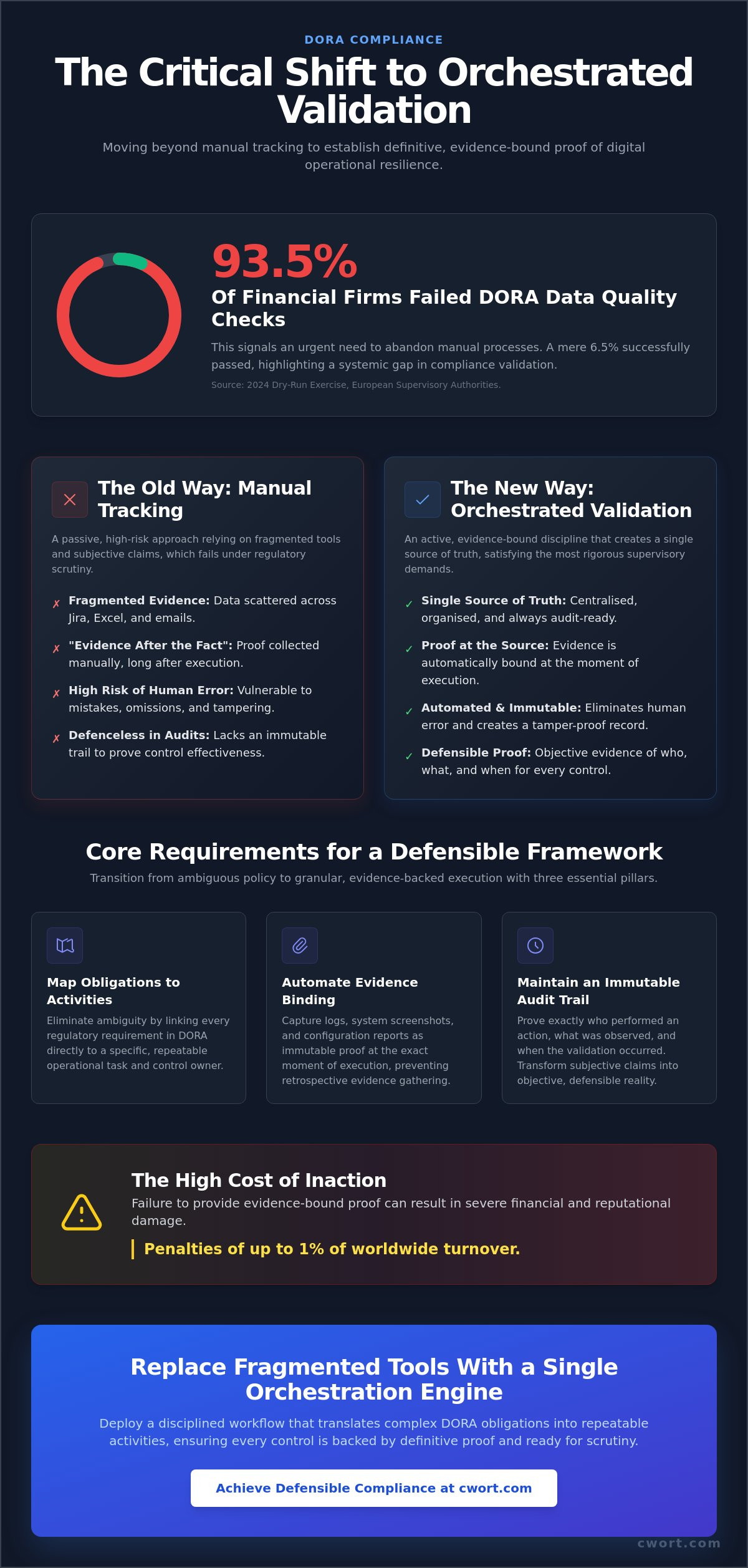
During a 2024 dry-run exercise by the European Supervisory Authorities, only 6.5% of nearly 1,000 financial firms successfully passed the data quality checks required for reporting. This statistic signals the urgent need for a more rigorous DORA compliance validation process that moves beyond manual oversight. You likely feel the mounting pressure of fragmented evidence scattered across Jira and Excel, whilst the fear of board-level reporting inaccuracies remains a constant concern. Proving separation of duties shouldn't require weeks of manual audit preparation or leave you vulnerable to penalties of up to 1% of worldwide turnover.
We understand that shifting from administrative tracking to definitive, evidence-based proof is the only way to satisfy modern regulatory expectations. This guide provides the blueprint for transitioning from manual tracking to an orchestrated validation system that satisfies regulatory scrutiny with evidence-bound certainty. You'll learn how to move beyond "paper compliance" to establish a single source of auditable truth. This transition ensures automated board-level reporting and defensible proof of control effectiveness with absolute professional maturity.
Key Takeaways
- Recognise why passive tracking fails under scrutiny and learn to implement an active validation process that proves ICT resilience with certainty.
- Establish a defensible DORA compliance validation framework by mapping regulatory obligations directly to execution activities with automated evidence binding.
- Identify the structural risks of using Jira or spreadsheets for high-stakes compliance and learn how to enforce a rigorous, auditable separation of duties.
- Deploy a disciplined workflow that translates complex DORA obligations into repeatable execution activities, ensuring every control is backed by definitive proof.
- Discover how a dedicated orchestration engine replaces fragmented tools with a single, professional system designed to withstand intense regulatory scrutiny.
What is DORA Compliance Validation in the 2026 Regulatory Landscape?
The era of theoretical preparation has concluded. In the current regulatory environment, financial entities must move beyond policy drafting into a state of continuous DORA compliance validation. This is the systematic process of proving ICT resilience through auditable evidence rather than merely stating intent. Whilst traditional "compliance tracking" is often a passive exercise in box-ticking, validation is an active, evidence-bound discipline. It requires that every control is not just present on a list, but is demonstrably effective in real-world scenarios. Regulators now demand a level of granularity that manual processes cannot provide.
The full application of the Digital Operational Resilience Act (DORA) in January 2025 shifted the burden of proof. By 2026, the focus has moved from initial implementation to the rigorous demonstration of effectiveness. For UK-based enterprises, this challenge is compounded by the overlap with the UK NIS framework. Managing these dual obligations requires a unified approach to ensure that national resilience standards and EU mandates don't create conflicting silos of fragmented data. Effective DORA compliance validation ensures that your resilience posture is defensible, transparent, and always audit-ready.
The Five Pillars of DORA Resilience
Validation transforms the five pillars from abstract concepts into operational mandates. ICT Risk Management now moves beyond static risk registers to focus on the real-time execution of controls across the entire estate. Incident Reporting requires pre-configured response workflows that automatically capture timestamps and decision logs, providing a clear trail for investigators. Finally, Operational Resilience Testing must bind test results directly to specific regulatory obligations. This proves that vulnerabilities are not just identified, but are remediated through a disciplined, traceable process.
The Shift from GRC to Orchestration
Traditional GRC tools often fail because they're designed for static reporting rather than the dynamic nature of ICT risk. They provide a snapshot of the past, whereas modern validation requires a live view of the present. Orchestration serves as the centralised engine that organises activities across disparate departments. It ensures that no regulatory obligation is left unassigned or unverified. By replacing fragmented spreadsheets with a disciplined orchestration system, organisations gain a single, defensible source of truth that satisfies the most rigorous supervisory scrutiny.
The Core Requirements for Defensible DORA Validation
Establishing a defensible framework requires a shift from abstract policy to granular execution. DORA compliance validation is only achievable when you map every regulatory obligation directly to a specific, repeatable activity. This eliminates the ambiguity often found in traditional GRC approaches. By ensuring that every requirement in the EU's Digital Operational Resilience Act is linked to an operational task, you create a structure where compliance is a byproduct of work, not an additional administrative burden.
Proof must be captured at the source. Automated evidence binding ensures that logs, system screenshots, and configuration reports are attached to the control outcome at the exact moment of execution. This prevents the "evidence after the fact" trap. Relying on manual collection weeks after a control was supposed to run is a major audit risk that suggests a lack of operational control. Additionally, an immutable audit trail is non-negotiable. You must prove exactly who performed the action, what was observed, and when the validation occurred. This level of traceability transforms compliance from a subjective claim into an objective, defensible reality.
Binding Evidence to Control Outcomes
The technical process of DORA compliance validation requires a direct, automated attachment of proof to the regulatory requirement. If an ICT asset inventory check is performed, the system must automatically ingest the resulting data as immutable evidence. This eliminates the possibility of human error or retrospective tampering. Traditional systems fail because they treat evidence as a separate, secondary task. In contrast, orchestrating these workflows ensures that audit-readiness is a permanent state, as the proof is inherently bound to the outcome of every control execution.
Real-Time ICT Risk Management Reporting
Static quarterly reviews are no longer sufficient for high-stakes environments. You must transition to continuous validation dashboards that reflect the actual status of your controls in real-time. This level of transparency provides board members with the objective data they need to fulfil their legal accountability under DORA. When a central bank auditor arrives, you shouldn't spend weeks reconstructing spreadsheets. Instead, you present a live, defensible record of effectiveness that significantly reduces the time and cost associated with manual audit preparation. This shift replaces the anxiety of potential failure with the calm of auditable certainty.
Why Regulators Reject Manual Spreadsheets and Jira for DORA
Regulators are increasingly dismissive of "compliance by spreadsheet." Whilst Excel and Jira are excellent for project management, they lack the structural integrity required for high-stakes DORA compliance validation. These tools are inherently passive; they record what a user claims happened rather than what the system proves occurred. When a National Competent Authority (NCA) reviews your ICT risk framework, they look for evidence of discipline, not just a list of completed tasks. Manual systems fail because they are prone to human error, lack immutable version control, and cannot prevent retrospective data manipulation.
The reliance on fragmented tools leads directly to "audit panic." This is the period of intense, high-cost manual reconstruction where teams scramble to find logs, screenshots, and emails to satisfy a specific request. This process isn't just inefficient; it's a major regulatory red flag. It suggests that your organisation doesn't have a handle on its operational resilience in real-time. A professional orchestration system replaces this chaos with a disciplined, always-ready state that satisfies DORA's technical standards by design. It transforms compliance from a desperate search for proof into a continuous, defensible reality.
The Separation of Duties Trap
DORA requires a clear, defensible distinction between the individuals executing a control and those validating its effectiveness. Manual trackers often fail this test through "self-marking," where an engineer can update a status to "compliant" without independent verification of the attached evidence. This creates a conflict of interest that regulators will not tolerate. Professional orchestration enforces this separation within the workflow itself. It ensures that validation is a mandatory, independent step that must be completed before a requirement is considered met, thereby removing the risk of subjective or fraudulent reporting.
The Hidden Cost of Manual Reconstruction
The financial burden of manual compliance is staggering. Hundreds of man-hours are lost every year to gathering evidence from disparate sources for auditors. Beyond the labour cost, spreadsheets lack the cryptographic integrity and version control needed to prove that evidence hasn't been altered. This lack of traceability makes manual records difficult to defend under intense scrutiny. By moving to a single orchestrated system, you ensure that every piece of evidence is captured, timestamped, and stored in a central, auditable location, allowing for an immediate and confident response to any regulatory inquiry. This level of professional maturity is exactly what auditors expect in 2026.
Implementing a Validated DORA Execution Workflow
Transitioning from static policy to operational reality requires a structured execution workflow. Effective DORA compliance validation is not a one-off event but a continuous cycle of orchestrated activities. You must move beyond high-level objectives and define exactly how each control is executed, verified, and recorded. This systematic approach ensures that resilience is built into your daily operations rather than treated as a periodic administrative burden. By following a disciplined five-step process, you can transform abstract regulatory mandates into a concrete, defensible reality.
- Step 1: Translate complex DORA obligations into structured, repeatable execution activities. Breakdown each article into specific tasks with clear success criteria.
- Step 2: Assign responsibilities with enforced duty separation. Ensure the person executing the task is never the same person validating the outcome.
- Step 3: Collect and bind evidence at the point of execution. Capture logs, screenshots, or system reports automatically to prevent retrospective data entry.
- Step 4: Generate automated, board-ready reports directly from the execution data. Remove the need for manual data aggregation or spreadsheet reconstruction.
- Step 5: Continuously monitor and iterate based on validation outcomes. Use the data to identify control gaps and refine your resilience posture in real-time.
Success in this transition depends on your ability to maintain a high formality register across all departments. Each step must be documented with precision to withstand the scrutiny of a National Competent Authority audit. If you are ready to replace fragmented manual tasks with a unified system, you should explore our DORA compliance validation platform to see how orchestration simplifies execution.
Mapping Obligations to Activities
The first stage of implementation involves breaking down complex DORA articles into simple, actionable tasks. This process must include every ICT provider and third party within your validation scope to ensure no gaps exist in your supply chain oversight. You must move from "we have a policy for Article 30" to "we execute these twelve specific tasks every quarter to validate Article 30 compliance." Mapping regulatory obligations to granular activities is the fundamental foundation of auditable truth.
Automating the Audit Trail
Traceability is the hallmark of a mature resilience programme. By utilising cryptographic timestamps and digital signatures, you ensure that your audit trail is both immutable and non-repudiable. Evidence must be stored in a centralised, audit-ready repository that is accessible to authorised stakeholders at a moment's notice. This approach significantly reduces friction for Subject Matter Experts (SMEs), who no longer need to spend hours searching for proof during an audit. Instead, the evidence is already bound to the control, providing a state of permanent audit-readiness.
CWORT: The Orchestration Engine for DORA Compliance Validation
Achieving absolute certainty in a high-stakes regulatory environment requires more than just better tracking; it requires a superior system of record. CWORT serves as the definitive platform for enterprise compliance orchestration, designed specifically to replace the fragmented, unreliable tools that currently compromise your resilience posture. It shifts the focus from administrative burden to evidence-bound reality. By centralising your DORA compliance validation efforts, you eliminate the gaps inherent in siloed systems and replace them with a single, disciplined engine of truth.
The value proposition is clear: remain audit-ready without the traditional manual workload. CWORT automates the collection and binding of evidence at the point of execution, ensuring that your records are always current and defensible. This transition allows senior leadership to move from a state of constant administrative anxiety to one of strategic assurance. You no longer have to hope your controls are effective; you have the objective, real-time data to prove it. This level of professional maturity is the only way to satisfy the rigorous oversight of the 2026 regulatory landscape.
From Fragmented Tracking to Unified Orchestration
CWORT integrates seamlessly with your existing technology stack to enforce compliance discipline across every department. Unlike generic project management software, this platform is engineered for the rigours of regulatory validation, ensuring that every task is mapped to a specific obligation. For the board, the return on investment is immediate. You significantly reduce the man-hours lost to manual audit preparation whilst simultaneously lowering the risk of non-compliance penalties. Orchestration transforms compliance from a reactive cost centre into a proactive, strategic advantage.
Securing Your DORA Future
Regulatory requirements don't exist in a vacuum. As you prepare for the next wave of ICT mandates, including NIS2 and the UK NIS framework, you need an engine that can handle multiple overlapping standards without duplicating effort. Choosing a UK-based partner is essential for navigating national regulatory nuances and ensuring your data remains within a trusted jurisdiction. CWORT provides the structural integrity needed to manage today's DORA requirements whilst future-proofing your organisation against upcoming governance shifts. Take control of your compliance trajectory today. Enquire about CWORT DORA Validation to secure your operational resilience.
Securing Operational Resilience in 2026 and Beyond
The transition from passive tracking to active DORA compliance validation is now a fundamental requirement for financial institutions aiming to withstand regulatory scrutiny. You've seen why manual spreadsheets fail to provide the structural integrity demanded by National Competent Authorities and how fragmented data leads to high-cost audit panic. By implementing an orchestrated execution workflow, you replace administrative anxiety with the calm of auditable certainty. This disciplined approach ensures that resilience is a permanent state rather than a periodic scramble for proof.
Lapace Services UK Ltd offers the UK-based expertise necessary to navigate these complex mandates with confidence. Our platform delivers evidence-bound control outcomes and board-ready automated reporting, providing the definitive proof required by auditors and senior leadership alike. Stop relying on fragmented tools and start building a defensible future today.
Request a DORA Validation Platform Demo
Establishing a single source of truth is the most effective way to protect your organisation whilst maintaining total professional maturity in an evolving landscape.
Frequently Asked Questions
What is the difference between DORA compliance tracking and validation?
Tracking is a passive recording of administrative intent whilst DORA compliance validation is the active, evidence-bound proof of control effectiveness. Validation requires that every regulatory obligation is linked to a concrete execution outcome that can withstand rigorous auditor scrutiny. It replaces subjective claims with objective, defensible reality by ensuring that proof is captured at the exact moment a control is executed.
How does CWORT handle the DORA requirement for separation of duties?
CWORT enforces a disciplined workflow that strictly separates the individual executing a control from the person validating the result. This prevents the "self-marking" trap common in manual systems and ensures that every piece of evidence is independently verified before a requirement is marked as satisfied. This structural accountability is built into the software design to satisfy the most stringent regulatory standards.
Can I use Jira for DORA compliance validation?
Jira is unsuitable for high-stakes validation because it lacks the immutable audit trails and cryptographic integrity required by European Supervisory Authorities. Regulators reject general-purpose tools that allow for retrospective data manipulation or lack enforced duty separation. Professional orchestration is necessary to provide the traceability and structural integrity that Jira cannot offer in a high-stakes audit environment.
What kind of evidence is required for a DORA audit?
Auditors require objective proof such as system logs, timestamped screenshots, and configuration reports that are cryptographically bound to specific regulatory articles. All reporting must reflect the entity's position as of 31 December 2025 and be submitted in the mandatory xBRL-CSV format. Spreadsheets are strongly discouraged by regulators because they lack the version control and data quality checks essential for reliable reporting.
How long does it take to implement a DORA validation platform?
Implementation timelines depend on the scale of your ICT estate, but an orchestrated platform allows for a phased approach that secures critical pillars first. Transitioning from manual spreadsheets to a centralised engine significantly reduces the time spent on future audit preparation. This methodical rollout ensures that your organisation achieves a state of permanent audit-readiness without disrupting core business operations.
How does DORA validation apply to third-party ICT service providers?
You must maintain a complete Register of Information for all ICT third-party service providers, including visibility into sub-vendors to manage fourth-party risk. Validation ensures that all contracts contain mandatory DORA clauses and that third-party risks are continuously monitored rather than reviewed annually. This level of supply chain visibility is a primary focus for regulators in 2026 and requires a disciplined, systematic approach.
Does CWORT support other frameworks like NIS2 or ISO 27001?
Yes, the orchestration engine is designed to manage multiple overlapping frameworks including NIS2, UK NIS, and ISO 27001 Control Mapping. This unified approach prevents the creation of redundant compliance silos and simplifies the management of national regulatory requirements. By using a single engine for all governance needs, you ensure consistency and reduce the administrative burden across your entire risk landscape.
What are the penalties for failing a DORA compliance audit in 2026?
National Competent Authorities have the authority to impose periodic penalty payments of up to 1% of the average daily worldwide turnover from the preceding business year. Beyond these financial penalties, failure to demonstrate DORA compliance validation can lead to public reprimands and severe reputational damage. Regulators have shifted from initial implementation guidance to strict enforcement, making defensible proof of effectiveness a non-negotiable requirement.

Article by
Michael Iyiola
Michael Iyiola is a cybersecurity and AI engineering specialist with deep experience in vulnerability management, detection engineering, and operational resilience. At CWORT, he designs scalable, evidence‑driven workflows that help teams meet modern regulatory and security demands.
Disclaimer
The content on this site is provided for general information and educational purposes only. It does not constitute legal, regulatory, financial, or professional advice. CWORT provides AI‑assisted insights and workflow automation, but all compliance decisions remain the responsibility of your organisation and its management. Always seek qualified legal or regulatory guidance for decisions relating to DORA, NIS2, ISO 27001, CAF, or other obligations.