
Across the UK and wider Europe, organisations are grappling with the stringent new enforcement standards of NIS2. The initial phases of implementation have revealed a systemic struggle for many entities to meet registration and reporting requirements, highlighting the complexity of compliance. For leaders across Europe, NIS2 compliance for critical infrastructure has evolved from a policy goal into a high-stakes operational mandate with direct executive liability. You likely find yourself trapped between fragmented evidence in Jira or Excel and the looming threat of penalties that can reach 2% of global annual turnover. Managing 18 distinct sectors requires more than just a passive tracking system; it demands a proactive architecture of proof.
We understand that the current manual approach to reconstructing evidence is both exhausting and indefensible during a rigorous audit. This guide provides the strategic framework to master these complexities by moving beyond basic checklists to a system of orchestrated, auditable evidence. You'll learn how to establish board-level visibility of your resilience whilst reducing the administrative burden of validation. We'll explore how to transform your compliance posture from a reactive scramble into a disciplined, evidence-based reality that secures your organisation against both cyber threats and regulatory scrutiny.
Key Takeaways
- Understand the expanded scope of the directive and how the classification of "Essential" or "Important" determines your organisation's specific oversight regime and regulatory obligations.
- Identify the ten core security measures under Article 21 and establish protocols for the mandatory 24-hour incident notification window to avoid severe non-compliance penalties.
- Move beyond fragmented spreadsheets and Jira tickets to develop a system of orchestrated validation that provides a defensible audit trail for regulators.
- Learn how to achieve NIS2 compliance for critical infrastructure by translating abstract technical standards into specific, executable organisational obligations with clear accountability.
- Discover how to replace manual evidence reconstruction with a unified orchestration platform that ensures real-time visibility for board-level oversight and resilience.
Navigating the Expanded Scope of NIS2 for Critical Infrastructure
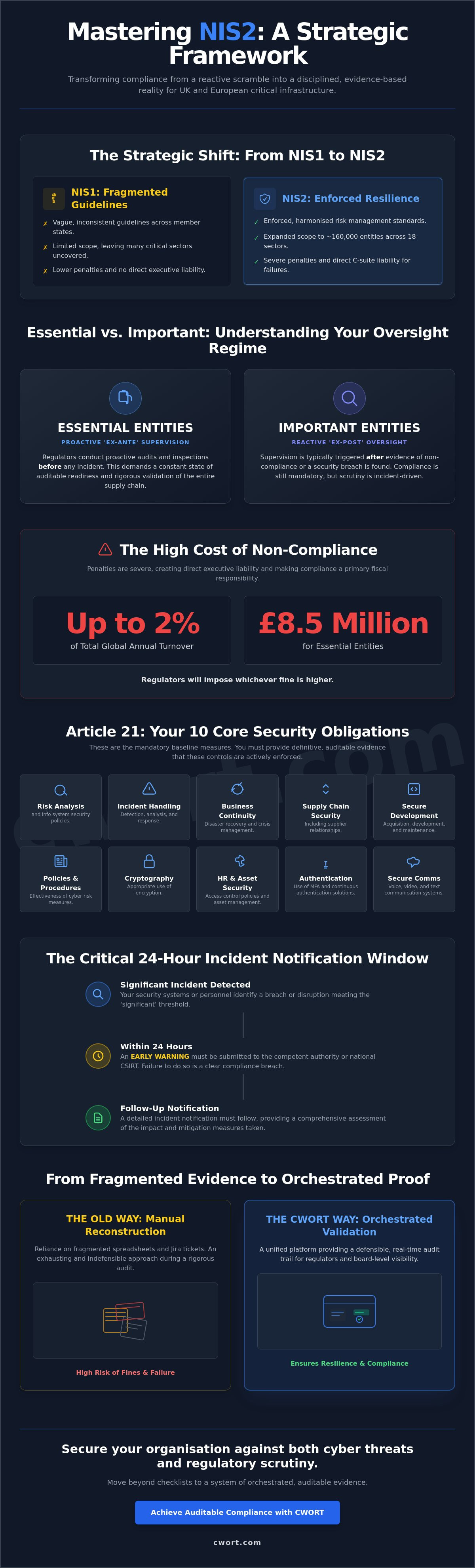
NIS2 represents a fundamental shift in how the United Kingdom and Europe approach systemic resilience. It replaces the fragmented NIS1 framework with a unified, more rigorous standard. This NIS2 Directive overview highlights its role in harmonising cybersecurity across 18 critical sectors. Achieving NIS2 compliance for critical infrastructure is no longer a "best effort" activity; it is a legal requirement backed by significant executive liability. The scope now captures approximately 160,000 entities, focusing on high-criticality areas such as energy, water, and space. This "all-hazards" approach requires organisations to defend against both sophisticated cyberattacks and physical disruptions to their core infrastructure.
Essential vs Important Entities: The Oversight Divide
The directive categorises organisations based on their systemic importance to society and the economy. Essential entities face "ex-ante" supervision, which means regulators will conduct proactive audits and inspections before any incident occurs. Important entities operate under an "ex-post" regime, where oversight is typically triggered only by evidence of non-compliance or a security breach. This divide forces essential providers to maintain a constant state of auditable readiness. It also necessitates stricter supply chain management, as critical providers must now validate the security posture of every direct supplier amongst their ecosystem. Sector-specific criticality determines the frequency and depth of this regulatory scrutiny, ensuring that the most vital services receive the most intense oversight.
The Strategic Shift from NIS1 to NIS2
The transition from NIS1 to NIS2 replaces vague guidelines with enforced risk management. Reporting requirements are now far more stringent. For instance, entities in Italy must notify the national CSIRT of significant incidents within a 24-hour window starting 1 January 2026. Penalties have also increased dramatically; essential entities face fines of up to £8.5 million or 2% of total global annual turnover, whichever is higher. This shift moves the focus from mere administrative tracking to definitive, evidence-based proof of security controls. Full enforcement of the directive, including regular audits for essential entities, is expected to be operational across primary jurisdictions by the fourth quarter of 2026. The window for administrative delay has closed. Organisations must move from tracking tasks to orchestrating definitive proof of resilience to ensure NIS2 compliance for critical infrastructure.
Deciphering the Technical and Operational Requirements
Article 21 of the Official EU NIS2 Directive mandates ten baseline security measures that constitute the bedrock of NIS2 compliance for critical infrastructure. These measures cover everything from risk analysis and incident handling to business continuity and cryptography. Crucially, the directive shifts the burden of proof. It's no longer sufficient to maintain a passive policy. You must provide definitive, auditable evidence that these controls are active and enforced. This requirement is designed to replace administrative checklists with a state of perpetual readiness.
The most significant shift for UK and EU leadership is the codification of executive liability. Management bodies are now held directly accountable for their organisation's cybersecurity failures. This removes the buffer between technical failure and board-level consequence. Boards must proactively oversee the implementation of security measures and participate in mandatory training. This isn't a task to be delegated and forgotten; it's a core governance obligation that requires constant validation. Failure to meet these standards can result in fines of up to £8.5 million or 2% of global turnover, making compliance a primary fiscal responsibility.
Risk Management and Incident Reporting Protocols
Meeting the reporting deadlines requires a highly disciplined internal structure. You must issue an 'early warning' within 24 hours of detecting a significant incident, followed by a detailed notification within 72 hours. This multi-stage process, which becomes active in jurisdictions like Italy from 1 January 2026, leaves no room for manual data reconstruction. Organise your response teams to follow a pre-validated workflow. This ensures that every report is backed by a clear chain of custody, satisfying the regulator's demand for transparency whilst maintaining operational pace.
Supply Chain Security: Managing the Ecosystem
Your security perimeter now extends to every direct supplier and service provider. You're required to assess the cybersecurity practices of these third-party partners and integrate these standards into your procurement contracts. This isn't a 'one-and-done' assessment; it's a continuous process of risk mitigation amongst your entire vendor base. You need auditable proof that your supply chain is resilient against both cyber and physical threats. Managing this ecosystem is a significant orchestration challenge, which is why many leaders use NIS2 Compliance Orchestration to bind third-party validation to their internal compliance framework.
The Critical Infrastructure Audit: Why Static Evidence Fails
Many organisations mistake a completed spreadsheet for a secure environment. In the high-stakes landscape of 2026, regulators are no longer satisfied with retrospective summaries or manual trackers. Achieving NIS2 compliance for critical infrastructure requires a shift from administrative tracking to definitive validation. When an auditor requests proof of a security control, they aren't looking for a "yes" in a Jira ticket. They demand a transparent, immutable chain of custody that proves the control was executed, validated, and monitored in real-time. Fragmented data lacks this integrity, often resulting in audit failures that trigger the significant penalties discussed in previous sections.
Executive liability has changed the nature of the conversation. Board members now face personal accountability for systemic failures, meaning they require more than just "best effort" assurances from their technical teams. They need auditable certainty. Relying on manual evidence collection creates a dangerous gap between the actual security posture and the reported status. This gap is where regulatory risk lives. To close it, organisations must move toward "evidence binding," a process where specific technical actions are mathematically or procedurally linked to regulatory control outcomes.
The Pitfalls of Manual Compliance Tracking
Checklists often create an administrative illusion of safety whilst leaving the organisation vulnerable. A ticked box in a spreadsheet doesn't prevent a breach, nor does it satisfy an auditor's need for proof of execution. Manual reconstruction of evidence during an audit is a high-risk activity that often leads to inconsistencies and data gaps. This "scramble" for proof suggests a lack of systemic control, which regulators interpret as a failure of governance. Static evidence loses its validity the moment it is manually moved between systems. Without a direct, automated link from the task to the record, the integrity of the evidence is compromised.
Binding Evidence to Control Outcomes
Integrity is maintained only when you capture evidence at the point of execution. By binding the proof to the action, you eliminate the possibility of retrospective tampering or human error. This transition replaces the outdated "trust me" model with a rigorous "show me" model that satisfies even the most demanding auditors. A critical component of this process is the enforcement of separation of duties amongst your workforce. Ensure that the individual performing a security task is never the same person validating the outcome. This structural discipline ensures that your NIS2 compliance for critical infrastructure is built on a foundation of defensible truth rather than administrative hope.
Orchestrating a Validated Compliance Framework
Success in meeting NIS2 compliance for critical infrastructure requires moving beyond the "gap analysis" model. A static assessment merely identifies what is missing; orchestration ensures that what is present actually works. This transition demands a five-step disciplined approach to governance. First, translate abstract technical standards into specific, executable organisational obligations. Second, assign clear accountability and enforce a strict separation of duties amongst your workforce. Third, orchestrate your workflows to capture evidence automatically whilst tasks are performed. Fourth, generate real-time, board-level reporting that reflects the actual state of resilience. Finally, continuously monitor and iterate based on the evolving threat landscape.
This systematic progression replaces the "hope-based" compliance model with a proactive architecture of proof. It enforces discipline by design, ensuring that every regulatory requirement is backed by a validated action. By binding execution to evidence in real-time, you eliminate the need for manual reconstruction during an audit. This approach doesn't just satisfy the regulator; it builds a more resilient organisation capable of defending against the sophisticated threats facing critical sectors in 2026.
From Obligation to Execution: Building the Workflow
Translating the high-level mandates of Article 21 into granular, daily operational tasks is the only way to ensure consistent performance. You must map every regulatory requirement to a specific owner and a defined frequency of execution. Automation plays a critical role here by reducing the administrative burden on technical teams. Instead of manually updating spreadsheets, your systems should produce evidence as a natural byproduct of the work being done. This creates a single source of truth for all compliance-related activities, eliminating the risk of conflicting data across fragmented tools like Jira or Excel. Implement NIS2 Compliance Orchestration to bridge the gap between technical execution and executive assurance.
Board-Level Visibility and Reporting
Executives and management bodies require a specific type of data to satisfy their new liability obligations. They don't need a list of completed IT tickets; they need to see control effectiveness. Strategic reporting must present the technical NIS2 status in a risk-focused context that highlights systemic resilience. Effective dashboards provide this "audit-ready" visibility on demand, allowing leadership to see where controls are failing before a regulator does. This level of transparency replaces the anxiety of potential failure with the calm of auditable certainty. By focusing on the maturity of your security measures rather than just task completion, you provide the board with the defensible proof they need to sign off on compliance with confidence.
CWORT: Transforming NIS2 Obligations into Auditable Evidence
CWORT is the definitive response to the systemic complexities of modern regulation. It functions as a cloud-based platform designed to orchestrate complex regulatory frameworks, moving far beyond the limitations of legacy GRC tools or manual trackers. Whilst standard trackers merely record what should happen, CWORT enforces the execution of what must happen. It replaces fragmented Excel files and disconnected Jira tickets with a unified system for evidence-based validation. This transition ensures that your organisation's posture is always auditable, transparent, and secure. By positioning itself as a proactive orchestrator, the platform provides the structural integrity required to satisfy the most demanding regulatory bodies.
The platform acts as a strategic partner for critical infrastructure providers seeking total assurance. It doesn't just monitor tasks; it enforces a disciplined workflow that mirrors the gravity of the NIS2 environment. This shift from passive tracking to active orchestration allows leadership to move from a state of constant anxiety to one of controlled certainty. In an era where executive liability is a functional reality, having a single, immutable source of truth is the only way to protect both the organisation and its directors from the consequences of non-compliance.
The CWORT Advantage: Orchestration over Administration
CWORT translates high-level NIS2 rules into structured execution activities, ensuring that every technical standard becomes a concrete task with a defined owner. The platform's unique "evidence binding" feature ensures that every control outcome is defensible by linking the proof directly to the point of execution. This eliminates the risk of data tampering or retrospective reconstruction of records. Additionally, the system enables consulting teams and internal enterprises to collaborate within a single, secure environment. This shared visibility ensures that everyone, from the technical lead to the external auditor, operates from the same set of validated facts. It enforces discipline by design, ensuring that separation of duties is not just a policy but a functional reality within the workflow.
Achieving Defensible Truth in Critical Infrastructure
Achieving NIS2 compliance for critical infrastructure requires a level of rigour that manual processes simply cannot provide. CWORT eliminates the exhausting need for manual audit preparation by maintaining a state of perpetual readiness. It produces regulator-ready outputs that demonstrate a clear chain of custody for every security measure mandated by the directive. This level of precision replaces the "administrative illusion" of compliance with the calm of auditable certainty. You no longer need to scramble for evidence from multiple sources or worry about the validity of your records when a 24-hour reporting window is triggered. We invite you to move beyond the spreadsheet and embrace a more sophisticated approach to organisational resilience. Take the final step toward total assurance and explore the CWORT platform for NIS2 orchestration to secure your infrastructure for the 2026 enforcement period.
Securing the Future of Critical Resilience
Transitioning from the administrative burden of NIS1 to the enforced risk management of NIS2 requires a fundamental change in operational philosophy. You've seen how fragmented trackers fail to provide the integrity required for a modern audit. Defensible truth is built through orchestration, not through the manual reconstruction of legacy data. To achieve NIS2 compliance for critical infrastructure, leadership must move toward systems that enforce discipline by design. This means binding technical execution to regulatory outcomes in real-time to satisfy the 24-hour reporting windows and executive liability mandates discussed throughout this guide.
CWORT provides this structural integrity. It offers a cloud-based orchestration engine that replaces fragmented Excel and Jira trackers with a unified system of record. You'll benefit from regulator-ready, board-level reporting generated automatically, whilst ensuring an enforced separation of duties for rigorous audit trails. The window for implementation is narrowing as the 2026 enforcement deadlines approach. Take control of your regulatory obligations and build a foundation of auditable certainty that protects both your organisation and its leadership. Orchestrate your NIS2 compliance with CWORT today and replace the anxiety of potential failure with the calm of validated resilience.
Frequently Asked Questions
What are the main differences between NIS1 and NIS2 for critical infrastructure?
NIS2 represents a significant expansion in scope and severity compared to its predecessor. It increases the number of covered sectors from seven to 18 and introduces direct personal liability for management bodies. Unlike the "best effort" approach of NIS1, this directive enforces strict risk management measures and requires organisations to provide definitive, auditable evidence of their security controls.
Which sectors are now classified as "Essential" under the NIS2 Directive?
Essential entities include high-criticality sectors such as energy, transport, banking, water, and space. These organisations are subject to "ex-ante" supervision, which means regulators conduct proactive audits and inspections regardless of whether a breach has occurred. This classification demands a state of perpetual readiness that differs from the reactive oversight applied to "Important" entities.
How does NIS2 affect the personal liability of senior management and the board?
Senior management bodies are now held directly accountable for their organisation's cybersecurity failures. Board members must undergo mandatory training and can face personal liability, including temporary bans from management functions, if they fail to oversee risk management effectively. This shift ensures that cybersecurity is treated as a core governance obligation rather than a delegated technical task.
What are the incident reporting timelines for critical infrastructure providers?
Organisations must follow a multi-stage reporting process that begins with an "early warning" within 24 hours of incident detection. A full notification is required within 72 hours, followed by a detailed final report within one month. Meeting these aggressive deadlines requires orchestrated workflows that can produce validated data without the need for manual reconstruction.
Can I use my existing GRC software or Jira for NIS2 compliance validation?
Standard GRC tools and Jira function as administrative trackers but often lack the rigour required for NIS2 compliance for critical infrastructure. They don't typically bind technical execution to regulatory obligations or enforce the strict separation of duties that auditors demand. Regulators require a defensible audit trail that proves controls were active at the point of execution, which static trackers cannot provide.
What happens if a critical infrastructure entity fails to comply with NIS2 technical standards?
Essential entities face administrative fines of up to £8.5 million or 2% of total global annual turnover, whichever is higher. Beyond financial penalties, regulators have the authority to suspend management licences and impose intensive oversight regimes. These measures are designed to ensure that systemic resilience is maintained across all critical sectors without exception.
How does NIS2 compliance overlap with other frameworks like DORA or ISO 27001?
DORA operates as "lex specialis" for the financial sector, meaning its specific requirements take precedence over NIS2 where they overlap. Whilst ISO 27001 provides a foundational set of security controls, it does not satisfy the specific orchestration and reporting mandates of the directive. Organisations should use control mapping to align these frameworks into a single, auditable architecture of proof.
What is the deadline for NIS2 implementation for UK-based entities operating in the EU?
UK entities with operations in the EU were required to comply with national implementation laws by the October 2024 transposition deadline. As of early 2026, most member states have moved into active enforcement, such as Germany's registration deadline which passed in March 2026. You must ensure your NIS2 compliance for critical infrastructure is fully operational now to avoid immediate regulatory intervention and potential penalties.
Disclaimer
The content on this site is provided for general information and educational purposes only. It does not constitute legal, regulatory, financial, or professional advice. CWORT provides AI‑assisted insights and workflow automation, but all compliance decisions remain the responsibility of your organisation and its management. Always seek qualified legal or regulatory guidance for decisions relating to DORA, NIS2, ISO 27001, CAF, or other obligations.