
A static spreadsheet is no longer a viable defence against a £17 million regulatory penalty. As the Cyber Security and Resilience Bill progresses through Parliament in May 2026, the margin for administrative error has vanished. You likely feel the strain of managing fragmented evidence across Jira and Excel whilst struggling to prove separation of duties during internal reviews. Implementing robust NCSC CAF assessment software is no longer a luxury; it's a strategic necessity to transform these disconnected data points into a disciplined, evidence-led validation framework.
We recognise the frustration of trying to map abstract NCSC CAF 4.0 outcomes to a complex operational reality. You deserve a single source of truth that replaces the anxiety of potential audit failure with the calm of auditable certainty. In this article, you'll discover how to transition from static checklists to a dynamic platform that satisfies UK NIS regulators. We will examine how to automate board-level resilience reporting and construct a defensible audit trail that stands up to the most rigorous inspections.
Key Takeaways
- Transition from passive administrative tracking to a proactive orchestration model that meets the rigorous demands of the Cyber Security and Resilience Bill.
- Deploy dedicated NCSC CAF assessment software to consolidate fragmented data into a single, defensible source of truth for UK NIS regulators.
- Navigate the complexities of CAF version 4.0 by integrating specific validation for AI-related cyber risks and secure software development lifecycles.
- Identify the critical orchestration gaps in standard GRC tools and task managers that prevent the enforcement of regulatory separation of duties.
- Establish a systematic workflow that binds verifiable evidence to every contributing outcome, ensuring your resilience status is both transparent and undeniable.
Beyond the Checklist: Why Enterprises Require NCSC CAF Assessment Software
The NCSC Cyber Assessment Framework (CAF) is no longer a voluntary exercise in administrative box-ticking. In the high-stakes regulatory climate of 2026, the transition from theory to practice requires more than a digital form. Whilst the NCSC Cyber Assessment Framework (CAF) provides a robust methodology for evaluating security posture, manual methods lack the structural integrity required for modern audits. Deploying dedicated NCSC CAF assessment software allows organisations to move beyond static snapshots, replacing guesswork with a strategic orchestration engine that enforces discipline by design.
Manual spreadsheets inevitably fail under the scrutiny of the Cyber Resilience Audit (CRA) scheme. These legacy tools offer a point-in-time view that becomes obsolete the moment a system configuration changes or a new threat emerges. Regulators now demand "validated compliance," a state where every claim of resilience is supported by tamper-proof, real-time evidence. True resilience is not a document; it is an active state of operational readiness that only a dynamic validation platform can accurately reflect.
The Limitations of Manual CAF Tracking
Manual systems suffer from a persistent "evidence gap" where documentation exists in isolation, disconnected from specific CAF controls. This fragmentation creates an immense administrative burden when updating version 4.0 requirements across multiple departments. Without a centralised system, version control becomes impossible and accountability vanishes. These manual processes fail to provide the board-level visibility regulators expect, leaving leadership unable to confirm if their essential functions are truly protected or merely documented on paper.
The Core Objectives of an Orchestrated CAF Platform
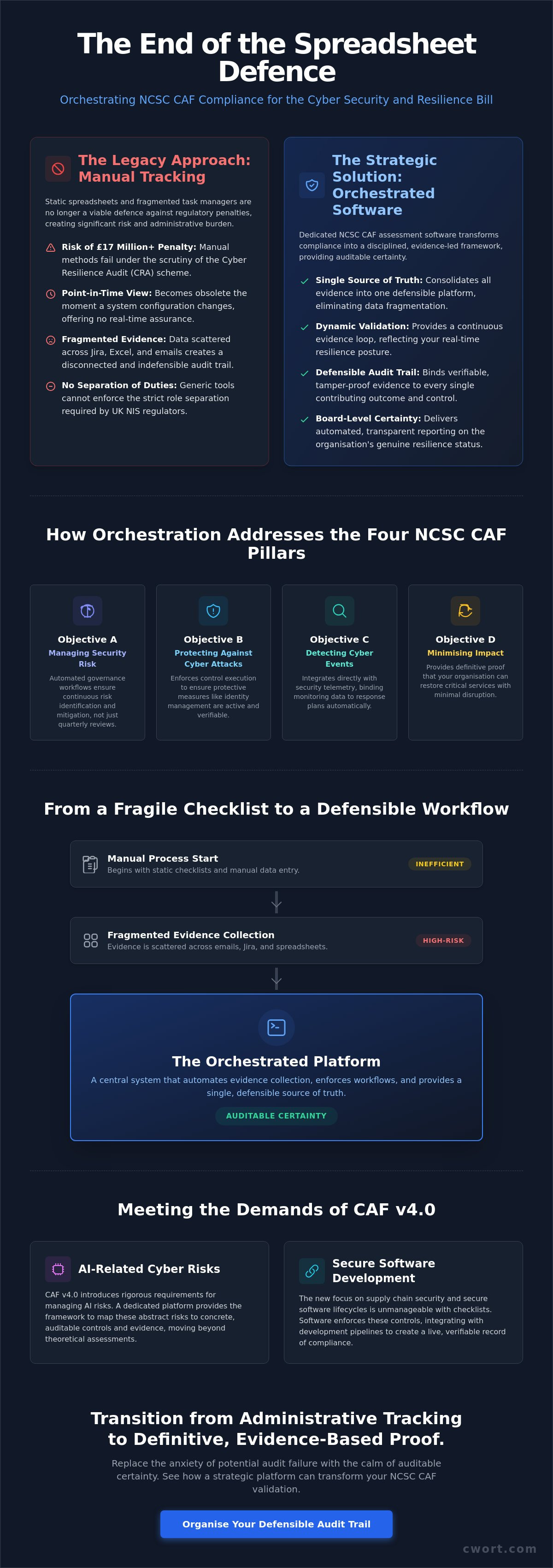
An orchestrated platform transforms the CAF from a set of obligations into a systematic workflow. It addresses the four pillars of the framework through rigorous, automated execution:
- Objective A: Managing Security Risk. Automated governance workflows ensure that risk management isn't a quarterly meeting but a continuous process of identification and mitigation.
- Objective B: Protecting Against Cyber Attacks. The platform enforces control execution, ensuring that protective measures like identity management and data security are active and verifiable.
- Objective C & D: Detecting and Minimising Impact. Integrated evidence loops bind monitoring data to response plans, providing definitive proof that your organisation can detect anomalies and restore critical services with minimal disruption.
By moving to NCSC CAF assessment software, enterprises shift their focus from administrative tracking to definitive, evidence-based proof. This transition replaces the anxiety of potential failure with the calm of auditable certainty, ensuring that your resilience posture is both transparent and undeniable to UK NIS regulators.
Navigating CAF v4.0: Software Features for Modern UK Resilience
The release of CAF version 4.0 marks a significant evolution in UK cyber governance. It shifts the burden of proof from simple compliance to threat-informed resilience. Managing this transition manually is no longer feasible. Advanced NCSC CAF assessment software provides the necessary framework to translate the 14 CAF principles and guidance into a series of actionable, auditable tasks. This orchestration ensures that Subject Matter Experts (SMEs) aren't just answering questions but are executing specific activities that generate defensible evidence.
Automated security monitoring plays a critical role in satisfying Objective C (Detection). Instead of manual log reviews, software integrates directly with security telemetry to provide a continuous evidence loop. This systematic approach ensures that every contributing outcome is backed by a verifiable record, leaving no room for ambiguity during a formal inspection. The result is a state of total assurance where the board can confidently report on the organisation's actual resilience status.
Managing AI and Software Supply Chain Risks
Version 4.0 introduces rigorous requirements for understanding attacker motivations and managing AI-related cyber risks. Legacy spreadsheets cannot track the fluid nature of AI security or the complex dependencies of a modern software supply chain. Dedicated software automates the assessment of these digital assets, ensuring that essential service software is maintained according to the latest NCSC security standards. It generates specific reports that map attacker methods to your existing controls, providing a clear gap analysis that regulators can validate. By using a specialised NCSC CAF assessment tool, organisations can prove they've accounted for the "Secure Software Development" outcomes required for NIS compliance.
Orchestrating Technical Standards Across the Estate
Translating high-level technical standards into granular execution activities is where most resilience programmes fail. Software solves this by decomposing complex principles into step-by-step workflows. For Principle B2 (Identity and Access Control), the platform enforces regular validation of user permissions and multi-factor authentication across the entire estate. This moves the organisation away from "paper-based" policy and toward operational reality. Dedicated software ensures Principle B5 (Resilient Networks) is validated through continuous evidence by linking real-time network telemetry directly to the relevant CAF outcomes. This transition from obligation to evidence creates a state of momentum, leading the organisation toward a successful regulatory conclusion.
Why Generic GRC Tools and Jira Fail NCSC CAF Audits
Many organisations assume their existing investment in Jira or standard GRC platforms covers their compliance needs. This is a dangerous misconception. Generic tools are designed for general task tracking, not for the rigorous validation required by UK NIS regulators. They lack the specific logic to bridge the "Orchestration Gap" where high-level policy must meet granular, auditable execution. Relying on these systems creates a false sense of security that quickly collapses under the weight of a formal inspection.
The fundamental issue is that generic tools don't understand the specific requirements of the NCSC Cyber Assessment Framework. Regulators don't want to see a list of completed tickets; they require proof of a disciplined process where execution and validation are strictly decoupled. Without NCSC CAF assessment software, your evidence remains "unbound," existing as isolated files in a repository rather than being structurally linked to specific contributing outcomes. This lack of binding makes it impossible to generate the audit-ready reports that boards and regulators now demand.
The Problem with Jira for Compliance Validation
Jira lacks the native capability to enforce a "separation of duties" workflow by design. In a regulatory context, the individual implementing a control must not be the one who validates its effectiveness. Without this enforced boundary, your audit trail is fundamentally flawed. Jira tickets are frequently rejected as definitive proof because they don't capture the technical rigour of the validation process. Using non-specialised tools leads to fragmented data silos, making it nearly impossible to provide a coherent, defensible narrative of resilience during a high-stakes audit.
Excel vs. Dedicated CAF Orchestration
Excel is a tool for calculation, not for complex regulatory orchestration. Spreadsheets are fragile, prone to human error, and offer no real-time visibility into your resilience status. They are static artefacts that fail to prove continuous compliance. In contrast, NCSC CAF assessment software acts as a proactive system that enforces discipline and accountability. It replaces the chaos of multi-user spreadsheet collaboration with a structured environment where every action is logged and every piece of evidence is verified. This transition establishes a "Defensible Truth" that manual trackers simply cannot match, ensuring your organisation moves beyond administrative tracking to definitive, evidence-based proof.
Implementing a Defensible CAF Assessment Workflow
Establishing a defensible workflow requires a transition from passive observation to active orchestration. A robust resilience posture is built on a four-step methodology that ensures every claim of compliance is backed by verifiable action. By utilising specialised NCSC CAF assessment software, organisations can move through these stages with precision, replacing the chaos of manual tracking with a disciplined, systematic process.
- Identify and Map: Begin by mapping essential functions and critical systems directly to the CAF Objective structure. This alignment ensures that your technical estate is viewed through the lens of regulatory obligation from the outset, providing a clear foundation for all subsequent activities.
- Enforce Accountability: Assign specific execution activities to Subject Matter Experts (SMEs). The platform must mandate a strict separation of duties; this ensures that the individual responsible for implementing a security control is never the person who validates its effectiveness, satisfying a core requirement for UK regulators.
- Bind Evidence: Capture and bind digital evidence directly to control outcomes as they occur. This creates a chronological, tamper-proof record that proves resilience was maintained throughout the reporting period, eliminating the risk of retrospective data gathering during an audit.
- Visualise Readiness: Generate real-time dashboards for leadership and regulator-ready outputs for auditors. This provides immediate clarity on your resilience status, allowing for proactive remediation of any identified gaps before a formal inspection begins.
Mapping Obligations to Execution
Translating NCSC principles into granular, day-to-day activities is essential for IT teams. It moves the framework from an abstract policy document into a series of executable tasks that are easy to manage. Activity-Control Binding creates a transparent audit trail, ensuring that every piece of telemetry is linked to a specific regulatory requirement. This systematic approach allows you to identify gaps in your CAF Objective A (Governance) early in the assessment cycle, facilitating strategic realignment before technical controls are even evaluated.
Generating Board-Level and Auditor-Ready Reports
Boards require strategic insights that reflect the organisation's true risk appetite rather than raw data silos. They need to understand the impact of cyber risk on essential functions through clear, high-level visualisations. Automating the production of the CAF "Output Profile" ensures that you are always ready for a formal UK NIS inspection. By centralising and automating evidence collection, the right platform reduces the administrative burden of audit preparation by 80% compared to manual methods. Deploying a dedicated NCSC CAF assessment tool ensures that your resilience programme is not just a plan, but a proven reality.
CWORT: The Strategic Platform for CAF Validation and UK NIS Compliance
CWORT stands as the definitive orchestration engine for organisations navigating the high-stakes environment of UK cyber regulation. It is not a passive repository for documentation; it is a proactive system designed to enforce the structural integrity required by the most rigorous audit standards. Whilst generic tools leave an "orchestration gap" between policy and proof, CWORT acts as the essential bridge between NCSC guidance and operational reality. By deploying this specialised NCSC CAF assessment software, enterprises can shift from the anxiety of administrative tracking to the certainty of a defensible, evidence-based posture.
The platform's unique "Evidence Binding" feature ensures that every contributing outcome within the CAF framework is backed by auditable proof. This mechanism prevents the common pitfall of "unbound evidence," where documentation exists but lacks a direct, verifiable link to a specific control. Furthermore, CWORT enforces a strict "Separation of Duties" by design. This ensures that the individual responsible for executing a security activity is never the one who validates its effectiveness, meeting a critical requirement that regulators use to distinguish between superficial compliance and genuine resilience.
Enforcing Discipline by Design
CWORT replaces the inefficient manual chasing of Subject Matter Experts with automated obligation execution workflows. This systematic approach ensures that security tasks are not just assigned but are executed and validated according to a disciplined schedule. The platform provides a unified architecture for managing DORA, NIS2, and NCSC CAF obligations simultaneously, eliminating the need for fragmented data silos. This integrated model ensures that your organisation remains "Audit-Ready" 365 days a year, transforming compliance from a periodic crisis into a continuous state of professional maturity.
Securing the Future of UK Critical Infrastructure
As the Cyber Security and Resilience Bill (reintroduced in May 2026) expands the scope of NIS regulations to include managed service providers and data centres, the margin for error has narrowed. CWORT supports this transition by providing a scalable framework that adapts to these evolving requirements. Working with a UK-based technology firm ensures that your NCSC CAF assessment software is aligned with the local regulatory landscape and the specific expectations of UK inspectors. This partnership provides the strategic oversight needed to protect essential functions against increasingly sophisticated threats.
Request a CWORT demo to see our CAF orchestration in action.
Secure Your Regulatory Future with Evidence-Led Orchestration
The shift toward CAF v4.0 and the impending Cyber Security and Resilience Bill leaves no room for administrative ambiguity. You've seen how manual spreadsheets and generic task managers fail to provide the structural integrity required for a formal UK NIS audit. True resilience requires a transition from static checklists to a proactive validation environment. By deploying specialised NCSC CAF assessment software, your organisation can finally bind technical evidence to regulatory outcomes in real-time.
CWORT provides the disciplined framework necessary to achieve this state of total assurance. As UK-based compliance validation experts, we offer proprietary evidence-binding technology and enforced separation of duties by design to ensure your posture is undeniable. Don't leave your resilience to chance or fragmented Jira tickets. Establish a single source of truth that satisfies regulators and empowers your board with auditable certainty.
Orchestrate your NCSC CAF assessment with CWORT, the platform regulators trust.
Take command of your regulatory obligations and transform your cyber defence into a source of professional pride and operational strength.
Frequently Asked Questions
What is the difference between NCSC CAF guidance and CAF assessment software?
NCSC CAF guidance provides the theoretical framework and desired outcomes, whereas NCSC CAF assessment software is the operational engine that executes and validates those outcomes. Guidance tells you what to achieve; software provides the workflow, evidence binding, and auditable proof required for regulatory inspections. It transforms a static document into a living system of record that enforces accountability across your organisation.
Is NCSC CAF assessment mandatory for UK critical infrastructure providers?
CAF assessments are mandatory for organisations designated as Operators of Essential Services (OES) under the UK NIS Regulations. With the reintroduction of the Cyber Security and Resilience Bill in May 2026, this scope expands to include managed service providers and data centres. Failure to provide a defensible assessment can result in fines of up to £17 million or 4% of global turnover for non-compliance.
How does CAF assessment software handle the updates in version 4.0?
Dedicated software automates the transition by mapping existing controls to the new v4.0 contributing outcomes, such as AI-related cyber risks and attacker motivation assessments. It identifies specific gaps introduced by the August 2025 update, allowing teams to remediate deficiencies before an audit begins. This systematic approach ensures that your resilience posture remains current without the manual burden of re-mapping every technical control.
Can I use CWORT to map CAF objectives to other frameworks like ISO 27001 or DORA?
CWORT enables the cross-mapping of CAF objectives to international standards like ISO 27001 and sector-specific regulations such as DORA or NIS2. This orchestration allows organisations to collect evidence once and apply it across multiple compliance regimes. By centralising these frameworks, CWORT eliminates redundant activities and provides a unified, real-time view of your global risk and resilience status.
How does software help in proving "Separation of Duties" during an NCSC CAF audit?
The software enforces a "Separation of Duties" by mandating that the individual executing a security activity is never the person who validates the evidence. This boundary is hard-coded into the workflow, creating a tamper-proof audit trail that generic task managers cannot replicate. Regulators accept this enforced discipline as definitive proof of a robust and objective internal control environment during formal inspections.
What kind of evidence is required for a successful CAF assessment?
Successful assessments require technical telemetry, configuration logs, and process documentation that is directly bound to specific CAF contributing outcomes. This evidence must prove that controls are not just designed but are active and effective in an operational environment. NCSC CAF assessment software ensures this data is captured chronologically, providing auditors with a transparent and undeniable record of resilience over time.
How long does it take to implement a CAF assessment platform in a large organisation?
Implementation typically takes between eight to twelve weeks, depending on the complexity of the technical estate and the maturity of existing governance. This timeframe includes mapping essential functions, configuring automated evidence loops, and training Subject Matter Experts on the orchestration workflow. Once established, the platform significantly reduces the ongoing administrative overhead of maintaining an audit-ready status across the entire digital estate.
Does CAF assessment software support the Cyber Resilience Audit (CRA) scheme?
Software is specifically designed to support the CRA scheme by generating the standardised Output Profiles required by UK regulators. It provides the structured reporting and evidence binding that CRA inspectors demand during their formal evaluations of critical national infrastructure. By using a specialised platform, organisations ensure their reporting is accurate, defensible, and aligned with the latest UK government security expectations.

Article by
Michael Iyiola
Michael Iyiola is a cybersecurity and AI engineering specialist with deep experience in vulnerability management, detection engineering, and operational resilience. At CWORT, he designs scalable, evidence‑driven workflows that help teams meet modern regulatory and security demands.
Disclaimer
The content on this site is provided for general information and educational purposes only. It does not constitute legal, regulatory, financial, or professional advice. CWORT provides AI‑assisted insights and workflow automation, but all compliance decisions remain the responsibility of your organisation and its management. Always seek qualified legal or regulatory guidance for decisions relating to DORA, NIS2, ISO 27001, CAF, or other obligations.