
The era of "hollow" compliance, where a policy document serves as a proxy for actual security, ended the moment the Serious Fraud Office shifted its focus to operational effectiveness. If your organisation still relies on manual logs and disconnected spreadsheets, you aren't just inefficient; you're indefensible. Ensuring compliance evidence integrity in 2026 requires more than a simple paper trail. It demands a system where every action is inextricably bound to a control outcome, creating an immutable record that survives the most aggressive regulatory scrutiny.
You likely feel the mounting pressure as DORA and NIS2 deadlines converge with the "failure to prevent fraud" offence now in full effect. It's exhausting to prove separation of duties whilst drowning in manual evidence collection that often lacks structural integrity. This guide provides the strategic framework to master evidence binding, shifting your posture from reactive anxiety to auditable certainty. We will examine how to replace fragile manual workflows with a defensible repository, ensuring your controls are validated, orchestrated, and ready for any audit.
Key Takeaways
- Understand how DORA and NIS2 have redefined the standards for proof, moving beyond static policies toward active, immutable evidence of control execution.
- Master the core principles of ensuring compliance evidence integrity by inextricably binding every operational activity to its specific regulatory outcome.
- Recognise the structural vulnerabilities of using spreadsheets and generic task managers, which lack the necessary constraints and audit trails for defensible governance.
- Learn to implement validated execution workflows that enforce mandatory evidence prompts and strict separation of duties at the precise moment of task completion.
- Discover how to transition from fragmented tracking to a single orchestrated system of truth that provides absolute certainty under rigorous regulatory scrutiny.
Defining Compliance Evidence Integrity in the 2026 Regulatory Landscape
In the current regulatory environment, the distinction between simple data storage and genuine evidence integrity has become a matter of corporate survival. Traditional compliance relied on a "snapshot" approach, where organisations gathered static documents to satisfy annual audits. This is no longer sufficient. Ensuring compliance evidence integrity in 2026 requires a transition from passive record-keeping to active, definitive validation. It isn't enough to show that a control exists; leadership must prove that the control operated exactly as intended at the precise moment of execution. Data storage is merely the act of saving a file. Evidence integrity is the indisputable proof that the file is authentic, untampered, and inextricably linked to a specific regulatory requirement.
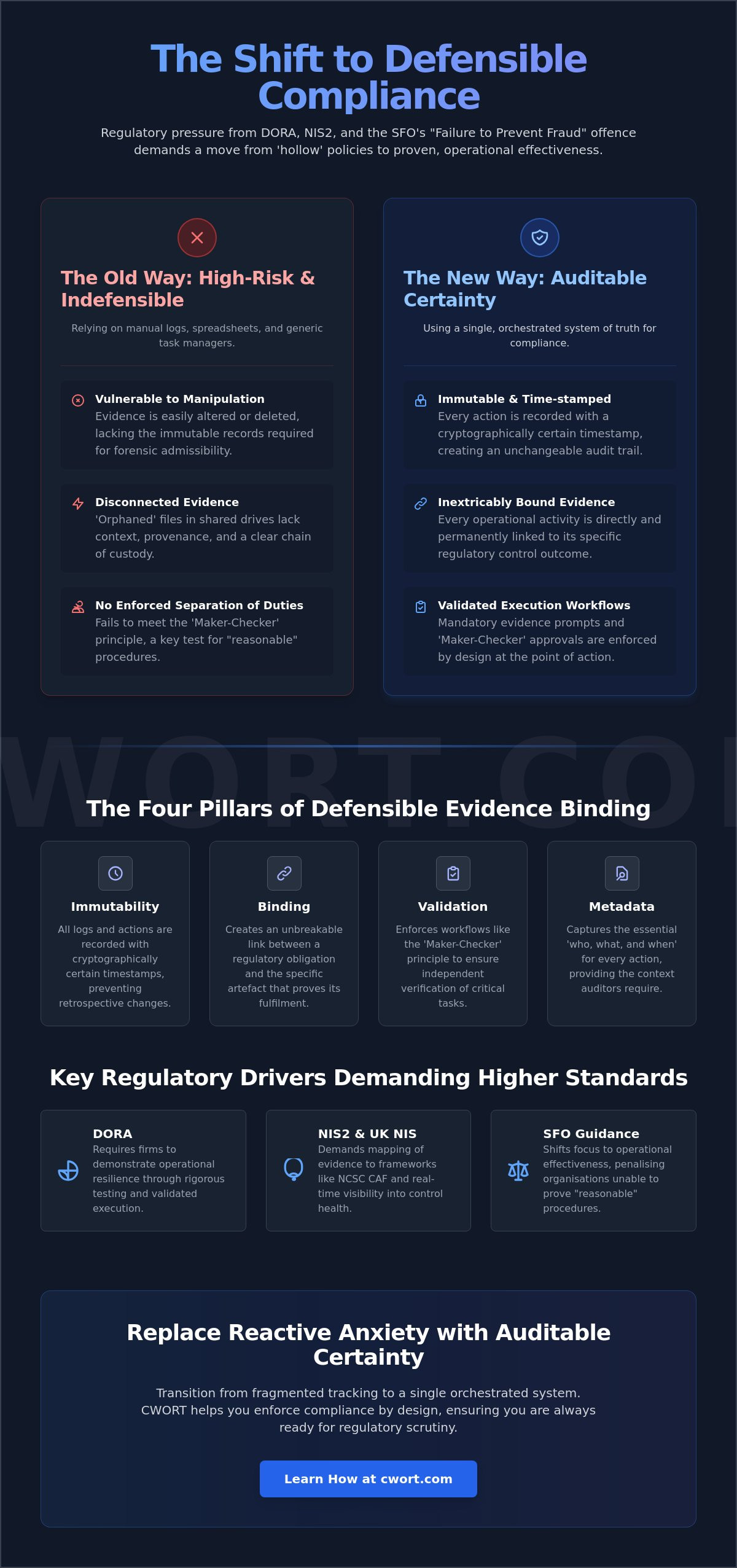
The Serious Fraud Office (SFO) updated its guidance in late 2025, shifting its focus from "tick-box" policies to the operational effectiveness of compliance programmes. Regulators now demand a continuous narrative of control execution. If your evidence repository contains gaps or lacks a clear chain of custody, it's considered "hollow" compliance. This structural vulnerability leaves the organisation exposed to the "failure to prevent fraud" offence, which carries severe penalties for leadership teams unable to demonstrate "reasonable" procedures through defensible proof.
The Admissibility vs. Auditability Debate
Forensic standards are migrating from the courtroom into everyday corporate governance. Whilst auditability once meant simply being able to find a document, the 2026 standard demands admissibility. The principles of digital evidence integrity now dictate how firms must handle compliance data. Every log must be immutable. Every action requires a cryptographically certain timestamp. Regulators now look for "sufficient" proof, which often includes the "Maker-Checker" principle. This ensures that one individual performs a task whilst a second, independent party verifies it, creating a multi-layered record of accountability that manual spreadsheets simply cannot replicate.
Regulatory Drivers: DORA, NIS2, and UK NIS
The Digital Operational Resilience Act (DORA) and NIS2 have elevated the technical requirements for evidence amongst UK enterprises. These frameworks demand more than just a list of completed tasks. They require a mapping of evidence directly to the NCSC CAF assessment framework. For critical infrastructure providers, ensuring compliance evidence integrity means providing real-time visibility into control health. DORA, specifically, requires firms to demonstrate resilience through rigorous testing and validated execution workflows. When an auditor asks for proof of a patch management cycle or a third-party risk assessment, the response must be a bound, immutable record that connects the obligation to the outcome without the possibility of retrospective manipulation.
By moving to a system of orchestrated validation, organisations replace the anxiety of potential audit failure with the calm of structural certainty. You don't just track compliance; you enforce it by design.
The Technical Pillars of Defensible Evidence Binding
Defensible compliance is built on the principle of binding. It is the process of creating an unbreakable, verifiable link between a regulatory obligation and the specific artefact that proves its fulfilment. Without this connection, evidence becomes "orphaned," existing as a disconnected file in a shared drive with no clear context or provenance. Ensuring compliance evidence integrity requires a shift from passive observation to active enforcement. You must ensure that every piece of data captured is a direct byproduct of a controlled execution process, rather than a retrospective collection effort that is vulnerable to manipulation.
A rigorous approach to integrity must account for the metadata surrounding every activity. This includes the identity of the executor, the precise timestamp of completion, and the specific control ID it satisfies. Implementing a robust data integrity audit framework ensures that evidence is not merely collected but is structurally sound. This metadata provides the "who, what, and when" that auditors require to establish a continuous chain of custody. If you cannot prove the context of a file, you cannot prove its validity.
Binding Evidence to Control Outcomes
Organisations often fail audits because their evidence lacks a direct lineage to the requirement. When evidence is "orphaned," it loses its defensive value. You must move beyond simple file storage and adopt a system that mandates evidence at the point of activity completion. This ensures that no task is marked as "done" unless the required proof is attached and validated. This real-time binding eliminates the frantic, last-minute data gathering that typically precedes an annual audit. By the time a regulator asks for proof, the evidence is already bound, immutable, and ready for inspection. For leadership, this provides a level of certainty that manual tracking can never achieve.
Enforcing Separation of Duties (SoD)
The person executing a control must never be the same individual who validates its completion. This "Maker-Checker" principle is a fundamental requirement under DORA and the UK NIS framework. Manual systems often fail here, as they rely on trust rather than technical constraints. Ensuring compliance evidence integrity means hard-coding these restrictions into your workflows. If your system allows an administrator to both perform a patch update and sign off on its success, you have a structural vulnerability.
Automated SoD workflows eliminate the risk of human error or collusion. They provide an objective record that the required checks and balances were in place. When an auditor examines your repository, they should see a clear, multi-party validation history for every critical action. This level of transparency is essential for surviving rigorous scrutiny in 2026. To see how these technical pillars are enforced in practice, you can explore a validated execution demo to understand the difference between tracking and orchestration.
Why Spreadsheets and Generic Task Managers Compromise Audit Integrity
Legacy tools like Excel were never designed for the rigours of 2026 regulatory scrutiny. Relying on spreadsheets creates a "reconstruction gap," a hidden operational cost where teams spend weeks manually validating data before an audit. This fragmented approach leads to "compliance debt," where the volume of unverified evidence grows faster than the team's ability to govern it. Ensuring compliance evidence integrity is impossible when your primary record can be edited by anyone with access without a permanent, immutable audit trail. If a document can be modified retrospectively without a trace, it isn't evidence; it's a liability.
The operational reality of manual tracking is one of constant risk. Research suggests that up to 88% of spreadsheets contain significant errors, a statistic that should alarm any board member responsible for DORA or NIS2 compliance. When your evidence is scattered across shared drives and disconnected tabs, you lose the ability to prove the chain of custody. This lack of structural integrity is precisely what regulators look for when assessing whether an organisation has "adequate" procedures in place.
The Fragility of Manual Tracking
Spreadsheets suffer from chronic version control issues. An employee might inadvertently alter a cell, or worse, intentionally modify evidence to hide a control failure. Without structured execution, a "done" status in a tracker is merely a claim, not proof. Aligning with UK government data integrity guidance requires a level of permanence and traceability that static files cannot provide. For those still trapped in manual cycles, replacing spreadsheets for regulatory compliance is the first step toward a defensible posture. You cannot build a secure repository on a foundation of "v1_final_FINAL.xlsx".
Jira vs. Compliance Orchestration
Jira is an excellent project management tool, but it is a poor compliance orchestrator. It lacks the necessary constraints to enforce regulatory nuances like mandatory evidence prompts or hard-coded separation of duties. In Jira, a ticket is often closed without the required proof being bound to the outcome. This creates integrity blind spots. There is no direct "obligation-to-outcome" mapping, meaning you cannot prove which specific DORA or NIS2 requirement a ticket satisfies. Standard PM tools allow for retrospective editing of comments and attachments, which is a significant red flag for auditors. If you cannot lock the record at the point of completion, your evidence is essentially hearsay. True orchestration requires a system that enforces discipline by design, ensuring that every action is validated and every outcome is defensible.
Establishing a Validated Execution Workflow for Enterprise Compliance
Proactive validation is the only method to eliminate the "reconstruction gap" that plagues traditional compliance departments. Relying on forensic investigations after a breach or audit failure is a high-risk strategy that modern regulators no longer tolerate. Ensuring compliance evidence integrity requires a shift toward a validated execution workflow. This system ensures that every regulatory requirement is translated into a discrete, manageable task that generates defensible proof by design. You must move from a state of passive monitoring to one of active orchestration, where the system itself enforces the standards you've set.
This transition requires a disciplined approach to how work is performed and recorded. By hard-coding compliance requirements into the daily operational flow, you remove the burden of proof from the individual and place it within the process. This creates a self-documenting environment where audit readiness is a constant state rather than a periodic crisis.
Step 1: Mapping Obligations to Activities
Begin by deconstructing abstract regulatory frameworks like DORA or ISO 27001 into granular, actionable activities. A requirement such as "regularly test ICT business continuity" is too vague for execution. Break it down into specific tasks: identify the systems, schedule the test, execute the failover, and record the results. Assign clear ownership to every task. Each activity must have a predefined "evidence requirement" that dictates exactly what file, log, or sign-off is needed to satisfy the control. Without this mapping, your team is simply performing tasks without knowing if they are meeting the standard.
Step 2: Orchestrated Execution and Capture
The most critical phase is capturing evidence whilst the activity is actually being performed. Traditional methods fail because they rely on memory and manual uploads days or weeks after the fact. Implement mandatory evidence prompts that prevent a task from being closed until the required proof is attached. This ensures that no control is left unvalidated. For a structured approach to this transition, consult the Enterprise Compliance Evidence Management Checklist. This ensures that every operational outcome is bound to its regulatory obligation at the point of completion, leaving no room for retrospective manipulation or data loss.
Step 3: Continuous Audit Readiness
Stop preparing for audits and start being perpetually ready for them. A validated workflow builds the audit trail in real-time, providing an unbreakable chain of custody. This allows you to provide the board with a live "compliance posture" dashboard, replacing static reports with dynamic, evidence-based certainty. You can learn more about automated compliance reporting for the board to understand how to translate granular technical evidence into strategic assurance. When you orchestrate execution, you don't just hope for a positive audit outcome; you guarantee it. To see how this workflow can be automated within your organisation, book a validation orchestration demo today.
CWORT: Orchestrating Continuous Compliance Validation
CWORT represents the final transition from administrative tracking to definitive, evidence-based proof. It is a proactive system that enforces discipline and accountability by design. Whilst most organisations struggle with fragmented data, CWORT replaces this chaos with a single orchestrated system of truth. It ensures that every action taken by your team is validated against the specific requirements of DORA, NIS2, or ISO 27001. By hard-coding these standards into the workflow, the platform removes the possibility of human error or procedural bypass. You don't just record activity; you enforce the standard.
Ensuring compliance evidence integrity becomes an automated byproduct of daily operations rather than a manual burden. The system mandates the capture of proof at the point of execution, creating a defensible record that is instantly ready for regulatory scrutiny. This level of orchestration significantly reduces the administrative load on compliance teams, allowing them to focus on strategic risk management instead of chasing missing documents or fixing spreadsheet errors. It transforms compliance from a periodic crisis into a continuous, quiet state of readiness.
Replacing Fragmented Tools with Orchestration
Orchestration is the only way to achieve absolute certainty in control effectiveness. CWORT translates complex, abstract regulations into structured, validated workflows that guide your team through every step of a controlled process. It automatically binds evidence to control outcomes, ensuring that every piece of data in your repository has a clear lineage and a verified purpose. This transparency secures board-level confidence. Leadership no longer has to rely on vague assurances; they can see the live status of their compliance posture through a lens of auditable certainty. By replacing disconnected task managers with a unified engine, you eliminate the integrity blind spots that lead to audit failure.
Strategic Resilience for UK Enterprises
Future-proofing your organisation requires a system that evolves alongside technical and legal standards. CWORT provides the structural framework needed to maintain strategic resilience in a shifting regulatory landscape. It serves as a comprehensive NCSC CAF Assessment Software, mapping technical evidence directly to the Cyber Assessment Framework. This ensures that your organisation remains compliant with UK-specific mandates whilst meeting broader international requirements.
Stop relying on hope and start enforcing truth. You can request a demonstration of the CWORT orchestration engine to see how to transform your compliance posture from a manual struggle into a state of total assurance. Moving to an orchestrated model is not just a technical upgrade; it's a strategic necessity for any enterprise operating in the high-stakes environment of 2026. Ensuring compliance evidence integrity is no longer a goal; with the right system, it's an inevitability.
Securing Your Defensible Regulatory Future
The regulatory landscape has moved beyond static policies toward a requirement for definitive, operational proof. You've seen that manual spreadsheets and generic task managers are no longer sufficient to withstand the scrutiny of DORA or NIS2 audits. Success now requires a disciplined shift toward orchestrated execution where every action is inextricably linked to a control outcome. Ensuring compliance evidence integrity is the only way to replace the reconstruction gap with a state of perpetual audit readiness.
By hard-coding validation and separation of duties into your daily workflows, you remove the burden of proof from your team and place it within a secure, automated process. This transition doesn't just reduce workload; it provides the board with absolute certainty in the face of high-stakes regulatory environments. Discover how CWORT orchestrates defensible compliance validation to enforce discipline by design. Our platform validates DORA, NIS2, and ISO 27001 controls, generating audit-ready evidence without the need for manual intervention. Step into the calm of auditable certainty and lead your organisation with confidence.
Frequently Asked Questions
What is the difference between compliance tracking and compliance validation?
Tracking is an administrative function that monitors the status of tasks, whilst validation is a technical process that proves control effectiveness. Tracking tells you a task is marked as "done"; validation provides the bound, immutable proof that the task was executed correctly. Ensuring compliance evidence integrity requires moving beyond simple status updates toward a system that captures definitive proof at the point of activity completion.
How does DORA define evidence integrity for financial institutions?
DORA mandates that financial entities maintain rigorous standards for the authenticity and reliability of ICT records. Evidence integrity under this framework means that all data related to incident management and resilience testing must be protected from unauthorised modification. Regulators expect a clear, traceable history of execution that proves controls were operational during the review period, rather than just documented in a policy.
Can I use existing tools like Jira for evidence based compliance management?
Jira is designed for flexible project management, not the rigid technical constraints required for regulatory orchestration. It lacks the hard-coded separation of duties and mandatory evidence prompts necessary to satisfy a 2026 audit. Whilst Jira can track tickets, it cannot prevent a user from closing a task without attaching the required proof. This creates "hollow" evidence that often lacks the metadata and immutability required for defensibility.
What are the risks of manual evidence collection during a regulatory audit?
Manual collection creates a "reconstruction gap" where teams spend weeks gathering data before an audit. This process is prone to human error and version control issues, leading to a "failure to prevent fraud" liability. Regulators view manual spreadsheets as low-integrity records because they lack immutable timestamps and a clear chain of custody. If you cannot prove that evidence hasn't been tampered with, your entire posture is vulnerable.
How do I ensure separation of duties in a digital compliance workflow?
Effective separation of duties (SoD) requires a "Maker-Checker" system enforced by technical constraints rather than mere policy. In a digital workflow, the system must prevent the individual who performed a task from being the one who validates the associated evidence. This ensures objective oversight and prevents collusion or accidental manipulation. Automating this workflow provides a permanent, auditable record that the required checks and balances were in place by design.
What role does metadata play in ensuring compliance evidence integrity?
Metadata provides the essential "who, what, when, and where" for every record. It captures the identity of the executor, the precise timestamp of the action, and the specific control ID it satisfies. Without this metadata, a piece of evidence is "orphaned" and lacks provenance. Regulators use these details to verify that the evidence is authentic, untampered, and was generated at the correct point in the control cycle.
How often should compliance evidence be validated for ISO 27001?
Evidence should be validated in alignment with the frequency of the control itself, rather than just during an annual review. If a control operates monthly, the evidence must be validated monthly. Waiting for an annual audit creates a significant risk that failures will go undetected for months. Modern standards expect continuous validation, providing leadership with real-time certainty that security controls are functioning as intended throughout the year.
What is regulator-ready evidence and how does it differ from internal reports?
Regulator-ready evidence is the raw, immutable proof of execution, whilst internal reports are often just high-level summaries. For a record to be regulator-ready, it must be bound to a specific obligation and include a complete validation history. Internal reports might show a percentage of completion, but a regulator will demand the underlying, untampered logs for each instance. Defensibility relies on the granular detail, not the summary.

Article by
Michael Iyiola
Michael Iyiola is a cybersecurity and AI engineering specialist with deep experience in vulnerability management, detection engineering, and operational resilience. At CWORT, he designs scalable, evidence-driven workflows that help teams meet modern regulatory and security demands.
Disclaimer
The content on this site is provided for general information and educational purposes only. It does not constitute legal, regulatory, financial, or professional advice. CWORT provides AI-assisted insights and workflow automation, but all compliance decisions remain the responsibility of your organisation and its management. Always seek qualified legal or regulatory guidance for decisions relating to DORA, NIS2, ISO 27001, CAF, or other obligations.