
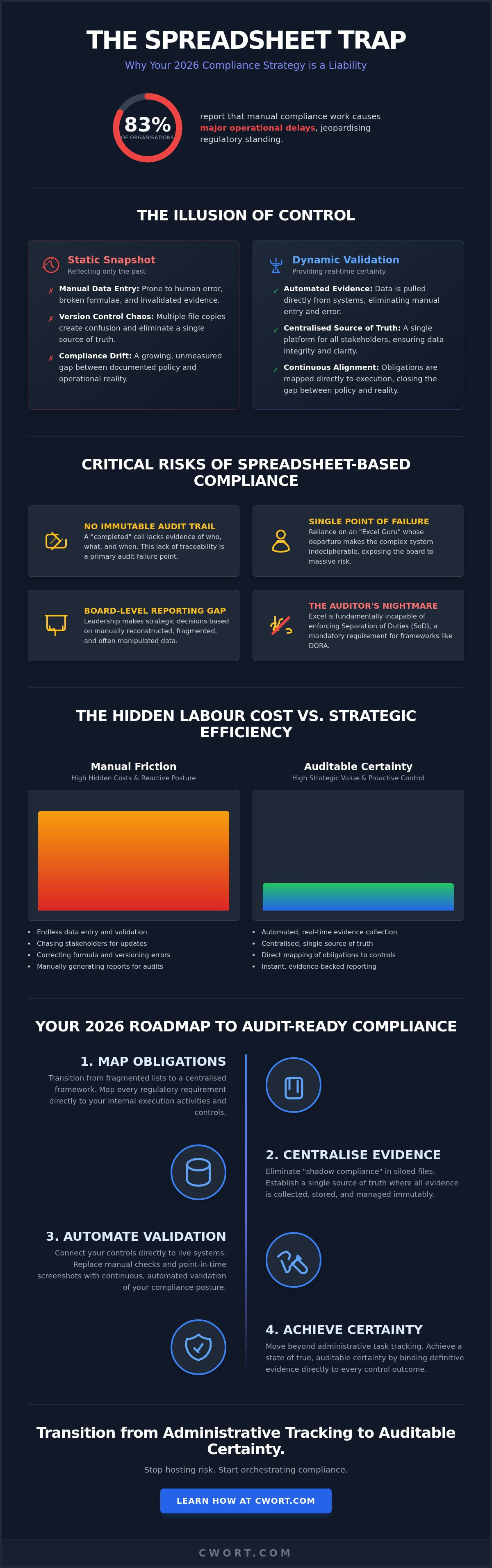
If your 2026 regulatory strategy relies on a file format designed decades ago, you aren't managing risk; you're hosting it. With 83% of organisations reporting that manual compliance work causes major delays, the era of "making do" with spreadsheets has ended. You likely recognise the fatigue of manual data entry and the persistent anxiety that a broken formula or a version control error will trigger an audit failure. It's a common struggle to prove a strict separation of duties whilst files circulate amongst stakeholders without a clear audit trail. This article explains why the risks of using excel for compliance management now pose a direct threat to your strategic standing. You'll learn why manual spreadsheets jeopardise regulatory validation and how to transition to an orchestrated, audit-ready compliance framework. We will break down the structural failings of legacy tools and provide a roadmap for achieving definitive, evidence-based control.
Key Takeaways
- Understand why a "green cell" in a spreadsheet fails to provide actual regulatory validation in a dynamic, high-stakes risk environment.
- Identify the critical risks of using excel for compliance management, specifically the absence of immutable audit trails and the danger of "single point of failure" dependencies.
- Evaluate the hidden labour costs of manual spreadsheet maintenance against the strategic efficiency of a centralised validation orchestration platform.
- Follow a structured 2026 roadmap to eliminate "shadow compliance" by mapping regulatory obligations directly to real-time execution activities.
- Transition from administrative task tracking to a state of auditable certainty by binding evidence directly to control outcomes for definitive proof.
The Illusion of Control: Why Spreadsheet Compliance Fails in 2026
Excel is a mirror that only reflects the past. For many leadership teams, a spreadsheet represents a familiar sense of order, yet this familiarity is exactly what makes it a strategic liability. In the high-stakes regulatory environment of 2026, spreadsheet compliance functions as a static snapshot. It captures a single moment in time whilst the dynamic regulatory landscape moves forward. The inherent risks of using excel for compliance management manifest most clearly when a document is mistaken for a control system. A green cell in a tracker does not equate to a validated control outcome; it merely signifies that someone, at some point, typed data into a box.
Regulators have shifted their focus. Under frameworks like DORA and NIS2, the expectation has moved from point-in-time reporting to continuous validation. If your risk register is a manual document updated quarterly, you're operating with systemic blind spots. This fragmentation amongst teams creates a dangerous disconnect. When data is siloed in individual files, leadership loses the ability to see the aggregate risk profile of the organisation. Relying on manual tools amplifies the risks of using excel for compliance management because they lack the structural integrity to support the real-time evidence required by modern auditors.
The Fragility of Manual Data Entry
Manual processes are inherently prone to decay. Consider the impact of a single broken VLOOKUP or an accidental cell deletion within an ISO 27001 audit trail. One technical error can invalidate months of evidence, leaving the organisation unable to defend its security posture during a high-pressure inspection. Human-in-the-loop data entry is the primary catalyst for compliance drift. Compliance drift is the unmeasured gap between policy and reality. Without automated triggers, your spreadsheets will inevitably drift away from the actual state of your technical controls, creating a false sense of security that vanishes the moment an auditor asks for proof.
Static Trackers vs. Dynamic Obligations
The UK NIS framework and emerging technical standards demand agility that Excel cannot provide. Updating fifty interlinked sheets every time a new regulatory requirement is released is a recipe for administrative collapse. Version control is a literal oxymoron in a shared spreadsheet environment; there is no definitive "source of truth" when multiple stakeholders hold different copies of the same file. Organisations must move toward validation orchestration to bridge this gap. Transitioning to a centralised system ensures that obligations are mapped directly to execution, replacing the chaos of manual tracking with the calm of auditable certainty.
Critical Risks of Using Excel for Compliance Management
Spreadsheets lack the structural integrity to support an immutable audit trail. This is a primary driver of the risks of using excel for compliance management. When a control is marked as "complete" within a cell, there is no granular record of who performed the action, what evidence they reviewed, or exactly when the state changed. This lack of traceability is a red flag for auditors. It transforms your compliance framework into a "Single Point of Failure" where the entire system often relies on one "Excel Guru". If that individual leaves the organisation, the complex macros and interlinked logic they created often become indecipherable. This leaves the board exposed to significant operational and regulatory risk.
The inability to bind evidence directly to control outcomes creates a dangerous "Board-Level Reporting Gap". Leadership teams frequently rely on data that has been manually reconstructed for quarterly reviews. This process is slow, reactive, and prone to manipulation. It forces senior executives to make strategic decisions based on a fragmented view of reality rather than a definitive, evidence-based truth. Transitioning to a system that enforces discipline by design is the only way to close this gap. If you are ready to replace manual friction with auditable certainty, you should request a demonstration of an orchestrated framework.
The Fatal Flaw: Separation of Duties (SoD)
DORA mandates strict enforcement of Separation of Duties between those who execute a control and those who validate its effectiveness. Excel is fundamentally incapable of meeting this requirement. It lacks the role-based access control (RBAC) necessary to prevent a single user from both performing a task and approving it. This creates an "Auditor's Nightmare". During an inspection, you cannot prove that the person who checked the box wasn't the same person who executed the activity. Without a system that hard-codes these boundaries, your organisation remains in a state of perpetual non-compliance with modern governance standards.
Evidence Disconnection and Audit Friction
Static trackers inevitably lead to the problem of "orphaned evidence". Whilst a status might be recorded in Excel, the actual supporting documents often reside in disparate SharePoint folders or email chains. The time-cost of manual evidence retrieval during a central bank audit is immense. It creates unnecessary friction and suggests a lack of professional maturity to the regulator. You need Regulatory Compliance Workflow Automation to bind evidence automatically to control outcomes. This ensures that every validated state is supported by a defensible, instantly retrievable record, removing the anxiety of potential failure during high-stakes reviews.
Comparing Spreadsheets to Compliance Orchestration Platforms
The distinction between administrative task tracking and rigorous validation orchestration represents the divide between a mere checklist and a defensible regulatory shield. Whilst tools like Excel are ubiquitous for general business functions, they fundamentally fail to provide the auditable certainty required by modern governance standards. A spreadsheet can report a status, but it cannot prove effectiveness. This gap highlights the inherent risks of using excel for compliance management, where "completion" is a self-reported claim rather than a validated outcome. Regulators now demand a level of evidence that manual trackers simply cannot generate without significant, error-prone human intervention.
Achieving auditable certainty in the 2026 regulatory landscape requires a shift in perspective. It is no longer sufficient to maintain a list of activities; you must demonstrate the continuous integrity of your control environment. This requires a system that moves beyond the limitations of "static tracking" and into the realm of "dynamic validation". By replacing manual oversight with automated orchestration, organisations can ensure that every regulatory obligation is backed by immutable proof, effectively eliminating the anxiety of potential audit failure.
Excel vs. CWORT: A Functional Breakdown
Compare these systems not by their interface, but by their ability to enforce discipline. Excel relies entirely on the integrity of the individual user; a validation engine like CWORT enforces integrity by design through hard-coded workflows and automated evidence capture. Many organisations mistakenly believe that Jira for compliance fails less than spreadsheets, yet both share the same fatal flaw: they are task managers, not validation engines. They lack the native ability to map technical evidence directly to regulatory obligations in real-time. Shifting to an orchestrated platform allows leadership to generate regulator-ready outputs instantly, eliminating the weeks of manual reconstruction typically required before an audit.
The Hidden Cost of Manual Compliance
Free software is an expensive illusion. Managing a manual NIS2 framework across a large enterprise typically consumes thousands of hours in Full-Time Equivalent (FTE) labour annually. This waste occurs during the endless cycle of chasing updates, fixing broken links, and reconciling disparate files amongst multiple stakeholders. Beyond internal labour, organisations often pay an "Audit Tax", which refers to the hefty consulting fees required to sanitise spreadsheet errors and bridge data gaps before a formal inspection. Presenting a fragmented Excel sheet to the NCSC or the PRA carries a severe reputational risk. It signals a lack of professional maturity and invites deeper, more intrusive scrutiny from regulators who now expect a sophisticated, systematic approach to governance.
Transitioning from Spreadsheets: A 2026 Roadmap for UK Enterprise
Decommissioning a legacy spreadsheet environment requires more than a software purchase; it demands a fundamental shift in governance methodology. The first step is to conduct a comprehensive inventory of all "Shadow Compliance" spreadsheets residing within individual departments. These unofficial trackers often bypass corporate oversight, significantly multiplying the risks of using excel for compliance management by creating unverified data silos. Once these files are identified, leadership must consolidate them into a centralised framework that establishes a single source of truth for evidence binding. This transition replaces fragmented administrative tracking with a disciplined, orchestrated system designed for regulatory validation.
Establishing clear accountability is the next priority. Identify specific Control Owners responsible for execution and Validators responsible for oversight. This structure hard-codes the Separation of Duties required by DORA and NIS2, moving away from the "honour system" inherent in shared workbooks. To ensure a successful migration, pilot an orchestration engine on a high-priority framework such as ISO 27001. Starting with a defined scope allows the organisation to refine its validation workflows before scaling the system across the entire enterprise. If you are ready to modernise your governance structure, you can request a demo of an orchestrated validation framework.
Phase 1: Obligation Mapping
Traditional compliance often stops at policy creation. Modern orchestration requires you to translate the complex text of DORA or NIS2 into structured execution activities. You must shift the internal dialogue from "Do we have a policy?" to "Is the control effectively operating right now?". This process involves breaking down high-level regulatory requirements into granular, repeatable tasks that produce defensible evidence. For a detailed guide on this transition, refer to the Regulatory Obligation Execution Workflow. Mapping obligations directly to execution ensures that every validated outcome is rooted in technical reality rather than administrative assumption.
Phase 2: Orchestrating the Workflow
Automation is the only effective remedy for compliance drift. By orchestrating the workflow, you can automate the hand-off between execution and validation teams, ensuring that no control activity is left unverified. Set up automated reminders and clear escalation paths for overdue evidence to maintain a state of continuous readiness. Integrating these workflows with board-level dashboards provides real-time visibility into the organisation's risk posture. This transparency replaces the anxiety of manual reconstruction with the calm of auditable certainty, allowing leadership to defend their compliance status with absolute confidence during any PRA or NCSC inspection.
Achieving Auditable Certainty with CWORT
CWORT eliminates the fundamental risks of using excel for compliance management by replacing fragmented, manual trackers with a single, unified orchestration environment. It moves beyond passive recording to active validation. By binding technical evidence directly to specific control outcomes, the platform provides the definitive proof that regulators now demand. This systematic approach ensures that every claim of compliance is supported by an immutable record, removing the ambiguity of self-reported spreadsheet data. It transforms your governance framework from a collection of static files into a proactive, defensible asset.
Enforce discipline by design. CWORT hard-codes Separation of Duties into your governance workflow, ensuring that the person executing a control isn't the same individual validating its effectiveness. This structural integrity is essential for meeting the stringent requirements of DORA and NIS2. Instead of spending weeks manually reconciling data before an audit, leadership can generate comprehensive, regulator-ready reports at the click of a button. This shift from administrative tracking to evidence-based reality provides the board with a clear, uncompromising view of the organisation's risk posture. It replaces the anxiety of potential failure with the calm of auditable certainty.
Moving Beyond GRC to Orchestration
Traditional GRC tools often act as glorified filing cabinets, yet CWORT represents the next evolution of compliance orchestration. It automates the entire lifecycle of a regulatory obligation, from execution to validation. This architectural shift delivers a "No-Manual-Reconstruction" promise for audits. You'll no longer need to hunt for orphaned evidence amongst disparate folders or email chains. We invite you to conduct a strategic validation of your current posture to identify exactly where manual processes are creating hidden vulnerabilities within your organisation.
DORA and NIS2 Validation in Practice
Managing overlapping UK and EU frameworks requires a sophisticated engine that can handle complex mapping simultaneously. CWORT provides structured execution for both internal enterprise teams and external consulting partners, ensuring consistency across the entire compliance programme. This rigour mitigates the risks of using excel for compliance management by ensuring that no obligation is left unverified or unmapped. To move from the anxiety of potential failure to a state of total assurance, book a CWORT platform demonstration to see evidence-based validation in action.
Securing Your Regulatory Future: From Manual Tracking to Orchestrated Certainty
Legacy spreadsheets are the single greatest threat to your 2026 audit readiness. We've explored how "green cells" provide only an illusion of control, whilst fragmented data silos create systemic blind spots that regulators like the PRA and NCSC will no longer tolerate. Transitioning to an orchestrated framework is the only way to replace human-in-the-loop drift with definitive, evidence-based truth. The risks of using excel for compliance management have evolved into significant strategic liabilities that jeopardise your organisation's standing. By enforcing structural discipline and automating validation, you move beyond mere administrative tracking into a state of total auditable certainty.
Now is the time to hard-code accountability into your governance model. You need a system that offers auditor-ready evidence binding, enforced Separation of Duties, and regulator-specific reporting for frameworks like DORA and NIS2. Don't wait for an audit failure to discover the gaps in your manual trackers. Stop managing spreadsheets and start validating compliance with CWORT. This transition will transform your compliance programme from a source of anxiety into a rigorous, proactive asset that stands up to the most intense regulatory scrutiny. You can achieve a state of permanent audit readiness today.
Frequently Asked Questions
Why is Excel considered a risk for DORA compliance?
Excel fails to meet DORA requirements because it cannot provide the continuous operational monitoring or the immutable audit trails mandated by the regulation. Whilst DORA focuses on digital operational resilience, a spreadsheet is a static document that relies on manual updates. This creates a dangerous lag between the actual state of your technical controls and your reported status, making it impossible to provide the real-time evidence required during a high-stakes inspection.
Can we use Jira instead of Excel for regulatory compliance?
Jira is a task management tool, not a regulatory validation engine. Whilst it is effective for tracking project progress, it lacks the native ability to map technical evidence directly to specific regulatory obligations. Using Jira often mirrors the risks of using excel for compliance management because it still requires manual intervention to prove that a completed ticket actually satisfies a control requirement. You need a system that validates outcomes, not just task completion.
What is the biggest weakness of spreadsheets in an ISO 27001 audit?
The lack of data integrity and version control represents the most significant failure point during an ISO 27001 audit. A single broken formula or an accidental cell deletion can invalidate months of evidence, leaving you unable to prove the effectiveness of your Information Security Management System (ISMS). Auditors look for a "source of truth", and a shared spreadsheet that multiple stakeholders can edit without a granular audit trail fails to meet that standard.
How does compliance orchestration differ from a standard GRC tool?
Standard GRC tools often function as passive repositories, or "filing cabinets", for compliance documentation. In contrast, compliance orchestration is a proactive workflow engine that enforces discipline by design. It automatically binds evidence to control outcomes in real-time, ensuring that every regulatory obligation is backed by a defensible record. This move from passive storage to active execution is what creates true auditable certainty.
Is it possible to enforce Separation of Duties within Microsoft Excel?
No, it is fundamentally impossible to enforce a strict Separation of Duties (SoD) within a standard spreadsheet. Excel lacks the granular role-based access control (RBAC) required to prevent a user from both executing a task and approving its completion. Under modern frameworks like NIS2, this lack of structural boundary is a major red flag for regulators who require independent validation of all critical controls.
How much time can an enterprise save by replacing spreadsheets with CWORT?
Enterprises can save thousands of hours in Full-Time Equivalent (FTE) labour by automating the manual cycle of chasing updates and reconciling disparate files. By centralising your framework, you eliminate the "Audit Tax" of manual reconstruction before inspections. This efficiency allows your risk and compliance teams to focus on strategic oversight rather than administrative data entry, significantly reducing the overall cost of governance.
What do UK regulators like the NCSC say about manual compliance tracking?
UK regulators are increasingly moving away from point-in-time, manual tracking in favour of ongoing supervision and technology-enabled frameworks. The NCSC’s Cyber Assessment Framework (CAF) encourages organisations to demonstrate a mature, systematic approach to risk management. Relying on manual spreadsheets is often viewed as a sign of low organisational maturity, suggesting that your controls are reactive rather than proactively managed.
How do I move my existing NIS2 checklist from Excel to CWORT?
The transition begins by mapping your existing checklist items to structured regulatory obligations within the CWORT platform. Instead of simply importing a list, you define the execution activities and the evidence required for each control. This process replaces your static checklist with a dynamic, orchestrated workflow that automatically captures proof of compliance, ensuring you're always ready for a regulatory review without manual preparation.

Article by
Michael Iyiola
Michael Iyiola is a cybersecurity and AI engineering specialist with deep experience in vulnerability management, detection engineering, and operational resilience. At CWORT, he designs scalable, evidence‑driven workflows that help teams meet modern regulatory and security demands.
Disclaimer
The content on this site is provided for general information and educational purposes only. It does not constitute legal, regulatory, financial, or professional advice. CWORT provides AI‑assisted insights and workflow automation, but all compliance decisions remain the responsibility of your organisation and its management. Always seek qualified legal or regulatory guidance for decisions relating to DORA, NIS2, ISO 27001, CAF, or other obligations.