
If your compliance strategy relies on reconstructing audit trails from Jira tickets and Excel spreadsheets weeks after the fact, you aren't managing risk; you're performing forensic archaeology. This manual approach is fundamentally indefensible in an era where the Digital Operational Resilience Act (DORA) and NIS2 demand absolute traceability. Regulators no longer accept retrospective narratives. They require validated, real-time evidence that proves your controls were executed exactly as specified.
We understand the board-level anxiety that stems from fragmented reporting and the fear of evidence being rejected due to a lack of clear separation of duties. It's a systemic failure that consumes weeks of subject matter expertise during every audit cycle. This article provides a definitive path forward. You will learn how automated compliance proof generation transforms compliance from a manual burden into an orchestrated system that produces regulator-ready evidence by design.
By moving to a model of continuous validation, you can establish a single source of truth that satisfies both auditors and the board. We will examine how to eliminate manual workloads and replace them with a disciplined framework that ensures your compliance status is always defensible, transparent, and complete.
Key Takeaways
- Understand why retrospective evidence collection fails under DORA and why regulators now demand real-time, validated proof of control execution.
- Implement automated compliance proof generation to bind evidence directly to specific activities, ensuring a defensible audit trail by design.
- Discover why technical scripts alone cannot validate strategic oversight and how to bridge the gap between technical automation and human accountability.
- Learn to standardise evidence formats across frameworks like DORA and ISO 27001 to create a single, reusable repository of truth for all regulatory requirements.
- Transition from passive GRC tracking to an active orchestration engine that delivers board-ready reports whilst significantly reducing SME workloads during audit cycles.
What is Automated Compliance Proof Generation in the DORA Era?
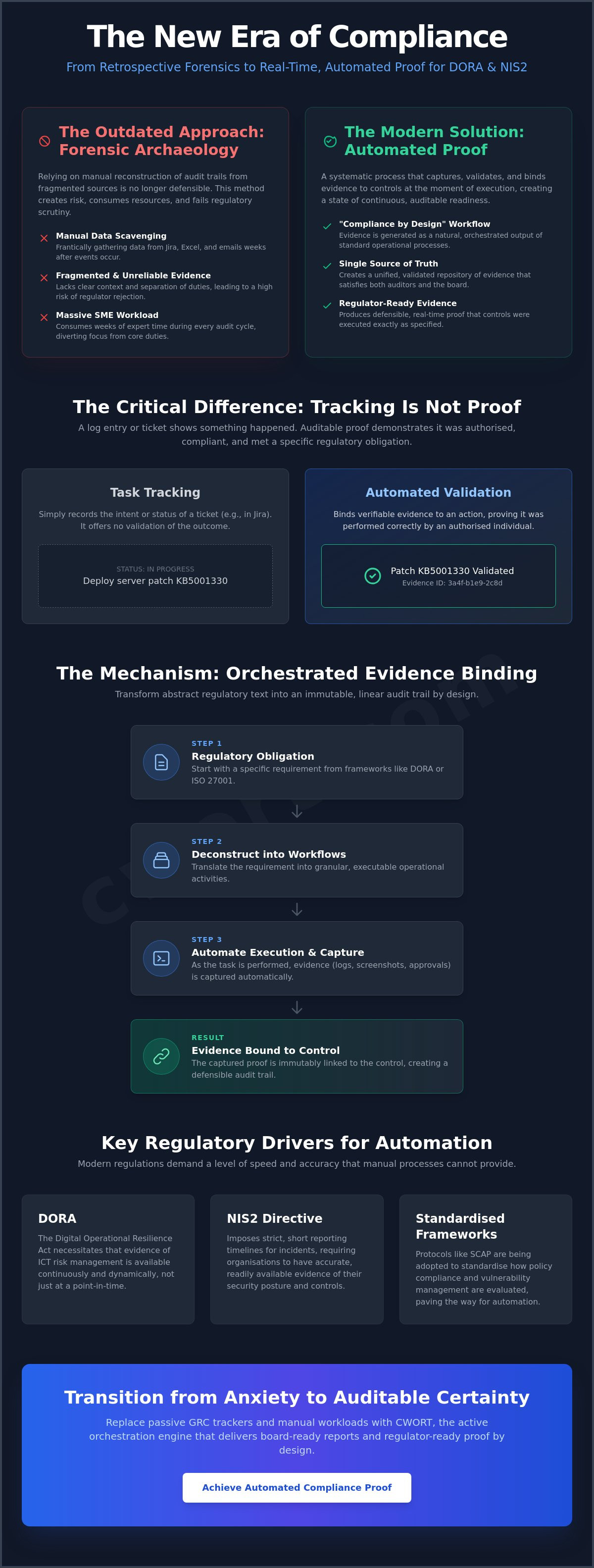
Stop treating compliance as a retrospective forensic project. In 2026, regulators like the FCA and PRA have moved beyond accepting spreadsheets as valid evidence. Automated compliance proof generation is the systematic process of capturing, validating, and binding evidence to specific regulatory control outcomes at the moment of execution. It replaces the frantic data scavenging that usually precedes an audit with a disciplined, "Compliance by Design" workflow. This transition ensures that your organisation is not just tracking tasks, but generating a defensible reality that satisfies high-stakes oversight.
Whilst many organisations believe their system logs constitute proof, there's a significant gap between raw data and auditable evidence. A log entry shows that something happened; auditable proof demonstrates that what happened was authorised, performed by the correct individual, and met the specific criteria of a regulatory obligation. This shift to automated compliance proof generation is no longer optional. With the Digital Operational Resilience Act (DORA) in full application since January 2025, the requirement for continuous readiness has replaced the era of point-in-time snapshots. Regulators now expect evidence to be as dynamic as the risks you manage.
The Critical Difference Between Tracking and Validation
Tracking a task in a tool like Jira merely records the intent or the status of a ticket. It doesn't constitute regulatory proof of a control outcome. Validation, however, ensures that the evidence is both authentic and contextually relevant to the control being tested. By integrating automated validation into your existing workflows, you eliminate the evidence gap that occurs when SMEs are forced to reconstruct events from memory or fragmented emails. This orchestrated approach ensures that every action taken within the enterprise is automatically bound to a verified outcome, leaving no room for ambiguity during an audit cycle.
Regulatory Drivers for Automation: DORA, NIS2, and UK NIS
The regulatory environment has shifted towards a high-frequency, high-stakes reporting model. DORA technical standards necessitate that ICT risk evidence is available in real-time, whilst the NIS2 directive imposes strict reporting timelines that manual processes simply cannot meet. To maintain integrity, organisations are increasingly adopting frameworks like the Security Content Automation Protocol (SCAP) to standardise how they evaluate policy compliance and vulnerability management. Compliance proof is the immutable link between a regulatory obligation and a verified execution activity. By moving away from passive GRC trackers and adopting an active orchestration engine like CWORT, leadership can replace audit-induced anxiety with the calm of auditable certainty.
The Mechanism of Orchestrated Evidence Binding
Effective compliance is not a byproduct of data collection. It is the deliberate result of orchestrating execution so that evidence is generated as a natural output of a process. This requires a proactive and continuous approach to automated compliance where regulatory obligations are no longer treated as abstract legal text. Instead, they must be translated into granular, executable activities. By doing so, you ensure that every digital artefact, from a system configuration log to a signed approval, is bound directly to the control outcome it supports.
Evidence binding is the critical bridge between action and proof. It creates a linear, immutable audit trail that tells a coherent story of governance. Unlike traditional methods that rely on manual retrospective gathering, automated compliance proof generation ensures that the link between an obligation and its verified execution is established at the point of origin. This methodology prevents the common industry pitfall of having data without context, which frequently leads to regulator rejection during high-stakes reviews.
Mapping Obligations to Execution Workflows
To achieve auditable certainty, you must deconstruct complex requirements from DORA or ISO 27001 into daily operational tasks. Every activity requires a defined owner, a separate validator, and a specific evidence requirement. This structure enforces a rigorous Separation of Duties (SoD) automatically at the point of execution. If the system detects that the person performing the task is also trying to validate it, the process is halted. This level of regulatory compliance workflow automation ensures that your internal controls are not just theoretical policies, but enforced realities.
Automated Validation vs. Manual Sampling
Manual sampling is a high-risk strategy that leaves your organisation vulnerable to hidden control failures. Regulators increasingly prefer 100% population testing, as it provides a complete picture of operational resilience. Automation allows for the continuous validation of every single control instance, rather than a small percentage. This transition reduces audit fatigue by removing the need for SMEs to manually verify repetitive steps. It shifts the focus from administrative box-ticking to strategic risk management. To see how this orchestration functions in a live environment, you may request a demonstration of the CWORT engine.
Why "Compliance as Code" is Only Half the Solution
Relying solely on "Compliance as Code" creates a dangerous illusion of total coverage. Whilst technical automation excels at verifying cloud configurations or firewall rules, it remains blind to the human-centric controls that form the backbone of corporate governance. Regulators do not just care about your encrypted databases. They demand proof of strategic oversight, qualitative third-party risk management, and evidence that senior leadership is actively managing resilience. Technical scripts cannot validate whether a board meeting was effective or if a vendor assessment was sufficiently rigorous. They lack the context of intent and accountability.
A purely technical approach often leaves a significant "governance gap" that auditors will inevitably exploit. This is why automated compliance proof generation must evolve into a hybrid model. It requires a system that orchestrates human validation with the same rigour as technical checks. You might already have automated security tools, but a SIEM or a vulnerability scanner provides raw data, not an auditable proof of process. True resilience requires an engine that binds these disparate technical outputs to the specific regulatory obligations they are intended to satisfy.
Bridging the Gap Between IT Ops and Corporate Governance
Technical outputs in formats like JSON or YAML are useless to a non-technical auditor or a board member. You must translate these machine-readable results into board-level intelligence that demonstrates clear compliance status. Recent academic research on AI-powered compliance emphasises the importance of document-backed answers and source citations to build a trusted repository of evidence. This level of transparency is vital for ensuring compliance evidence integrity across the entire organisation. It ensures that every stakeholder, from the DevOps engineer to the Chief Risk Officer, is working from a single, verified narrative.
Maintaining Evidence Integrity in Hybrid Environments
Modern enterprises operate across a fragmented landscape of cloud, on-premise, and legacy systems. This complexity often leads to "shadow compliance," where different teams adopt varying automation standards, creating a disjointed and indefensible audit trail. You must centralise automated compliance proof generation into a single, orchestrated repository to maintain structural integrity. This prevents the fragmentation of evidence and ensures that your compliance posture is consistent across all environments. By enforcing a unified standard of proof, you replace the chaos of manual tracking with a disciplined, central source of truth that is always ready for regulatory scrutiny.
Building a Regulator-Ready Evidence Repository
Constructing a repository that withstands regulatory scrutiny requires more than just a storage folder. It demands a disciplined architecture where evidence is standardised for cross-framework usability, allowing you to map a single proof point from DORA to ISO 27001 seamlessly. Through automated compliance proof generation, you establish a system of record that includes automated version control and enforced Separation of Duties (SoD) by design. This ensures that every artefact is authentic, untampered, and immediately accessible. Providing regulators with secure, real-time dashboards significantly reduces the friction of an audit cycle, as it allows them to self-serve evidence without disrupting your operational teams.
A centralised repository eliminates the chaos of "shadow compliance" where different departments maintain their own disjointed records. By enforcing a single standard of truth, you ensure that your evidence is always auditor-ready, regardless of which framework is being tested. This orchestrated approach moves the organisation away from reactive document gathering and towards a state of continuous, defensible readiness.
Step 1: Define the Control Outcome and Evidence Requirements
Precision is the first step toward auditable certainty. You must identify exactly what "good" looks like for every regulatory obligation before you begin collecting data. This involves determining the precise digital artefacts, such as configuration snapshots or timestamped logs, required to prove the outcome. The value of evidence lies in its ability to prove a specific control was effective at a specific time. Without this clarity, you risk collecting noise rather than proof that satisfies a regulator's rigorous standards.
Step 2: Automate the Collection and Binding Process
Once requirements are defined, your orchestration engine must integrate directly with your technical stack. By pulling raw data from tools like Jira, GitHub, and your SIEM, the system binds that data to the relevant control activity automatically. This removes the possibility of human error or unauthorised manipulation. For a comprehensive list of standard requirements, refer to this enterprise compliance evidence management checklist to ensure your artefacts meet the highest regulatory standards.
Step 3: Generate Board-Level and Auditor-Ready Outputs
The final stage is the automated production of compliance status reports for the board. These documents must be structured to align with specific auditing frameworks, providing a clear, linear audit trail that includes all necessary approvals and validations. This level of transparency replaces board-level anxiety with the confidence of verified data. Automated compliance proof generation ensures that these reports are not just static snapshots, but living documents that reflect your current resilience posture. To see how you can build a defensible evidence repository for your organisation, book a consultation and demo today.
CWORT: The Enterprise Engine for Automated Compliance Proof
Stop managing compliance through passive observation. Traditional GRC tools often act as little more than glorified spreadsheets, requiring manual updates and constant human intervention to remain relevant. CWORT fundamentally shifts this dynamic by functioning as an active "Obligation Execution" engine. It replaces fragmented trackers with a single orchestrated validation system that enforces discipline by design. Instead of hoping your controls are effective, you deploy a system that ensures they are executed, validated, and documented in real-time. This transition moves your organisation from a state of perpetual audit anxiety to one of auditable certainty.
The strategic advantage of this approach lies in the concept of "Defensible Truth." In high-stakes regulatory environments, having data isn't enough; you must have proof that withstands the most rigorous scrutiny. Automated compliance proof generation through CWORT ensures that every piece of evidence is bound to a specific regulatory requirement at the point of origin. This eliminates the need for "audit fire drills" and manual reconstruction, allowing your leadership to present a definitive, evidence-based reality to regulators and the board without hesitation.
Replacing Spreadsheets with Orchestrated Validation
Manual labour is the greatest bottleneck in modern compliance. SMEs and compliance teams often spend weeks scavenging for evidence across disparate systems, a process that's both inefficient and prone to error. CWORT eliminates this burden by enforcing accountability through automated workflows. It ensures that every task has a verified outcome and a clear separation of duties, preventing the "evidence gaps" that lead to regulatory rejection. For financial entities, this level of rigour is essential for DORA compliance validation, ensuring that operational resilience is a proven fact rather than a policy statement.
Future-Proofing Your Compliance Strategy for 2026
The regulatory landscape is accelerating, and 2026 represents a critical milestone for digital oversight. With the DORA Register of Information (ROI) submission deadline approaching in March 2026 and the EU AI Act enforcement beginning in August 2026, the era of manual tracking is officially over. You need a system that scales as your organisation grows and as new technical standards emerge. By centralising your automated compliance proof generation now, you ensure that your framework is robust enough to handle the next wave of UK and EU regulations. Don't wait for a failed audit to modernise your infrastructure. Contact CWORT today to see how we transform abstract obligations into a concrete, defensible reality.
Achieving Auditable Certainty in a High-Stakes Regulatory Landscape
The transition from manual tracking to automated compliance proof generation is a strategic imperative for any organisation facing the rigours of DORA, NIS2, or ISO 27001. You've seen how fragmented evidence collection creates indefensible gaps and why purely technical solutions fail to address the complexities of corporate governance. By orchestrating your execution workflows, you replace the anxiety of potential failure with the calm of validated, regulator-ready evidence. This disciplined approach ensures that your compliance posture is always based on defensible truth rather than retrospective narratives.
Developed by Lapace Services UK Ltd, CWORT is the active engine used by regulated UK enterprises to eliminate manual audit preparation and enforce structural integrity across the enterprise. It's time to move beyond passive GRC tools and adopt a system that generates proof by design. Establish a single source of truth that satisfies both the board and the regulator whilst freeing your SMEs from the burden of evidence scavenging. Secure your operational resilience and maintain total control over your regulatory obligations.
Request a CWORT Demo: Generate Regulator-Ready Proof Today
Frequently Asked Questions
What is the difference between compliance automation and automated proof generation?
Compliance automation typically focuses on executing technical tasks, whilst automated compliance proof generation focuses on the defensible result. It binds technical outputs to specific regulatory obligations, ensuring that every action is validated and timestamped for an auditor. This distinction shifts the focus from merely performing an activity to providing a definitive, auditable proof of its outcome.
Can automated compliance proof be used for DORA audits?
Yes, automated proof is essential for satisfying DORA's strict ICT risk management and reporting standards. Since January 2025, financial entities have been required to provide real-time, validated evidence of their operational resilience. Automated systems ensure this data is always available and regulator-ready, reducing the risk of evidence being rejected during high-stakes reviews.
How does automated proof generation handle "Separation of Duties"?
Orchestrated systems enforce Separation of Duties (SoD) by design within the execution workflow. The system automatically prevents a single individual from both performing a control activity and validating its outcome. This creates a hard-coded barrier that satisfies one of the most common regulatory requirements for internal control integrity and accountability.
Is it possible to automate evidence collection from legacy on-premise systems?
Automation is achievable across hybrid environments, including legacy on-premise systems. By utilising secure connectors and API integrations, the orchestration engine pulls raw data from legacy logs and binds it to modern control outcomes. This ensures a single source of truth exists across the entire enterprise infrastructure, regardless of its age.
How do regulators view automated compliance evidence compared to manual reports?
Regulators increasingly view automated evidence as superior to manual reports because it is immutable and less susceptible to retrospective manipulation. Manual spreadsheets are often perceived as unreliable forensic reconstructions. Automated proofs provide a timestamped, linear audit trail that demonstrates continuous compliance rather than an easily manipulated point-in-time snapshot.
Does automated compliance proof generation replace the need for internal auditors?
It doesn't replace internal auditors; it transforms their role from data scavengers to strategic risk analysts. By automating the repetitive task of evidence gathering, auditors can spend their time evaluating the effectiveness of the control framework. This increases the overall professional maturity of the governance function whilst reducing audit fatigue.
How long does it take to implement an automated compliance proof system?
Implementation timelines depend on the volume of controls and the complexity of your technical stack. Most organisations can establish core orchestration for priority frameworks like DORA or NIS2 within a few weeks. This rapid deployment allows teams to begin replacing fragmented manual trackers with validated evidence almost immediately.
What types of evidence can be automatically bound to control outcomes?
A wide range of digital artefacts can be bound to control outcomes, including system logs, configuration snapshots, and signed approvals. Metadata from CI/CD pipelines and vulnerability scan results are also commonly used. The system ensures these artefacts are contextually linked to the specific regulatory obligation they were designed to support.

Article by
Michael Iyiola
Michael Iyiola is a cybersecurity and AI engineering specialist with deep experience in vulnerability management, detection engineering, and operational resilience. At CWORT, he designs scalable, evidence‑driven workflows that help teams meet modern regulatory and security demands.
Disclaimer
The content on this site is provided for general information and educational purposes only. It does not constitute legal, regulatory, financial, or professional advice. CWORT provides AI‑assisted insights and workflow automation, but all compliance decisions remain the responsibility of your organisation and its management. Always seek qualified legal or regulatory guidance for decisions relating to DORA, NIS2, ISO 27001, CAF, or other obligations.