
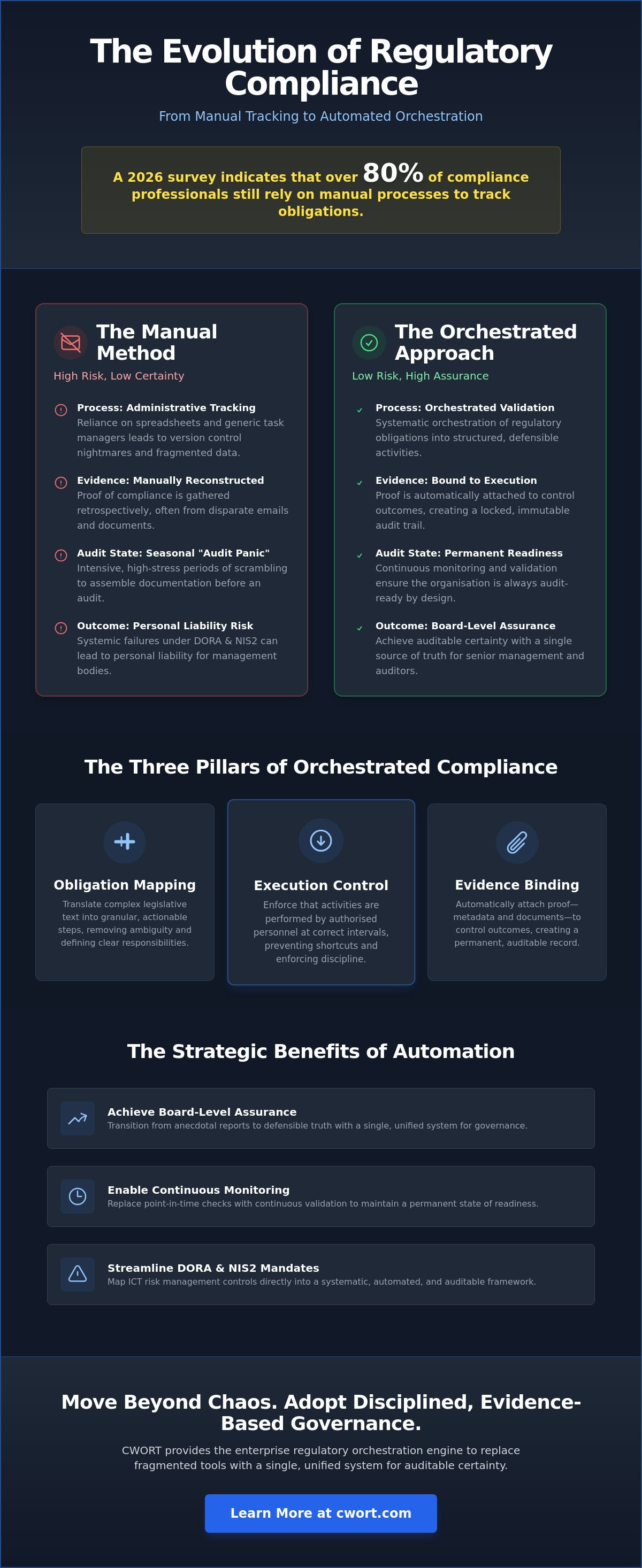
A 2026 survey indicates that over 80% of compliance professionals still rely on manual processes and spreadsheets to track obligations. This reliance persists despite the active enforcement of DORA and NIS2, where management bodies now face personal liability for systemic failures. Implementing regulatory compliance workflow automation is no longer an operational luxury. It's a strategic necessity for any UK enterprise that requires auditable certainty over mere administrative tracking.
You've likely experienced the fatigue of version control nightmares and the anxiety of manual document reconstruction during high-stakes audits. These manual methods fail because they lack traceability between a regulatory obligation and its execution. We'll show you how to transition to orchestrated validation, ensuring your compliance workflows are audit-ready by design. This guide outlines the path to reducing administrative burdens whilst establishing a single source of truth for board-level reporting. Move beyond the chaos of fragmented data and adopt a disciplined, evidence-based approach to governance.
Key Takeaways
- Transition from passive administrative tracking to orchestrated validation, ensuring every regulatory requirement is met with concrete, defensible evidence.
- Leverage regulatory compliance workflow automation to bridge the evidence gap created by manual spreadsheets and generic task management software.
- Establish board-level assurance through continuous monitoring, replacing seasonal audit anxiety with a permanent state of readiness and total traceability.
- Streamline the execution of DORA and NIS2 mandates by mapping ICT risk management controls directly into a systematic, automated framework.
- Minimise administrative friction whilst enforcing a disciplined governance structure that supports senior management accountability and strategic oversight.
What is Regulatory Compliance Workflow Automation?
Regulatory compliance workflow automation is the systematic orchestration of regulatory obligations into structured, defensible execution activities. It represents a fundamental shift from passive record-keeping to active enforcement. Whilst traditional methods focus on recording that a task occurred, an orchestrated system ensures that every action aligns with a specific regulatory requirement. This distinction is critical. Task tracking merely monitors activity; validated execution proves compliance through a locked, immutable audit trail.
By 2026, the regulatory landscape has undergone a significant transformation. Authorities enforcing mandates such as DORA and NIS2 no longer accept retrospective, self-certified summaries as sufficient proof of resilience. They demand real-time visibility into control effectiveness. This shift is a central pillar of Regulatory technology (RegTech), where software is used to enhance governance through precision and transparency. Enterprises must move away from reactive manual checks. They must adopt proactive, automated control mapping that binds every operational action to a regulatory obligation.
The Core Components of an Orchestrated Workflow
Effective regulatory compliance workflow automation relies on three foundational pillars that transform abstract rules into concrete reality:
- Obligation Mapping: This process involves translating complex legislative text into granular, actionable steps. It removes ambiguity, ensuring every team member understands their specific role in maintaining the compliance posture.
- Execution Control: This component ensures that activities are performed by authorised personnel at the correct intervals. It enforces discipline by design, preventing the shortcuts that often lead to audit failures.
- Evidence Binding: Unlike manual systems, an orchestrated engine automatically attaches proof to the control outcome. When a task is completed, the metadata and supporting documentation are instantly linked, creating a permanent record for auditors.
Why Traditional GRC Tools Fall Short
Many legacy Governance, Risk, and Compliance (GRC) platforms function as little more than digital filing cabinets. They suffer from the "data silo" problem, where evidence of compliance lives in a separate system from the controls themselves. This fragmentation forces teams into a state of "audit panic" as they scramble to reconstruct events months after they occurred. These systems also lack the hard-coded enforcement required to ensure a proper separation of duties.
A superior alternative is a dedicated orchestration engine. By using a platform like CWORT, UK enterprises can replace fragmented tools with a single, unified system. This approach ensures that compliance is not an afterthought but a built-in feature of the operational workflow. It replaces the uncertainty of manual oversight with the absolute rigour of automated validation.
The Strategic Benefits of Automating Compliance Workflows
Strategic leadership requires more than just a passing grade from auditors. It demands board-level assurance that is rooted in evidence rather than anecdotal reports. Whilst many organisations view automation as a tool for speed, its true value lies in its ability to enforce a state of "defensible truth". Implementing regulatory compliance workflow automation transforms compliance from a periodic burden into a continuous, business-as-usual function. This shift is essential for UK enterprises facing the stringent demands of DORA and NIS2, where the first NIS2 compliance audit deadline of 30 June 2026 has created a sense of strategic urgency amongst critical infrastructure providers.
Eliminate the recurring phenomenon of "audit panic". By replacing manual, point-in-time checks with continuous validation, you ensure that your controls are always operational. This proactive stance significantly reduces operational risk. It enforces a strict separation of duties by design, ensuring that no single individual can both execute and validate a control. This structural integrity is what regulators now expect. It moves the organisation away from fragile, person-dependent processes toward a robust, system-enforced culture of accountability.
Achieving Auditable Certainty by Design
Automated workflows produce regulator-ready outputs without the need for manual intervention or document reconstruction. Stop wasting hours searching through fragmented email chains to prove a control was met. Instead, rely on a permanent, immutable audit trail that binds evidence directly to the regulatory requirement at the moment of execution. This level of transparency provides the calm of auditable certainty that only regulatory compliance workflow automation can deliver. It replaces the inherent risks of "reconstructing" history with the absolute confidence of a real-time record.
Operational Efficiency and Resource Allocation
Automation liberates your Subject Matter Experts (SMEs). When you remove the administrative burden of tracking tasks across spreadsheets, your most valuable personnel can focus on high-level risk strategy and resilience planning. This reduction in "compliance fatigue" is vital for maintaining employee engagement and accuracy. An orchestrated engine allows you to manage multiple frameworks, such as ISO 27001 and NIS2, within a single environment. You can map overlapping controls once and execute them across various mandates, which drastically increases your organisational scalability. To see how this orchestration functions in practice, you can explore our compliance validation platform.
Why Jira and Spreadsheets Fail Regulatory Audits
Relying on legacy tools for high-stakes governance is a high-risk strategy. Whilst spreadsheets and Jira are ubiquitous in the corporate environment, they were never designed to meet the rigorous evidence standards of 2026 regulators. A survey from February 2026 indicates that over 80% of compliance professionals still rely on these manual processes to track obligations. This inertia creates a dangerous "Evidence Gap" where the claim of compliance is entirely disconnected from the proof of execution. For firms under the scope of DORA or NIS2, treating Jira for compliance vs orchestration is a gamble that risks significant financial penalties and personal liability for senior management.
Manual trackers lack the structural integrity required during a high-stakes audit. They provide no automated enforcement of controls and offer no inherent way to prove that a specific action was taken by the correct individual at the mandated time. True regulatory compliance workflow automation requires a system that binds evidence to the control outcome at the moment of execution. Without this link, your compliance posture is merely a set of unsubstantiated claims that will crumble under regulatory scrutiny.
The Fragility of the Spreadsheet Model
Spreadsheets are inherently fragile. They are prone to human error, formula corruption, and accidental deletion, any of which can invalidate months of tracking effort. Beyond these operational risks, spreadsheets fail the "chain of custody" test. They don't provide a verifiable, immutable timestamp for evidence. Regulators are increasingly rejecting manual trackers because they can be edited retrospectively. If you can't prove that your data hasn't been tampered with, it doesn't count as evidence. This lack of immutability makes manual tracking a liability rather than an asset.
Jira: A Task Tool, Not a Validation Engine
The #1 industry misconception is that Jira is a compliance tool. It isn't. Jira is a productivity platform designed to track "completion," but compliance requires "validation." A ticket marked as "Done" tells an auditor nothing about whether the control was effective or if the person who completed it had the proper authority. Standard ticketing systems struggle to enforce a strict separation of duties, making it difficult to prove that execution and validation were handled by different parties. Enterprises require a dedicated regulatory obligation execution workflow that enforces these rules by design. Regulatory compliance workflow automation ensures that every step is authorised, validated, and recorded in a way that Jira simply cannot replicate.
Implementing Workflow Automation for DORA and NIS2
The period for theoretical planning has ended. With the NIS2 transposition deadline having passed in October 2024 and DORA fully enforceable since January 2025, UK enterprises must now demonstrate functional resilience. Transitioning to regulatory compliance workflow automation requires a disciplined roadmap that maps ICT risk management requirements directly into an orchestrated engine. This approach creates a powerful synergy between DORA compliance validation and daily operations. It ensures that every resilience requirement is not just a policy on paper but a verified action in a defensible system. Evidence-based validation is now the baseline for NIS2 compliance, as firms approach their first mandatory audit deadline on 30 June 2026.
Execution must be precise and accountable. You cannot rely on manual oversight to manage the complex interdependencies of these new frameworks. Instead, use an orchestration engine to enforce the rigorous standards required by the FCA and PRA. This shift replaces the anxiety of potential failure with the calm of auditable certainty. It allows your organisation to maintain a permanent state of readiness, even as regulatory expectations continue to evolve. To ensure your infrastructure meets these standards, you can request a platform demonstration.
Mapping Obligations to Execution Activities
Success begins by decomposing complex legislative text into discrete, actionable tasks. This process removes the ambiguity that often leads to control failure. Start by identifying specific regulatory obligations and translating them into clear execution steps. Assign these tasks to the appropriate Subject Matter Experts (SMEs) whilst maintaining central oversight through a unified dashboard. Every activity must have a pre-defined evidence requirement. This ensures that when a task is completed, the necessary proof is captured immediately and bound to the control outcome. This level of granularity is essential for proving compliance to an auditor without the need for retrospective document reconstruction.
Enforcing Separation of Duties (SoD)
Modern regulators view the Separation of Duties (SoD) as a non-negotiable standard for operational integrity. Automation prevents the high-risk practice of "self-validation," where the individual performing a control also confirms its success. By integrating SoD directly into your regulatory compliance workflow automation system, you enforce an objective verification process. The system ensures that the person executing a task is never the person signing off on its validity. This hard-coded discipline provides the objective proof required for board-level assurance. It eliminates the potential for human error or internal bias, creating a robust and defensible audit trail that satisfies the most demanding regulatory bodies.
CWORT: The Enterprise Regulatory Orchestration Engine
For UK enterprises, the transition to regulatory compliance workflow automation is the definitive step toward operational resilience. CWORT serves as the logical conclusion for leadership teams seeking auditable certainty over mere administrative tracking. It replaces the inherent instability of fragmented spreadsheets and generic task tools with a singular, high-integrity orchestration engine. By centralising governance, the platform enables the automatic generation of board-level, audit-ready outputs that reflect the real-time status of your controls. This approach ensures that your organisation moves beyond the "audit panic" described earlier, establishing a disciplined culture of evidence based compliance management.
Execution must be defensible. Fragmented systems fail because they cannot prove a chain of custody for evidence. CWORT solves this by hard-coding accountability into every stage of the workflow. It enforces a state of total assurance where every regulatory requirement is backed by a validated, system-generated record. This level of rigour is essential for meeting the expectations of the FCA, PRA, and other UK regulatory bodies who now demand proof over promises.
From Obligation to Auditable Proof
The CWORT workflow is designed with a linear, uncompromising logic. Every regulatory obligation is mapped to a specific activity, which is then subjected to rigorous validation before the resulting evidence is bound to the record. This sequence creates an immutable audit trail that requires no manual reconstruction. Whether you are managing the UK NIS Framework, performing an NCSC CAF assessment, or maintaining ISO 27001 control mapping, the engine enforces compliance by design. It ensures that every piece of evidence is captured at the point of execution, providing a defensible truth that satisfies both internal auditors and external regulators.
Strategic Partnership for UK Enterprise
CWORT is more than a utility. It is a strategic partner that enforces accountability amongst your senior management and operational teams. By adopting a compliance orchestration platform, you shift the focus from administrative tracking to genuine strategic resilience. This transition is vital in an era where personal liability for management bodies is a concrete reality under DORA and NIS2. Stop relying on fragile, person-dependent processes. Adopt a system that proactively enforces discipline and provides the security of auditable certainty. Request a CWORT demonstration to validate your compliance posture and secure your organisation's regulatory future.
Securing Your Regulatory Future Through Orchestration
Manual tracking is a significant liability in an era of personal liability and active enforcement. We've established that transitioning to regulatory compliance workflow automation replaces the fragility of spreadsheets with the rigour of validated execution. This shift ensures your organisation is fully prepared for the 30 June 2026 NIS2 audit deadline and the continuous resilience mandates of DORA. You can finally replace the anxiety of "audit panic" with the calm of auditable certainty.
It's time to move beyond the limitations of generic productivity tools that lack structural integrity. Enforce a strict separation of duties by design and generate regulator-ready outputs without the need for manual reconstruction. Reclaim control over your governance posture by adopting a system that prioritises evidence over administrative promises. Orchestrate your regulatory validation with CWORT to replace Jira and Excel with definitive, auditable proof. You're now equipped to lead your organisation toward a state of total assurance and strategic resilience.
Frequently Asked Questions
What is regulatory compliance workflow automation?
Regulatory compliance workflow automation is the systematic orchestration of legal and regulatory obligations into structured, executable activities that generate verifiable proof. It moves beyond simple task tracking by enforcing the execution of specific controls and automatically capturing the necessary evidence. This ensures that every compliance requirement is linked to a defensible action, providing a permanent and immutable audit trail for the organisation.
How does automation help with DORA and NIS2 compliance?
Automation converts the complex ICT risk management mandates of DORA and NIS2 into granular, recurring workflows that enforce discipline by design. It ensures that the Digital Operational Resilience Act’s requirements for continuous monitoring are met through system-enforced validation rather than manual checks. By hard-coding these obligations into daily operations, UK enterprises avoid the high-risk gamble of attempting to reconstruct evidence during a live regulatory audit.
Can I use Jira for regulatory compliance workflow automation?
No, Jira is a productivity tool designed for general task management and lacks the technical rigour required for a validation engine. It cannot natively enforce a strict separation of duties or bind immutable evidence to control outcomes in a way that satisfies 2026 regulatory standards. Relying on Jira creates a dangerous evidence gap, as it tracks task completion rather than the objective validity of the control itself.
What is evidence binding in compliance management?
Evidence binding is the process of automatically attaching proof of performance to a specific control outcome at the exact moment of execution. This creates a permanent, unalterable link between a regulatory obligation and the evidence of its fulfilment. It eliminates the risk of data tampering and ensures that auditors have immediate access to a verifiable chain of custody without requiring manual intervention.
How does automation improve board-level compliance reporting?
It provides a single source of truth by aggregating real-time data from across the enterprise into high-level, objective dashboards. Boards receive evidence-based reports that reflect the actual state of control effectiveness rather than subjective summaries or anecdotal updates. This transparency allows leadership to exercise informed oversight and fulfil their personal liability obligations under frameworks where management is held directly accountable for resilience failures.
Is spreadsheet-based compliance still acceptable to UK regulators?
Spreadsheets are increasingly viewed as a liability because they lack immutability and are prone to formula corruption and human error. Whilst many firms still utilise them, regulators now demand the auditable certainty that only automated systems can provide. A 2026 survey indicates that over 80% of compliance professionals acknowledge that manual processes are insufficient for the rigorous demands of active enforcement under NIS2 and DORA.
What is the difference between GRC automation and compliance orchestration?
GRC automation typically focuses on digitising existing records for reporting, whereas compliance orchestration actively enforces the execution and validation of controls. Orchestration drives accountability by ensuring that compliance is a built-in feature of operational activity rather than a retrospective administrative burden. It moves the organisation from passive data collection to a proactive state of system-enforced governance and defensible truth.
How long does it take to implement a compliance automation platform?
Implementation follows a structured, phased approach that begins with mapping core frameworks such as ISO 27001 or the NCSC CAF. Initial configuration and obligation mapping are typically achieved within weeks, followed by the systematic onboarding of specific operational workflows. The total duration depends on the complexity of the organisation’s infrastructure and the number of regulatory frameworks being integrated into the orchestration engine.

Article by
Michael Iyiola
Michael Iyiola is a cybersecurity and AI engineering specialist with deep experience in vulnerability management, detection engineering, and operational resilience. At CWORT, he designs scalable, evidence-driven workflows that help teams meet modern regulatory and security demands.
Disclaimer
The content on this site is provided for general information and educational purposes only. It does not constitute legal, regulatory, financial, or professional advice. CWORT provides AI-assisted insights and workflow automation, but all compliance decisions remain the responsibility of your organisation and its management. Always seek qualified legal or regulatory guidance for decisions relating to DORA, NIS2, ISO 27001, CAF, or other obligations.