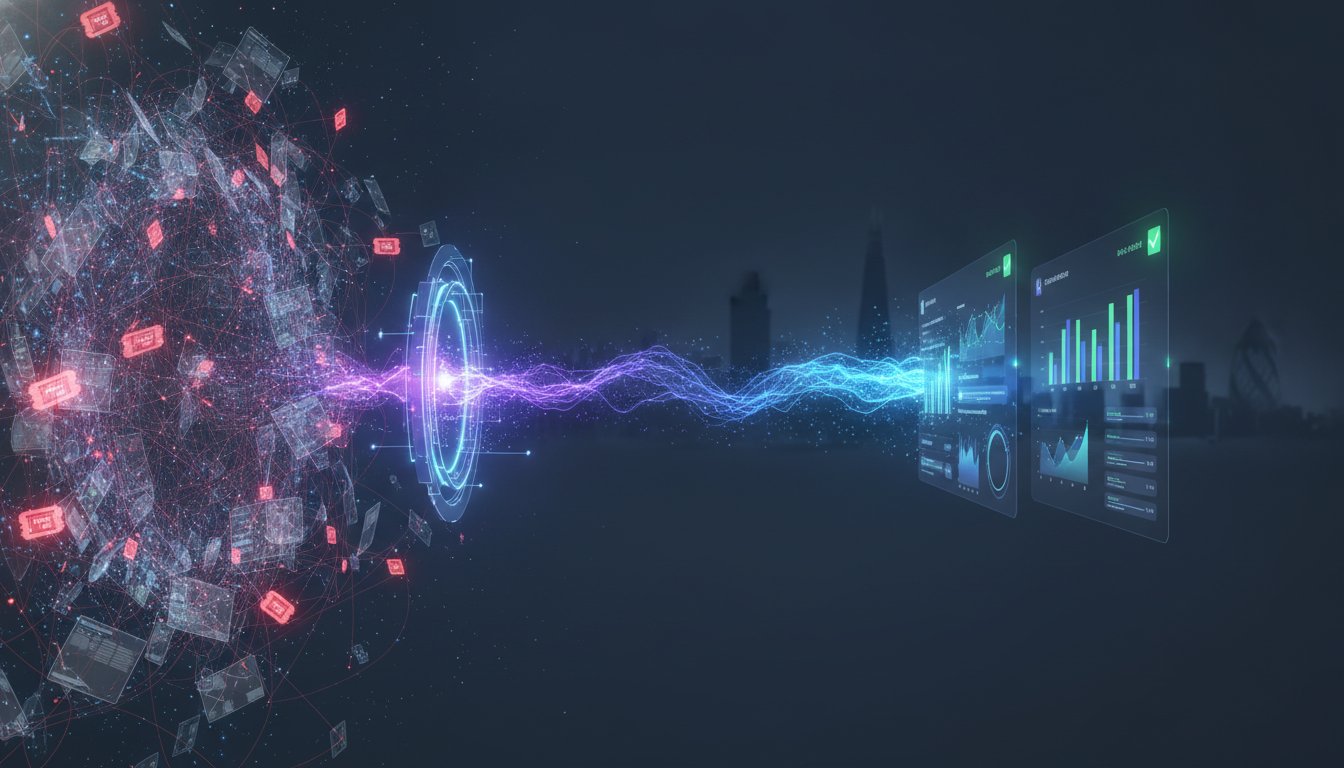

Why are you still treating ISO 27001 compliance as an annual event when your security threats operate in milliseconds? In 2026, relying on a frantic scramble of spreadsheets three weeks before an external audit isn't just inefficient; it's a strategic liability. You likely feel the mounting pressure of manual evidence gathering, where SMEs lose hours to administrative tasks and internal auditors struggle to prove control effectiveness. Deploying robust ISO 27001 compliance validation software is no longer a luxury, but a necessity for any organisation that values auditable certainty over the "green checkmark" fallacy.
Stop managing compliance through historical snapshots and start enforcing discipline by design. We agree that the traditional audit cycle is broken and fundamentally prone to human error. This article promises to show you how to transition from static observations to a dynamic, evidence-led monitoring framework that stands up to the most rigorous regulatory scrutiny. We'll examine the shift toward automated evidence repositories and real-time gap visibility, providing a clear roadmap to reduce manual labour whilst maintaining a defensible security posture that satisfies both the board and the auditor.
Key Takeaways
- Abandon the terminal "snapshot audit" model in favour of a real-time feedback loop that satisfies modern regulatory scrutiny.
- Master the transition from basic API automation to full orchestration for managing the 70% of controls that require human-centric validation.
- Eliminate "Watermelon Compliance" by deploying ISO 27001 compliance validation software that binds every control action to an immutable evidence trail.
- Build a robust monitoring framework by precisely mapping regulatory obligations to assets and defining specific validation frequencies for Annex A controls.
- Replace fragmented spreadsheets and tickets with a unified "execution-to-evidence" engine that ensures total auditable certainty.
Beyond the Annual Audit: Why Continuous Monitoring is Non-Negotiable in 2026
Audit cycles are no longer discrete events. In the high-stakes regulatory environment of 2026, the "Snapshot Audit" is in terminal decline. Regulators, boards, and supply chain partners no longer accept a static PDF as definitive proof of security. They demand a transparent, evidence-based reality. The transition to the ISO/IEC 27001 standard (2022 version) marked a fundamental pivot. It shifted the focus from administrative tracking to genuine operational effectiveness. You can't rely on manual heroics to bridge the gap between surveillance visits anymore.
Continuous compliance monitoring functions as a real-time feedback loop. It's the difference between hoping a control works and knowing it does. This shift requires a psychological transition. You must move from defensive compliance, where you hide weaknesses, to operational resilience, where you orchestrate certainty. Deploying ISO 27001 compliance validation software allows leadership to replace the anxiety of potential failure with the calm of auditable certainty. It moves the organisation from a state of "preparedness" to a state of permanent readiness. For leadership teams looking to master this transition, Formatour Incorporated provides the advisory expertise necessary to ensure strategic transformation and long-term organisational resilience.
The Risk of the "Compliance Gap"
ISO 27001:2022 and the Clause 9.1 Mandate
The 2022 update reinforced Clause 9.1, which mandates rigorous monitoring, measurement, analysis, and evaluation. You must define exactly "what" is being monitored and "when" the validation occurs for every Annex A control. This forces a move from qualitative assessments to quantitative validation. You can no longer say "we think it works"; you must say "we have the data". Using dedicated ISO 27001 compliance validation software ensures this mandate is met by design. It transforms abstract requirements into concrete, defensible reality through disciplined orchestration and automated evidence collection.
Orchestration vs Automation: Redefining ISO 27001 Compliance Workflows
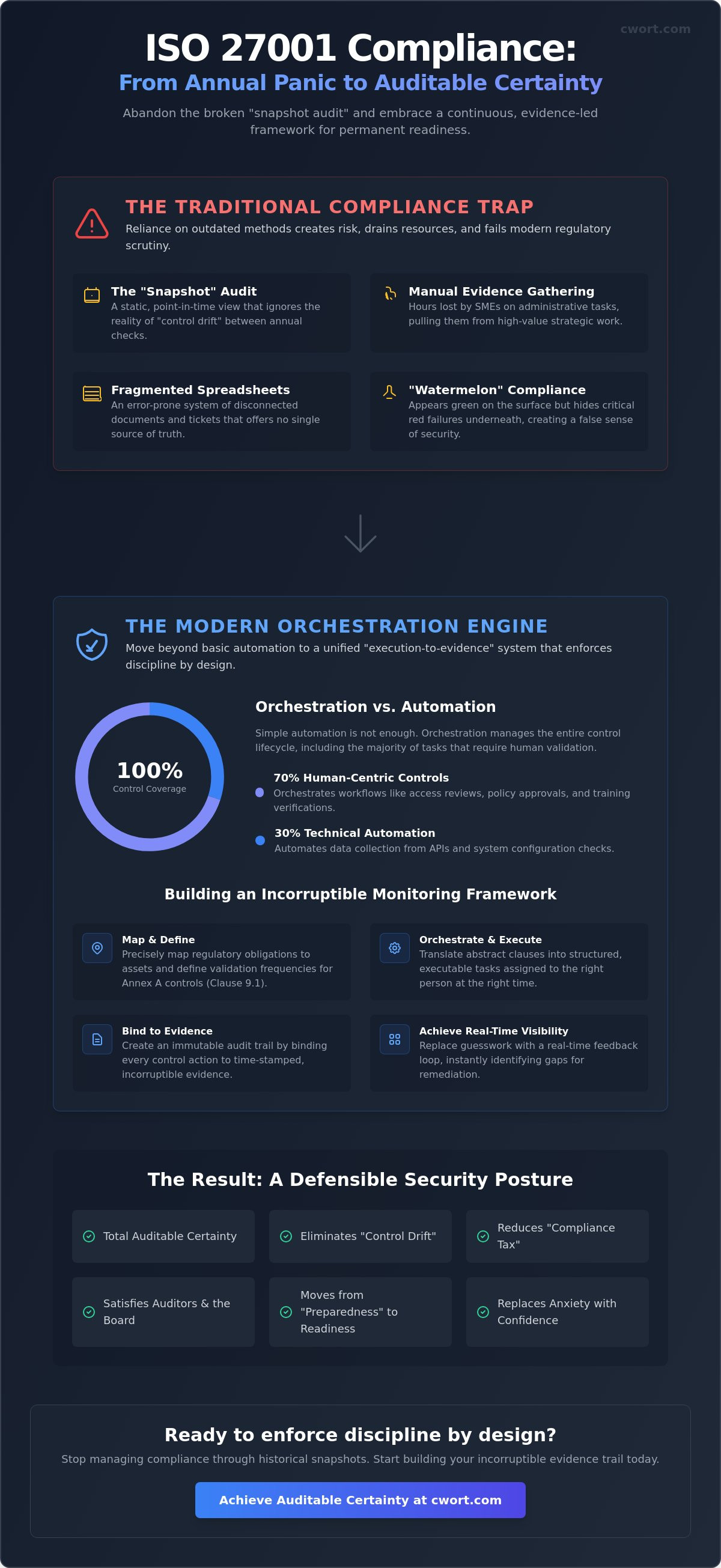
Automation is a commodity; orchestration is a strategy. Many organisations mistake basic API pulls for a complete solution. In reality, technical automation typically addresses only 30% of the ISO 27001 control landscape. The remaining majority includes human-centric processes, such as access reviews and policy approvals, which cannot be solved by a simple data pull. This is where ISO 27001 compliance validation software becomes a critical asset. It doesn't just observe data; it orchestrates the entire lifecycle of a control, ensuring that every required action is performed, validated, and recorded.
This methodology aligns with the core principles of Information Security Continuous Monitoring (ISCM). By moving beyond passive observation, you enforce a "Validation-First" culture that reduces the heavy "compliance tax" on technical teams. Instead of engineers losing days to manual evidence gathering, the system manages the workflow. It prompts the right person at the right time, tracks their response, and automatically generates the necessary audit trail. This transition replaces friction with flow, allowing your technical talent to focus on innovation whilst the system maintains the integrity of your security posture.
The Orchestration Engine: Turning Obligations into Activities
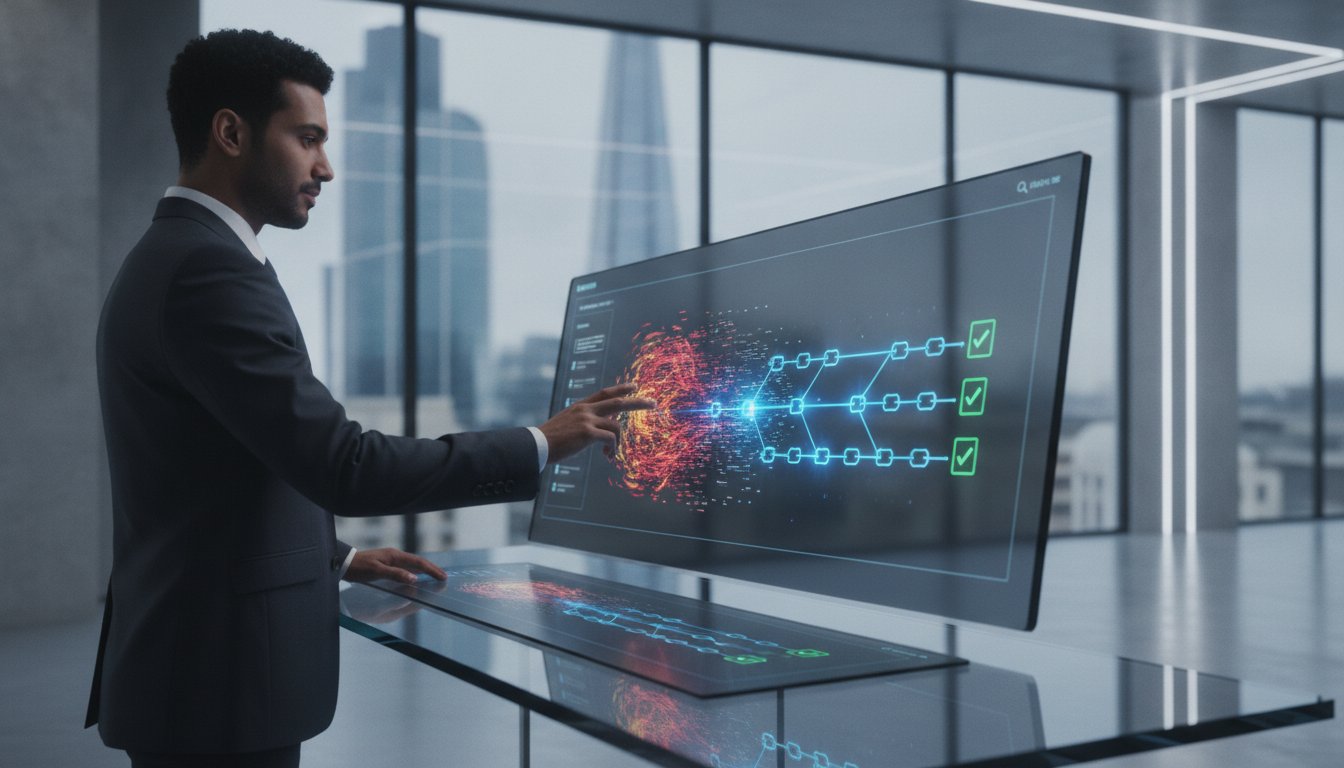
The engine functions by translating abstract ISO 27001 clauses into structured, executable tasks. Every obligation must be mapped to a specific activity with a defined frequency. If a control requires a monthly review of privileged accounts, the system triggers the task, logs the precise time-stamp of completion, and archives the evidence. This creates an incorruptible single source of truth. By integrating directly with your existing technical stack, the software ensures that compliance is a natural output of your daily operations rather than a separate, burdensome project.
Enforcing Separation of Duties (SoD) by Design
Manual trackers and spreadsheets are notoriously poor at preventing "maker-checker" conflicts. They often fail to provide the granular oversight needed to ensure the individual performing a control isn't the one validating it. Sophisticated ISO 27001 compliance validation software bakes Separation of Duties directly into the workflow. This is essential for meeting the rigorous standards required by DORA and UK NIS frameworks. It ensures that every action is verified by an independent party, providing the definitive proof that auditors expect. You can explore how orchestrated workflows can replace your manual trackers to achieve this level of auditable certainty.
The Evidence Gap: Why Passive Dashboards Fail Regulatory Scrutiny
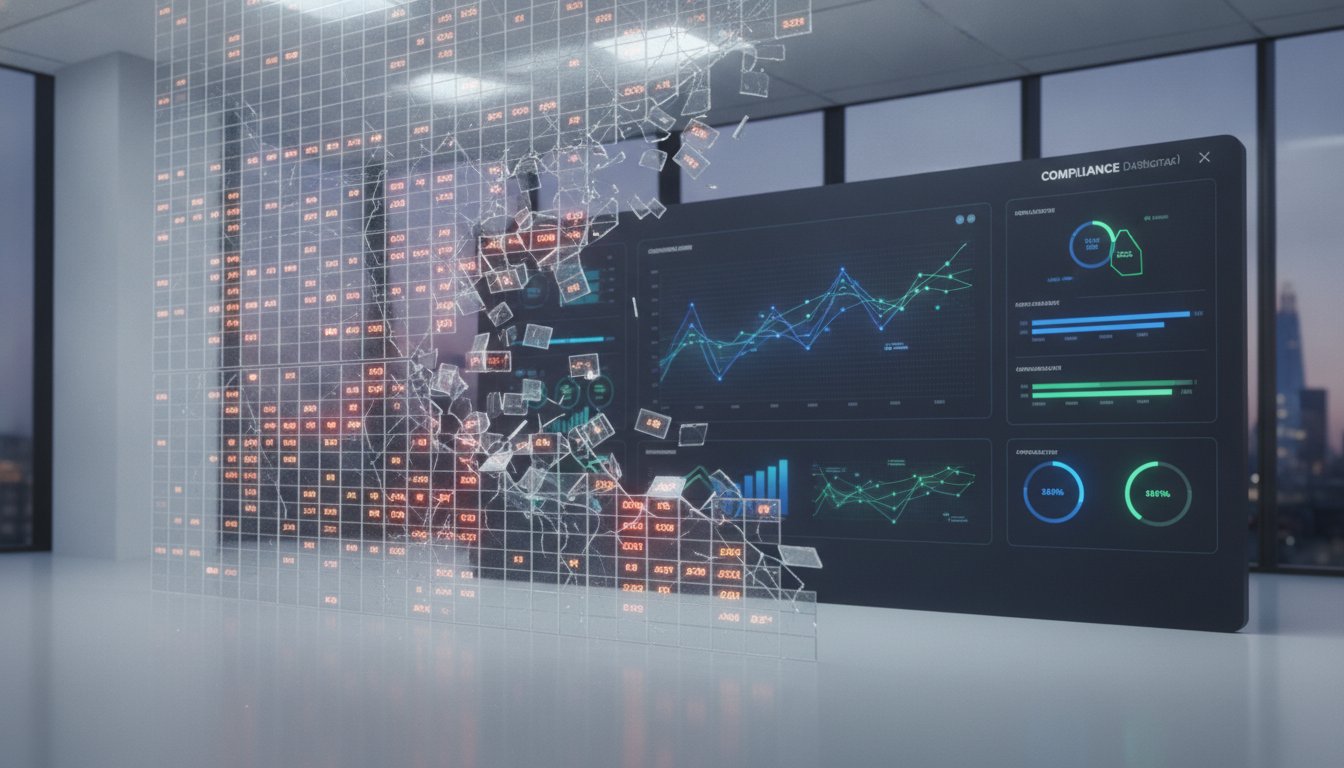
Dashboards are often decorative. They present a facade of security that masks underlying control failures. This is the danger of "Watermelon Compliance": a status that appears green on the surface but is fundamentally red on the inside. In high-stakes environments governed by UK NIS or DORA, a passive dashboard that relies on manual updates is a strategic liability. You need ISO 27001 compliance validation software that bridges the gap between a visual status and the raw, immutable evidence required for a 2026 audit. If your dashboard doesn't provide a direct link to the underlying proof, it isn't a management tool; it's a distraction.
The shift from "attestation" to "validation" is now mandatory. Simply saying you've performed a control is no longer sufficient for modern regulatory scrutiny. You must prove it happened with defensible data. This requires a transition from qualitative claims to quantitative evidence. An auditor should be able to navigate your repository and find the proof for any specific control within minutes. This level of transparency replaces the anxiety of the "manual reconstruction" phase with the calm of auditable certainty. It ensures your organisation is always ready for a surveillance visit without the need for a frantic last-minute scramble.
Binding Evidence to Control Outcomes
Evidence binding is the process of linking a compliance action directly to its record. In 2026, screenshots and static PDFs are no longer sufficient. They're too easy to manipulate and lack the necessary context. Modern auditors expect metadata-driven proof. They want to see the system logs, the precise time-stamps, and the digital signatures that confirm a control was active at a specific moment. By using ISO 27001 compliance validation software, you create an immutable audit trail. This ensures that every action is cryptographically bound to its outcome, providing a level of integrity that manual trackers cannot match.
Regulator-Ready vs Board-Level Reporting
Your reporting must satisfy two distinct audiences. Regulators demand granular technical proof. They want to see how your Statement of Applicability (SoA) maps to specific organisational assets and how those assets are protected. Conversely, the board requires high-level risk summaries that inform strategic decision-making. Orchestration allows you to automate the generation of both. It ensures that technical teams produce the granular evidence required for UK NIS or DORA alignment whilst the system distils that data into clear, objective insights for leadership. This dual-stream reporting removes the burden of manual report preparation and ensures total alignment across the organisation.
Building an Incorruptible ISO 27001 Monitoring Framework
- Step 1: Map obligations to assets. Don't just list your controls. Categorise every organisational asset by risk profile and regulatory significance to ensure your monitoring efforts are targeted where they matter most.
- Step 2: Define validation frequency. Establish a precise cadence for every Annex A control. Critical technical controls might require real-time validation, whilst personnel-related controls may only need quarterly reviews.
- Step 3: Establish the SoD matrix. Codify your Separation of Duties. Ensure the system prevents the "maker-checker" conflict by requiring independent validation for every compliance action.
- Step 4: Implement automated alerts. Shift from reactive remediation to proactive management. Configure the system to trigger immediate notifications when a control fails or an evidence gap is detected.
- Step 5: Conduct dry run audits. Stress test your framework. Use your continuous data stream to simulate an external audit, identifying systemic weaknesses before they become non-conformities.
Following this structured approach ensures that compliance is a consistent output of your operations. You can request a demo of our orchestration engine to see how these steps are unified into a single, defensible reality.
Customising Control Models for UK Enterprise
Generic templates are a liability for sophisticated UK organisations. They fail to account for the unique operational nuances and the specific rigour required for high-stakes environments. You must align your framework with local standards, specifically mapping your ISO 27001 controls to NCSC CAF requirements. This ensures your security posture scales alongside your growth and remains resilient against emerging regulations like UK NIS. Customisation isn't about complexity; it's about accuracy.
The Role of Internal Audits in a Continuous Cycle
Continuous monitoring transforms the role of the internal auditor. They are no longer administrative data gatherers; they become strategic risk analysts. By utilising specialised ISO 27001 internal audit software, your team can focus on evaluating control effectiveness rather than chasing evidence. This software supports the wider monitoring framework by providing a real-time view of the ISMS. It allows auditors to identify trends and systemic failures early, ensuring the organisation maintains a state of total assurance throughout the year.
CWORT: Validating ISO 27001 Control Effectiveness Through Orchestration
Stop wasting your technical talent on the administrative burden of fragmented Jira tickets and Excel sheets. These legacy tools were never designed to manage the complexity of a modern Information Security Management System (ISMS). CWORT functions as a unified orchestration engine that replaces manual tracking with a disciplined, automated workflow. By adopting ISO 27001 compliance validation software like CWORT, you shift the focus from mere administrative tracking to definitive, evidence-based proof. This is the only way to eliminate the "compliance tax" that currently drains your SMEs and internal auditors.
The core of the platform is the "Execution-to-Evidence" loop. This mechanism ensures that every compliance action is bound to an auditable outcome. When a control task is triggered, the system doesn't just record that it was assigned; it captures the output, validates the result, and archives the proof in an immutable repository. This loop ensures that no control exists in isolation. Every action is part of a continuous chain of evidence that demonstrates your security posture is active and effective every day of the year. This transition from passive observation to active orchestration is why leading UK enterprises are moving away from traditional GRC tools in favour of CWORT.
Board-level assurance is no longer a retrospective report based on historical data. CWORT provides leadership with real-time visibility into the actual effectiveness of your ISMS. Instead of waiting for an annual audit to discover control gaps, you see them as they occur. This transparency allows for immediate remediation, ensuring that your organisation remains resilient against emerging threats and regulatory shifts. It replaces the anxiety of potential failure with the calm of auditable certainty, providing a level of governance that satisfies both the board and the most rigorous external auditors.
Designed for Rigour, Built for Speed
Complexity shouldn't hinder execution. CWORT is engineered to handle the overlapping requirements of DORA, NIS2, and UK NIS alongside the ISO 27001 framework. The platform generates "Regulator-Ready" outputs that require zero manual editing, allowing your team to respond to information requests in minutes rather than days. Our professional implementation process ensures that your custom control model is correctly mapped from day one. This systematic approach guarantees that your framework is built for long-term structural integrity whilst delivering immediate operational speed.
Securing Your Future Compliance Posture
In a landscape of increasing corporate liability, having a defensible truth is a significant strategic advantage. CWORT reduces the total cost of compliance by automating the repetitive tasks that typically require hundreds of manual hours. More importantly, it increases the quality of your security by ensuring that controls are never bypassed or forgotten. You can request a CWORT demonstration to see orchestrated validation in action and discover how to transform your compliance from a burden into a competitive strength. CWORT stands as the definitive ISO 27001 compliance validation software for organisations that demand professional maturity and total assurance.
Advancing Toward Permanent Audit Readiness
The transition from a static, point-in-time audit to a dynamic monitoring framework is no longer optional. It's a strategic necessity for organisations navigating the high-stakes regulatory landscape of 2026. You've seen how passive dashboards fail under scrutiny and why orchestration is the only viable path to managing the human-centric controls that basic automation ignores. Implementing ISO 27001 compliance validation software ensures that every control is not just tracked, but rigorously validated and cryptographically bound to its outcome.
CWORT provides the definitive solution for UK enterprises. It orchestrates DORA, NIS2, and ISO 27001 within a single, unified platform whilst enforcing the strict Separation of Duties required by modern regulators. By replacing manual evidence gathering with automated, regulator-ready proof, you eliminate the anxiety of external audits and provide the board with total auditable certainty. It's time to replace fragmented spreadsheets with a disciplined system designed for rigour and built for execution.
Discover how CWORT orchestrates ISO 27001 validation for UK enterprises and secure your organisation's future security posture. Take control of your compliance journey today.
Frequently Asked Questions
What is the difference between ISO 27001 automation and orchestration?
Automation is a passive data pull that typically addresses technical configurations, whilst orchestration is a proactive workflow engine. Automation might verify a single setting via API, but orchestration manages the entire lifecycle of a control, including human-centric tasks like approvals and reviews. It ensures that every compliance action is assigned, executed, and cryptographically bound to an auditable outcome.
How does continuous monitoring help with the Statement of Applicability (SoA)?
Continuous monitoring transforms the SoA from a static spreadsheet into a living document. It provides a real-time view of control effectiveness by mapping regulatory obligations directly to organisational assets. This systematic approach ensures that you can prove a control is applicable and active at any given moment, rather than relying on historical snapshots taken during the previous year's audit.
Can we use Jira for ISO 27001 continuous compliance monitoring?
Jira is a project management tool, not ISO 27001 compliance validation software. It lacks the built-in regulatory logic, immutable audit trails, and strict Separation of Duties enforcement required for high-stakes audits. Relying on fragmented tickets often leads to an "evidence gap," as Jira cannot bind technical proof to control outcomes in a way that satisfies rigorous external scrutiny.
How often should evidence be collected in a continuous monitoring programme?
Does continuous monitoring replace the need for an external auditor?
No, continuous monitoring does not replace the requirement for an independent third-party assessment. An external auditor must still verify your ISMS to grant or renew ISO 27001 certification. However, a continuous monitoring framework makes the process significantly faster and more successful. It provides the auditor with a transparent, regulator-ready repository of evidence that proves your controls have been effective throughout the entire year.
How does ISO 27001 continuous monitoring align with DORA requirements?
Continuous monitoring aligns with DORA by enforcing the ICT risk management and operational resilience standards mandatory for financial entities. It provides the definitive proof that ICT systems are protected by active, validated controls. By utilising ISO 27001 compliance validation software, you can orchestrate your security outcomes to satisfy both ISO 27001 and DORA frameworks within a single, unified workflow.
What are the most common pitfalls when implementing a continuous monitoring tool?
The most dangerous pitfall is "Watermelon Compliance," where dashboards display a green status based on self-attestation rather than raw evidence. Organisations also fail when they rely on generic "out of the box" templates that don't reflect their specific UK business model. Failing to define a strict Separation of Duties matrix is another common error that leads to non-conformities during an audit.
Is continuous monitoring suitable for small to medium-sized UK enterprises?
Yes, it is particularly beneficial for SMEs that lack the resources for large, dedicated compliance departments. Continuous monitoring automates the repetitive manual tasks that typically drain hundreds of hours from technical teams. For SMEs operating in the manufacturing or utilities sectors, providing this level of auditable certainty is often a mandatory requirement for maintaining status as a trusted supply chain partner.

Article by
Michael Iyiola
Michael Iyiola is a cybersecurity and AI engineering specialist with deep experience in vulnerability management, detection engineering, and operational resilience. At CWORT, he designs scalable, evidence-driven workflows that help teams meet modern regulatory and security demands.
Disclaimer
The content on this site is provided for general information and educational purposes only. It does not constitute legal, regulatory, financial, or professional advice. CWORT provides AI-assisted insights and workflow automation, but all compliance decisions remain the responsibility of your organisation and its management. Always seek qualified legal or regulatory guidance for decisions relating to DORA, NIS2, ISO 27001, CAF, or other obligations.