
Your existing spreadsheet-based compliance strategy is a liability that won't survive a 2026 regulatory audit. Implementing robust UK NIS audit readiness software is no longer optional; it's the only way to bridge the gap between static policy and defensible, real-time proof. You already understand the mounting pressure of the new Cyber Security and Resilience Bill, where a failure to report an incident within 24 hours can trigger fines of up to £17 million or 4% of global turnover. Relying on fragmented evidence buried in Jira or Excel is a risk your board cannot afford to take.
It's time to stop the manual chase for documentation and move toward an orchestrated system that validates evidence automatically. This article demonstrates how to master the complexities of the UK NIS Regulations by shifting from administrative tracking to a proactive validation engine. We will examine how to map the NCSC CAF v4.0 directly to your technical operations, ensuring you maintain a single source of truth that delivers automated, audit-ready reports whilst significantly reducing the administrative burden on your SMEs.
Key Takeaways
- Eliminate compliance debt by transitioning from passive oversight to active validation in alignment with the 2026 UK Cyber Security and Resilience Bill.
- Implement purpose-built UK NIS audit readiness software to translate the abstract principles of NCSC CAF v4.0 into granular, executable activities.
- Replace fragmented manual tracking with a system of orchestration that enforces separation of duties and accountability at the point of execution.
- Adopt a structured five-step validation workflow to bind evidence directly to regulatory obligations; this ensures total transparency for regulator-level scrutiny.
- Consolidate disparate data from Jira and Excel into a single source of truth to deliver automated, board-ready reports that demonstrate definitive compliance.
The Evolution of UK NIS Audit Readiness: Why Manual Tracking Fails in 2026
The regulatory environment in the United Kingdom has reached a critical inflection point. Organisations can no longer satisfy competent authorities through passive administrative oversight or retroactive documentation. Instead, the focus has shifted toward active validation. This transition is codified in the upcoming Cyber Security and Resilience Bill, which mandates a level of rigour that legacy systems cannot provide. Adopting sophisticated UK NIS audit readiness software is the only way to transform abstract policy into a verifiable, real-time record of resilience that stands up to regulator-level scrutiny.
Traditional GRC tools often function as glorified filing cabinets. They record what should happen, yet they rarely prove what actually occurred. This discrepancy creates a "compliance debt" that remains invisible until an auditor demands proof of execution. When that moment arrives, teams are forced into a frantic, manual reconstruction of evidence whilst under the intense pressure of regulators like Ofcom or the ICO. This process is not only inefficient; it is inherently prone to error and lacks the structural integrity required to establish a "defensible reality." A defensible reality requires a systematic, immutable link between a regulatory obligation and a validated technical outcome, a standard that manual spreadsheets simply cannot reach.
The Limitations of Fragmented Compliance Data
Jira tickets and Excel logs are insufficient for the 2026 audit standard. These tools lack the immutable audit trails necessary to prove separation of duties or the integrity of a specific control at a precise point in time. In rapidly evolving ICT environments, evidence becomes stale within days, rendering static snapshots useless. Data silos further exacerbate the problem by preventing a cohesive, cross-organisational view of security posture. Without a unified UK NIS audit readiness software solution, leadership remains blind to systemic vulnerabilities that an external auditor will certainly identify during a deep-dive assessment.
Strategic Urgency: The Cost of Non-Compliance
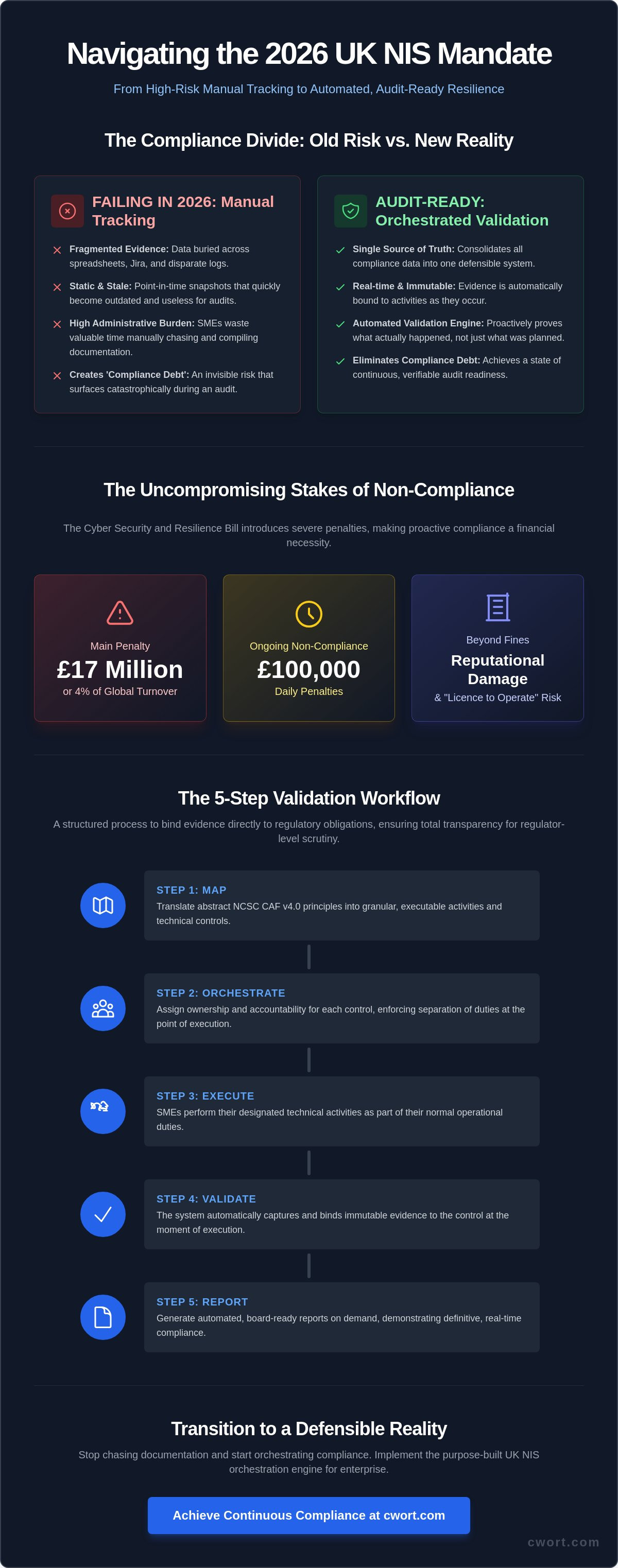
The UK's 2026 enforcement posture is uncompromising. With potential fines reaching the greater of £17 million or 4% of global annual turnover for security breaches or notification failures, the financial stakes are absolute. Regulators can also impose daily penalties of up to £100,000 for ongoing non-compliance. Beyond the immediate fiscal impact, a failed audit risks severe reputational damage and the potential loss of a "licence to operate" within critical national infrastructure. Audit readiness is a state of continuous validation where evidence is bound to obligations at the moment of activity.
Mapping the NCSC CAF to Automated Execution
The NCSC Cyber Assessment Framework (CAF) v4.0 is the definitive architecture for UK NIS compliance. It is not a static checklist; it is an outcome-based model that requires operators to demonstrate specific security results. High-calibre UK NIS audit readiness software functions by deconstructing these high-level outcomes into discrete, repeatable tasks. This systematic approach eliminates the ambiguity inherent in manual assessments and ensures that every technical control is aligned with a regulatory requirement.
Indicators of Good Practice (IGPs) serve as the benchmark for "achieved" status within a CAF audit. Proving these IGPs manually is a logistical nightmare; it requires gathering logs, screenshots, and timestamps from dozens of disconnected systems. Automation changes the dynamic by binding evidence to activities at the point of execution. This creates an immutable chain of proof that links daily technical operations back to the overarching CAF principles. When an auditor asks for evidence of "systemic risk management," you don't offer a policy; you present a validated history of executed controls.
Objective A & B: Managing Risk and Protecting Against Attack
Governance and risk management obligations are often treated as theoretical exercises. Under the CAF, these require evidence of active, documented oversight. Effective software maps these obligations to real-world workflows, ensuring that governance isn't just a document in a drawer. Identity and access control validation moves from periodic, manual reviews to automated evidence binding. Every privilege change or access grant becomes a validated event. This shift ensures that data security and system resilience are proven through concrete execution rather than unsubstantiated claims.
Objective C & D: Detecting Events and Minimising Impact
Detection and recovery capabilities must be more than theoretical; they must be tested and auditable. Orchestration allows teams to run incident response drills that capture auditable logs automatically. This process validates that monitoring systems actually trigger during a simulated event. The outcome is a suite of board-level reports that demonstrate recovery capabilities based on validated testing rather than optimistic projections. This level of rigour is exactly what a dedicated NCSC CAF assessment tool provides by design. It transforms incident response from a reactive scramble into a disciplined, documented programme of resilience.
Compliance Orchestration vs. Administrative GRC: A Strategic Comparison
Traditional Governance, Risk, and Compliance (GRC) tools function as passive systems of record. They document what should happen, yet they remain detached from the technical reality of the network. True UK NIS audit readiness software operates as a system of execution. It doesn't just track tasks; it orchestrates them by binding evidence directly to control outcomes. This creates a defensible, immutable audit trail that regulators now demand to see. By moving from a record of intent to a record of action, organisations replace the stress of manual evidence collection with the calm of auditable certainty.
Regulators increasingly favour orchestrated systems because they provide a level of traceability that manual logs cannot match. When evidence is bound to an activity at the moment of execution, it carries a timestamp and a validated identity. This eliminates the possibility of retroactive documentation or "pencil-whipping" compliance reports. In a high-stakes NIS audit, the ability to show an unbroken chain of custody for every security event is the difference between a successful validation and a costly enforcement action. CWORT enforces this discipline by design, ensuring that every regulatory obligation is backed by concrete, technical reality.
The Problem with Administrative GRC
Administrative GRC creates a dangerous compliance gap. This is the temporal void between a control failing in the field and a human eventually updating the tracking tool. Relying on manual updates introduces significant risk of human error and documentation lag. These legacy tools often lack the technical granularity required by the NCSC CAF v4.0. They provide a surface-level illusion of security that often disintegrates under the rigorous scrutiny of a competent authority audit. Without real-time integration, your compliance status is always an outdated snapshot rather than a live reflection of your resilience.
The Advantages of an Orchestration Engine
An orchestration engine like CWORT enforces discipline by design. It implements Separation of Duties (SoD) at the point of activity, ensuring that the individual performing a task isn't the same person validating its success. This system provides a single pane of glass for internal teams and external auditors alike. It offers real-time visibility into compliance status across the entire enterprise. Automated reminders and escalations ensure that critical NIS obligations are met on time, every time, replacing the anxiety of the unknown with the certainty of validated execution. This proactive approach ensures you're always audit-ready, not just audit-prepared.
Preparing for a UK NIS Audit: The 5-Step Validation Workflow
Achieving a state of perpetual audit readiness requires a transition from reactive documentation to a disciplined validation workflow. Passive checklists fail because they lack temporal context and technical verification. By contrast, a structured orchestration approach ensures that every regulatory requirement is met with a corresponding, validated action. Deploying UK NIS audit readiness software provides the framework necessary to execute this workflow with precision, moving the organisation from a position of vulnerability to one of auditable certainty.
The transition to the 2026 regulatory standard involves five distinct stages of validation:
- Step 1: Translate. Convert high-level regulatory obligations from the Cyber Security and Resilience Bill and NCSC CAF v4.0 into structured, granular execution activities.
- Step 2: Assign. Establish clear lines of accountability by assigning these activities to specific owners whilst enforcing strict separation of duties via the platform.
- Step 3: Bind. Capture and bind real-time evidence directly to control outcomes as they occur, ensuring an immutable link between action and proof.
- Step 4: Generate. Produce regulator-ready reports instantly, eliminating the need for manual data reconstruction or retrospective evidence gathering.
- Step 5: Sustain. Implement continuous validation cycles to ensure that audit readiness is maintained as a permanent operational state, not a one-off event.
Enforcing and Proving Separation of Duties
Separation of Duties (SoD) has become a primary focal point for UK competent authorities in 2026. Auditors now demand proof that critical security functions are not consolidated under a single individual, a common failure point in manual GRC systems. CWORT solves this by enforcing SoD at the point of activity. The system prevents the same user from both performing a task and validating its completion. This structural guardrail provides the definitive proof required to satisfy rigorous oversight. You can generate specific SoD reports that demonstrate organisational integrity with a single click, providing auditors with the traceability they require.
Generating Audit-Ready Outputs
Regulator-ready reporting must be comprehensive, timestamped, and immutable. Traditional methods often involve months of preparation to reconstruct a compliance narrative. Orchestration reduces this timeline to mere minutes. A regulator-ready report includes the specific CAF principle, the executed activity, the associated evidence, and the validated owner. Providing auditors with access to a secure, read-only "Evidence Vault" allows them to review your compliance posture without disrupting your operations. This transparency builds immediate trust with the competent authority. To see how this workflow transforms your compliance posture, explore the UK NIS framework management capabilities of our orchestration engine.
CWORT: The UK NIS Orchestration Engine for Enterprise
CWORT represents the definitive evolution of UK NIS audit readiness software. It moves beyond the administrative limitations of legacy GRC platforms by enforcing a system of execution where evidence is bound to outcomes in real time. For the enterprise, this means the end of fragmented data silos and the start of a single, orchestrated source of truth. Whether you are managing internal technical teams or collaborating with external consulting partners, CWORT provides the structural integrity required to transform compliance from a seasonal burden into a continuous operational advantage. It replaces the "compliance debt" of manual tracking with the definitive proof of a validated technical reality.
Fragmented tools like Jira and Excel cannot provide the immutability required for a 2026 audit. CWORT consolidates these disparate streams into a unified orchestration engine. This transition allows leadership to move from a position of hope to a state of auditable certainty. By integrating directly with your operational workflows, the platform ensures that no regulatory obligation is left to chance. Every activity is tracked, every duty is separated, and every piece of evidence is bound to the relevant NCSC CAF principle at the moment of creation.
Built for UK Regulatory Scrutiny
The platform is engineered specifically to withstand the rigour of the UK's evolving regulatory landscape. It addresses the high standards set by DORA and the Cyber Security and Resilience Bill whilst supporting the full NCSC CAF assessment lifecycle from start to finish. As a UK-based technology partner, Lapace Services UK Ltd understands the specific expectations of competent authorities like Ofcom and the ICO. This localised expertise ensures that the software remains aligned with the unique requirements of the UK market, providing a level of assurance that generic, global GRC tools simply cannot match.
CWORT delivers a suite of capabilities designed for high-consequence environments:
- Automated Evidence Binding: Eliminates the need for manual data reconstruction by capturing proof at the point of activity.
- CAF Lifecycle Management: Provides a structured path through the NCSC Cyber Assessment Framework v4.0.
- Immutable Audit Trails: Ensures that every change and validation is recorded with a permanent, timestamped record.
- Partner Integration: Enables consulting partners to provide oversight and validation within a secure, shared environment.
Taking the Next Step Toward Auditable Certainty
2026 is the year to abandon spreadsheets and adopt a systematic approach to UK NIS. The complexity of the new Cyber Security and Resilience Bill demands a move from administrative tracking to compliance orchestration. You can begin this transition by mapping your existing obligations to an execution engine that guarantees auditable certainty. It is time to replace the anxiety of potential failure with the calm of a proven, defensible reality. Request a CWORT demo to see orchestrated NIS readiness in action and secure your organisation's standing within the UK's critical national infrastructure.
Transitioning to a State of Permanent Audit Readiness
The 2026 regulatory landscape demands a move from administrative hope to technical certainty. Relying on fragmented spreadsheets is a strategic liability that won't withstand the scrutiny of the Cyber Security and Resilience Bill. By implementing specialised UK NIS audit readiness software, your organisation can finally bridge the gap between abstract governance and concrete, validated execution. This transition ensures that every security control is backed by an immutable record of action, providing the definitive proof required by competent authorities.
CWORT, developed by Lapace Services UK Ltd, offers a rigorous orchestration engine designed to support the NCSC CAF, DORA, and ISO 27001 frameworks. It replaces the seasonal scramble for documentation with automated, regulator-ready report generation that delivers a single source of truth for your board. It's time to replace compliance anxiety with the professional maturity of an orchestrated system. Secure your UK NIS audit readiness with the CWORT orchestration engine and ensure your resilience is always auditable. Your path to defensible compliance starts with a commitment to disciplined validation.
Frequently Asked Questions
What is the difference between NIS2 and the UK NIS Regulations in 2026?
The primary difference lies in the legislative framework; the UK is moving toward the Cyber Security and Resilience Bill rather than adopting the EU's NIS2 Directive. Whilst they share objectives, the UK Bill introduces stricter incident reporting timelines and higher potential penalties of up to £17 million. Organisations must ensure their compliance strategy accounts for these specific UK mandates rather than relying on generic EU frameworks.
Can CWORT integrate with our existing Jira and DevOps workflows?
CWORT integrates seamlessly with Jira and DevOps workflows to capture technical evidence at the point of activity. It transforms these execution tools into sources of truth for auditors by binding ticket completions to specific regulatory obligations. This eliminates the need for manual data entry and ensures that your compliance status reflects the real-time state of your technical environment.
How does UK NIS audit readiness software handle legacy systems?
Sophisticated UK NIS audit readiness software manages legacy assets by implementing structured manual validation workflows where automated API integration is not possible. The platform enforces periodic checks and binds human-verified evidence to the relevant CAF principles. This ensures that older infrastructure remains within the scope of your orchestrated compliance environment without creating visibility gaps during a regulator-led assessment.
What specific evidence do UK regulators look for during a NIS audit?
UK regulators prioritise evidence that proves security outcomes rather than just policy existence. They require immutable logs showing initial incident notifications within 24 hours, validated access reviews, and documented recovery testing results. Providing a timestamped audit trail that links technical activities to NCSC CAF indicators is essential for demonstrating the defensible reality that authorities like Ofcom and the ICO expect.
Is CWORT suitable for both CNI and digital service providers?
CWORT is designed to support both Operators of Essential Services (OES) in critical national infrastructure and Relevant Digital Service Providers (RDSPs). The platform's flexibility allows it to map specific obligations across diverse sectors, from energy and water to cloud computing and online marketplaces. It ensures that regardless of your sector, your compliance posture remains aligned with the latest UK legislative requirements.
How long does it take to implement a compliance orchestration platform?
Implementation timelines vary based on organisational maturity, yet orchestration platforms significantly accelerate the path to audit readiness compared to manual GRC setups. Most enterprises can establish a baseline validation engine within weeks by mapping existing workflows to the CAF. This proactive approach replaces months of retrospective evidence gathering with a system that generates regulator-ready reports on demand.
Does the software support NCSC CAF assessment mapping automatically?
The software provides native mapping to the NCSC Cyber Assessment Framework v4.0 principles and Indicators of Good Practice (IGPs). It automatically translates high-level objectives into granular tasks for your technical teams. This ensures that every activity performed within the network contributes directly to your overall compliance score, providing a clear, auditable link between operations and regulatory obligations.
How does CWORT prove separation of duties for regulatory purposes?
CWORT proves separation of duties by enforcing structural guardrails that prevent the same identity from both performing and validating a security task. The platform records these distinct actions in an immutable audit trail, providing definitive proof of organisational integrity. This level of traceability is a critical requirement for 2026 audits, as it demonstrates that no single individual can bypass your internal control environment.

Article by
Michael Iyiola
Michael Iyiola is a cybersecurity and AI engineering specialist with deep experience in vulnerability management, detection engineering, and operational resilience. At CWORT, he designs scalable, evidence‑driven workflows that help teams meet modern regulatory and security demands.
Disclaimer
The content on this site is provided for general information and educational purposes only. It does not constitute legal, regulatory, financial, or professional advice. CWORT provides AI‑assisted insights and workflow automation, but all compliance decisions remain the responsibility of your organisation and its management. Always seek qualified legal or regulatory guidance for decisions relating to DORA, NIS2, ISO 27001, CAF, or other obligations.