
Most board-level compliance reports are little more than a collection of educated guesses, stitched together from fragmented spreadsheets and Jira tickets minutes before the meeting begins. This manual reconstruction creates a dangerous gap between your reported status and the defensible reality required by regulators. Transitioning to a system of automated compliance reporting is no longer a luxury; it's a strategic necessity for any UK enterprise facing the strict 2026 DORA reporting cycles or NCSC CAF assessments.
You understand the friction of chasing evidence across departments whilst worrying if a single human error will lead to an audit failure. It's a common struggle that leaves leadership blind to real-time risks. This article demonstrates how to replace that anxiety with the certainty of a validated orchestration system that produces regulator-ready proof at the touch of a button. We'll examine the shift from passive tracking to a proactive environment where evidence is bound to control outcomes, ensuring your board visibility is backed by a single, uncompromising source of truth.
Key Takeaways
- Transition from passive, periodic snapshots to a continuous validation model that reflects your real-time regulatory posture.
- Identify the critical "Evidence Gap" where traditional dashboards fail to bind raw data to specific, defensible control outcomes.
- Learn to translate abstract regulatory obligations into structured, executable workflows that eliminate the need for manual evidence reconstruction.
- Establish a reporting hierarchy that provides the board with strategic assurance whilst satisfying the granular requirements of external auditors.
- Discover how an orchestration engine simplifies automated compliance reporting for complex frameworks including DORA, NIS2, and ISO 27001.
The Evolution of Automated Compliance Reporting in 2026
The landscape of regulatory compliance has shifted from a back-office administrative burden to a front-line strategic requirement. By 2026, the definition of success has moved beyond mere documentation. True automated compliance reporting is now defined as a continuous validation process, not a periodic snapshot taken once a quarter. Stating that a control exists is no longer sufficient. You must prove it functioned correctly at the specific moment of a transaction or event. This shift from reactive tracking to proactive orchestration is the only way to maintain a defensible position in a high-velocity digital environment.
Traditional reporting often focuses on historical narratives, telling a story about what was done weeks or months ago. Validation is different. It provides definitive, evidence-based proof that your systems are operating within defined parameters right now. In the current regulatory climate, the gap between "reporting" and "validation" is where liability lives. Organisations that fail to bridge this gap find themselves vulnerable during audits, unable to produce the granular evidence required to satisfy increasingly sophisticated regulators.
The Regulatory Drivers: DORA, NIS2, and UK NIS
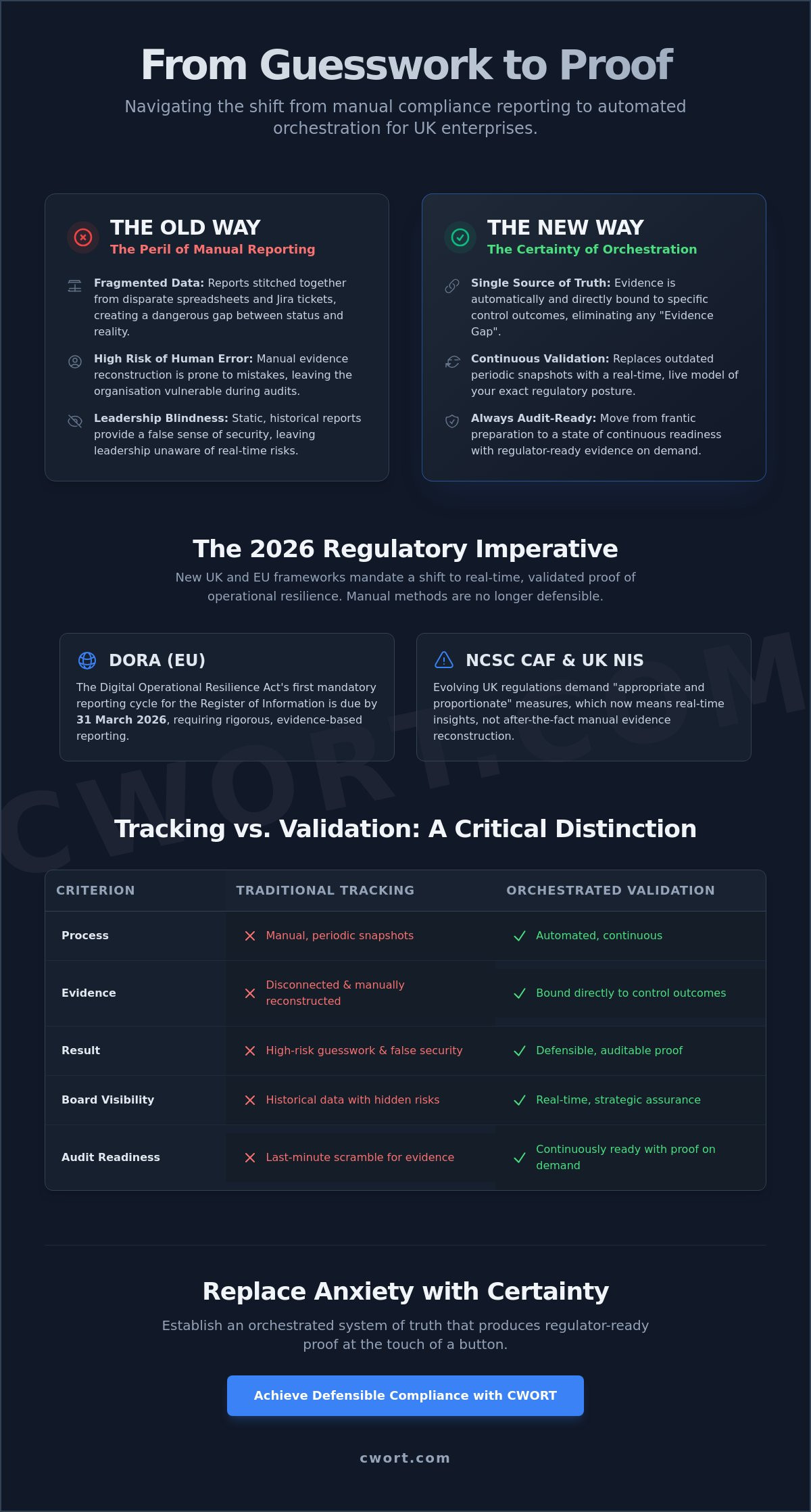
New frameworks demand uncompromising visibility into operational resilience. The EU's Digital Operational Resilience Act (DORA) mandates its first mandatory reporting cycle for the Register of Information by 31 March 2026. For UK enterprises, the pressure is equally intense as the NCSC CAF and UK NIS regulations evolve. Regulators no longer accept manual reconstruction of evidence as an "appropriate and proportionate" measure. They expect real-time insights into ICT risk and supply chain integrity. This has forced a transition toward standardised technical reporting formats that allow for immediate validation across both UK and international jurisdictions. You cannot meet these 2026 deadlines using 2020 methods.
From Manual Spreadsheets to Orchestrated Evidence
Spreadsheets are where audit trails go to die. Relying on manual data entry introduces a high probability of human error and data fragmentation. In a high-velocity environment, a static report is obsolete the moment it's generated. It represents a past state that may no longer exist. Orchestrated evidence solves this by binding live data directly to specific control outcomes. It replaces the frantic scramble of audit preparation with a state of continuous readiness. Instead of reconstructing history for an auditor, you're presenting a live, validated record of execution. This transition ensures that your automated compliance reporting remains accurate, traceable, and, most importantly, defensible under scrutiny.
Stop viewing compliance as a destination. It's a continuous state of operational integrity. By moving away from fragmented tracking and embracing a system of orchestrated truth, you protect the organisation from the anxiety of potential failure. You replace guesswork with auditable certainty, providing the board with the assurance they need to lead with confidence.
Why Conventional Automation Fails Regulatory Scrutiny
Many leadership teams mistake a green dashboard for actual compliance. This is a critical strategic error. A dashboard is merely a visualisation layer; it doesn't guarantee the integrity of the underlying data. Without a system that binds evidence to specific regulatory obligations, automated compliance reporting becomes a liability rather than an asset. It creates a false sense of security that collapses under the weight of a serious audit. Automation without orchestration simply generates faster, more complex errors at scale.
Automation often collects raw data but fails to interpret it against a specific control outcome. This creates a dangerous "Evidence Gap." Implementing Continuous Control Monitoring requires more than just gathering logs. It requires a disciplined approach to ensure that every piece of data serves as defensible proof of a specific regulatory requirement. Generic GRC tools often fail here because they lack the technical depth to enforce separation of duties during the actual execution of a control. They track the administrative task whilst ignoring the technical reality of the outcome.
The Distinction Between Tracking and Validation
Tracking tells you a task was started. Validation proves the task achieved its intended security or regulatory outcome. Regulators in 2026, particularly those enforcing DORA or the UK NIS framework, dismiss reports that lack a clear, immutable audit trail. You must bind evidence at the precise point of execution. Post-hoc evidence gathering is no longer defensible. It suggests a lack of systemic control and invites deeper regulatory scrutiny into your operational resilience. Validation requires a direct, unbreakable link between the regulatory obligation and the technical proof of its fulfilment.
The Hidden Danger of Fragmented Compliance Tools
Fragmented data is an auditor's greatest red flag. When your evidence is scattered across Jira tickets, Excel spreadsheets, and various cloud consoles, you create "islands of data" that are impossible to verify. Proving control effectiveness across these disconnected systems requires manual reconstruction. This process is slow, prone to error, and fundamentally lacks structural integrity. Modern regulators view manual intervention as a failure of the compliance system itself. If your current reporting feels like a manual reconstruction exercise, it is time to explore a validated orchestration engine that enforces truth by design.
Relying on disconnected tools makes it impossible to provide the board with a single source of truth. It forces compliance teams into a reactive cycle of chasing data rather than managing risk. To achieve auditable certainty, you must move beyond simple data collection. You need a system that orchestrates the entire compliance lifecycle, ensuring that every action is recorded, every control is validated, and every report is regulator-ready without human intervention.
Moving Beyond Spreadsheets: Orchestrating Auditable Evidence
Stop treating compliance as a side effect of IT operations. To achieve auditable certainty, you must implement a Regulatory Obligation Execution Workflow. This framework translates abstract legal requirements into structured, executable activities that leave no room for ambiguity. Traditional methods fail because they treat compliance as a post-hoc documentation exercise. Orchestration flips this model. It ensures that automated compliance reporting is the direct result of controlled execution, where every action is pre-validated against a specific regulatory mandate. By binding evidence directly to control outcomes, you eliminate the need for manual reconstruction during an audit.
Enforce discipline through a systematic approach. When a regulation demands a specific security measure, the workflow should dictate exactly how that measure is implemented, verified, and recorded. This level of rigour replaces the frantic scramble of "evidence gathering" with a steady stream of validated proof. It shifts the focus from administrative tracking to definitive, evidence-based reality. This is how you move from a state of constant anxiety to one of auditable certainty.
Replacing Jira and Excel with Orchestration
Generic tools like Jira are designed for task management, not regulatory assurance. They follow a "task-based" approach that relies on human assertion; someone ticks a box to say a control is finished. This is structurally insufficient for the 2026 DORA mandates or UK NIS requirements. A validation-based approach, such as that utilised by CWORT, requires evidence to be bound to the activity before it can be closed. This creates a single source of truth across ISO 27001 and NCSC CAF frameworks. It prevents the "evidence gap" by ensuring no control is marked "complete" without the necessary technical proof. Orchestration ensures your data is not just collected, but contextually mapped to the obligations it satisfies.
Enforcing Separation of Duties (SoD) by Design
Separation of Duties is a cornerstone of UK financial regulations and a non-negotiable requirement under DORA. Manual systems often fail this test during high-pressure audit cycles because they lack hard system boundaries. Orchestrated workflows enforce SoD at the system level, preventing the "maker" from acting as the "checker" within the same process. This structural discipline removes the risk of internal collusion or accidental oversight. Enforcing Separation of Duties by design is the fundamental cornerstone of regulatory trust. It replaces individual discretion with systematic accountability. This ensures that every report generated for the board is intrinsically defensible and reflects a controlled, auditable environment.
By moving beyond the limitations of spreadsheets, you build a foundation of integrity. You're no longer just reporting on compliance; you're orchestrating it. This transition provides the board with the calm of auditable certainty, knowing that every piece of evidence is bound to a validated outcome. It is the only way to satisfy the sophisticated demands of modern regulators whilst maintaining operational velocity.
A Framework for Board-Level Reporting and Regulatory Assurance
Establishing a structured reporting hierarchy is the final step in securing a defensible posture. You must distinguish between technical validation and strategic oversight. Effective automated compliance reporting serves two distinct masters: the auditor who requires granular proof and the board member who needs risk-based assurance. Delivering the same report to both stakeholders is a failure of communication and governance. One requires the "how," whilst the other demands the "so what." This hierarchy ensures that information flow is both precise and relevant, preventing data fatigue whilst maintaining total transparency.
Continuous monitoring provides the pulse of your organisation's health. It ensures that status updates are not just snapshots in time but reflections of a live, functioning system. In high-stakes regulatory environments, waiting for a monthly report is a risk you cannot afford. You need a system that surfaces exceptions immediately, allowing for remediation before auditors ever arrive on-site. This proactive approach transforms compliance from a reactive scramble into a disciplined, business-as-usual activity that supports operational velocity.
The Auditor-Ready Report: Granular and Defensible
Auditors in 2026 no longer accept anecdotal evidence or random sampling. They demand immutable logs, cryptographic timestamps, and digital signatures that prove a control was executed correctly at the required time. Your system must provide a transparent map from the specific regulatory obligation to the validated proof. By providing regulators with direct access to a validated evidence repository, you drastically reduce audit friction and preparation time. This transparency demonstrates a mature, controlled environment that requires far less manual interrogation. It shifts the burden of proof from your team to the system itself.
The Board-Level Dashboard: Strategic Insights
The board doesn't need to see every log entry; they need to understand business risk and strategic alignment. Translate technical data into clear metrics that highlight "control hotspots" where resilience may be lagging. This allows leadership to allocate resources effectively before a minor gap becomes a major breach. Providing real-time status updates replaces the anxiety of the unknown with the calm of auditable certainty. When the board can see a live, validated view of their DORA or UK NIS posture, they can lead with uncompromising confidence. They transition from worrying about potential failure to overseeing a state of continuous readiness.
Request a demonstration of our validated reporting engine to see how we bridge the gap between technical evidence and board-level assurance.
CWORT: Orchestrating Defensible Truth for UK Enterprise
CWORT serves as the definitive orchestration engine for UK enterprises, replacing the fragmented and error-prone nature of manual tracking with a disciplined system of record. It is not merely a tool for observation; it is a proactive environment that enforces accountability by design. By translating complex frameworks such as DORA, NIS2, and ISO 27001 into executable workflows, CWORT ensures that compliance is a natural consequence of daily operations rather than a periodic crisis. This represents a fundamental transition from passive obligation to active validation. It provides the structural integrity required to turn automated compliance reporting into a strategic advantage for leadership teams.
Traditional GRC tools often leave a gap between policy and practice. CWORT closes this gap by enforcing the rules of engagement within the workflow itself. It doesn't just ask if a control was performed; it validates that the control met the specific technical criteria defined by the regulator. This level of orchestration ensures that your organisation remains resilient against both operational failures and regulatory scrutiny. You're no longer just collecting data; you're orchestrating defensible truth. This structural discipline is what separates a mature enterprise from one that is merely ticking boxes.
The CWORT Advantage: Validation Over Tracking
Manual reconstruction of evidence is a significant operational risk that drains resources and increases the likelihood of audit failure. CWORT eliminates this burden by capturing and validating proof at the precise point of execution. This unified approach allows organisations to manage multiple frameworks, including NIS2, DORA, and the NCSC CAF, from a single, authoritative interface. For a deeper look at specific requirements for financial firms, see our guide on DORA Compliance Validation: A Guide for Financial Institutions. By centralising these activities, you ensure that your automated compliance reporting remains consistent and defensible across the entire enterprise, regardless of the underlying technical complexity.
Request a Demo: See Orchestration in Action
The path to total assurance requires a move away from fragmented data and administrative anxiety. Transform your compliance posture into a pillar of strategic assurance by implementing a system that orchestrates truth at the source. See how CWORT can transform your specific compliance environment by delivering a single source of truth that satisfies boards and regulators alike. Our platform generates regulator-ready outputs that satisfy the most stringent audit requirements without manual intervention. Request a CWORT demo to see how we orchestrate your compliance validation and replace fragmented tracking with a system of auditable certainty.
Securing Strategic Assurance in an Era of Continuous Regulation
The transition from passive tracking to proactive orchestration is the only way to satisfy the 2026 mandates of DORA and UK NIS. Relying on fragmented data in Excel or Jira creates a liability that no green dashboard can mask. You must move to a system where evidence is bound to outcomes by design, ensuring that every control is validated before it is reported. This structural discipline replaces the frantic scramble of audit preparation with a state of continuous readiness.
Developed by Lapace Services UK Ltd, CWORT replaces the manual reconstruction of evidence with a validated engine that produces both strategic board-level insights and granular, regulator-ready proof. This shift ensures your automated compliance reporting remains a source of truth rather than a point of failure. It's time to replace administrative anxiety with the calm of auditable certainty. Request a CWORT demo to see how we orchestrate your compliance validation and transform your regulatory posture into a pillar of operational integrity.
You have the opportunity to lead your organisation toward a future of disciplined, evidence-based maturity where compliance supports, rather than hinders, your strategic objectives.
Frequently Asked Questions
What is the difference between GRC software and automated compliance reporting?
Traditional GRC software typically functions as a passive repository for documents and manual self-assessments. In contrast, automated compliance reporting is a dynamic validation engine that binds live technical evidence to specific regulatory outcomes. Whilst GRC tools track what you say you are doing, automated reporting provides definitive proof of what has actually occurred within your environment.
Can automated reporting help with DORA compliance specifically?
Yes, it is designed to meet the rigorous March 2026 DORA reporting deadlines. The system automates the creation of the Register of Information and provides continuous validation of ICT risk controls. This ensures that your submissions to National Competent Authorities are accurate, complete, and backed by a defensible audit trail that satisfies European Supervisory Authorities.
How does automated compliance reporting handle evidence for audits?
Evidence is captured automatically at the point of execution and bound to the relevant control. This eliminates the frantic, manual reconstruction of history that often leads to audit failure. By maintaining a real-time, immutable repository of proof, the system ensures you are always in a state of continuous audit readiness without human intervention.
Is automated reporting secure enough for sensitive financial data?
The orchestration engine is built to satisfy the high-stakes security requirements of UK financial services. It focuses on validating control outcomes and capturing metadata rather than moving sensitive underlying data sets. This approach maintains the structural integrity of your environment whilst providing the auditable certainty required by modern governance standards.
How much time can my team save with automated compliance validation?
Industry data indicates that automated compliance reporting software can reduce audit preparation time by 60-80% through continuous evidence collection. This significant reduction allows your compliance and technical teams to move away from administrative data chasing. They can instead focus on high-value strategic risk management and operational resilience.
Can I use CWORT alongside existing tools like Jira?
CWORT integrates into your existing workflow to provide the validation layer that task management tools lack. Whilst Jira is excellent for tracking that a task was assigned, it cannot prove the technical outcome of that task. CWORT enforces the discipline required to ensure no ticket is closed until the necessary regulatory evidence is captured and validated.
What happens if a regulator requests proof of separation of duties?
The system produces a definitive report showing that separation of duties was enforced at the system level for every controlled activity. It logs the distinct identities of the "maker" and the "checker" for every workflow execution. This provides regulators with clear, undeniable proof that your internal controls prevent collusion and accidental oversight by design.
Does automated reporting support multiple frameworks like NIS2 and ISO 27001 simultaneously?
The orchestration engine utilises a "collect once, report many" model to satisfy multiple frameworks concurrently. It maps individual technical controls to the specific requirements of NIS2, ISO 27001, and the NCSC CAF. This unified approach prevents the duplication of effort and ensures a single, consistent source of truth across your entire regulatory landscape.

Article by
Michael Iyiola
Michael Iyiola is a cybersecurity and AI engineering specialist with deep experience in vulnerability management, detection engineering, and operational resilience. At CWORT, he designs scalable, evidence‑driven workflows that help teams meet modern regulatory and security demands.
Disclaimer
The content on this site is provided for general information and educational purposes only. It does not constitute legal, regulatory, financial, or professional advice. CWORT provides AI‑assisted insights and workflow automation, but all compliance decisions remain the responsibility of your organisation and its management. Always seek qualified legal or regulatory guidance for decisions relating to DORA, NIS2, ISO 27001, CAF, or other obligations.