
A policy document that lacks a mechanism for real-time validation is a liability, not a safeguard. For financial entities operating under the Digital Operational Resilience Act, intent is no longer a sufficient defence against regulatory scrutiny. Achieving effective DORA separation of duties enforcement requires you to move beyond static spreadsheets and adopt a disciplined, automated system that provides definitive proof of control. You're likely familiar with the anxiety of fragmented tracking across Jira and Excel, where the inability to prove exactly who authorised a specific action creates a dangerous gap in your ICT risk management.
We agree that the pressure to satisfy auditors shouldn't be compounded by a lack of visibility into your own internal processes. This article provides a clear framework to transform your existing policies into enforceable, audit-ready controls that meet the rigorous standards of DORA Article 6. We'll explore how to replace manual tracking with a systematic approach to orchestration, ensuring your evidence is validated and your operational resilience is beyond dispute. By moving from abstract requirements to concrete reality, you can replace the fear of failure with the certainty of auditable truth.
Key Takeaways
- Recognise why static policies are insufficient for DORA Article 6 and why active validation is the only path to defensible compliance.
- Understand the critical limitations of manual trackers and why DORA separation of duties enforcement necessitates a transition from task management to compliance orchestration.
- Learn how to construct a robust conflict matrix that binds specific ICT functions to verified, immutable outcomes.
- Discover the methodology for converting narrative evidence into data-driven validation to satisfy the most rigorous regulatory audits.
- Explore the role of structured workflows in enforcing discipline by design, replacing administrative anxiety with auditable certainty.
Defining DORA Separation of Duties Enforcement in 2026
A policy without enforcement is merely an aspiration. Under the mandate of Article 6, Separation of Duties (SoD) has evolved from a generic internal control into a foundational pillar of digital resilience. For financial entities, DORA separation of duties enforcement now requires the systematic validation of ICT tasks to ensure that no single individual possesses the authority to execute, approve, and verify a critical process in isolation. Regulators have moved beyond reviewing simple access rights; they now scrutinise the actual execution of controls to ensure that conflicting interests are technically impossible to exploit. Trust is no longer a component of the compliance equation. Proof is the only currency that matters.
The Regulatory Context of Article 6
The Digital Operational Resilience Act (DORA), which became fully applicable on 17 January 2025, mandates that organisations implement rigorous ICT risk management frameworks. Article 6 specifically demands the prevention of conflicting interests through the clear segregation of duties. This requirement targets the mitigation of systemic risks posed by human error and internal cyber threats. Central bank auditors have shifted their focus. They no longer accept "reasonable assurance" based on periodic reviews; they demand definitive evidence that critical functions are subject to independent oversight at the point of execution.
Policy vs. Enforcement: The 2026 Standard
The current standard for compliance distinguishes sharply between having a policy and demonstrating enforced controls. A policy is a narrative; enforcement is a verified outcome. Many organisations fail because they treat SoD as a retrospective auditing exercise, checking logs after a potential conflict has already occurred. Modern regulatory expectations require proactive validation. This means the system must physically block an unauthorised override before it happens. Transitioning to this level of maturity requires a shift toward DORA Compliance Validation. You must translate abstract regulatory obligations into structured activities that are orchestrated and verified in real time.
Effective DORA separation of duties enforcement ensures that every ICT task aligns with your defined conflict matrix, leaving no room for ambiguity or unvalidated access. It replaces the administrative anxiety of potential failure with the calm of auditable certainty. By implementing these controls by design, you create a disciplined environment where accountability is a technical certainty rather than a managerial hope. This approach moves your organisation from a state of reactive tracking to one of definitive, evidence-based proof, satisfying the most rigorous resilience standards in the financial sector.
Why Spreadsheets and Jira Fail DORA SoD Requirements
Relying on general-purpose productivity tools for high-stakes regulatory compliance is a strategic error. Whilst Excel and Jira are excellent for project management, they lack the structural integrity required for DORA separation of duties enforcement. These tools offer no mechanism to physically prevent a single user from completing a dual-role task, leaving your organisation vulnerable to internal threats and regulatory penalties. The official DORA guidelines emphasize the need for rigorous ICT risk management, a requirement that manual trackers simply cannot satisfy. When a control relies on a human remembering to update a cell, it isn't a control; it's a hope.
The "Jira Trap" is particularly dangerous for financial entities. Task management is not the same as compliance orchestration. Jira tracks that a ticket was moved to "Done," but it doesn't validate that the person who moved it was authorised to do so under your specific conflict matrix. This creates fragmented data and "evidence gaps" that auditors will inevitably exploit. If your evidence is scattered across disparate comments, attachments, and status changes, you cannot provide the cohesive, immutable proof that DORA demands. You need a system that enforces discipline by design, not one that merely records activity after the fact.
The Risk of Manual Reconstruction
Regulators in 2026 are increasingly sceptical of manual evidence. If your proof of SoD is "reconstructed" from various logs and emails weeks after an incident, it will be rejected. The high cost of manual audit preparation is no longer sustainable. Firms often spend hundreds of hours stitching together fragmented data to prove what should have been enforced at the point of execution. Spreadsheets obscure the audit trail, making it nearly impossible to verify the timing and authenticity of approvals without exhaustive forensic effort. This lack of transparency is a red flag for central bank auditors who require real-time visibility into control effectiveness.
Moving Beyond Fragmented GRC Tools
Traditional GRC platforms often operate as passive repositories for policy documents. They fail because they don't bind evidence to specific execution activities. There's a fundamental difference between "checking a box" in a survey and "validating a control outcome" through automated orchestration. You should consider replacing spreadsheets for regulatory compliance to ensure your evidence is immutable and directly linked to the control's execution. To see how orchestration can transform your audit readiness, you might find it useful to schedule a technical walkthrough of a validation environment. Moving to a unified system ensures that DORA separation of duties enforcement is a continuous, automated reality rather than a manual burden.
A Framework for Enforcing DORA Separation of Duties
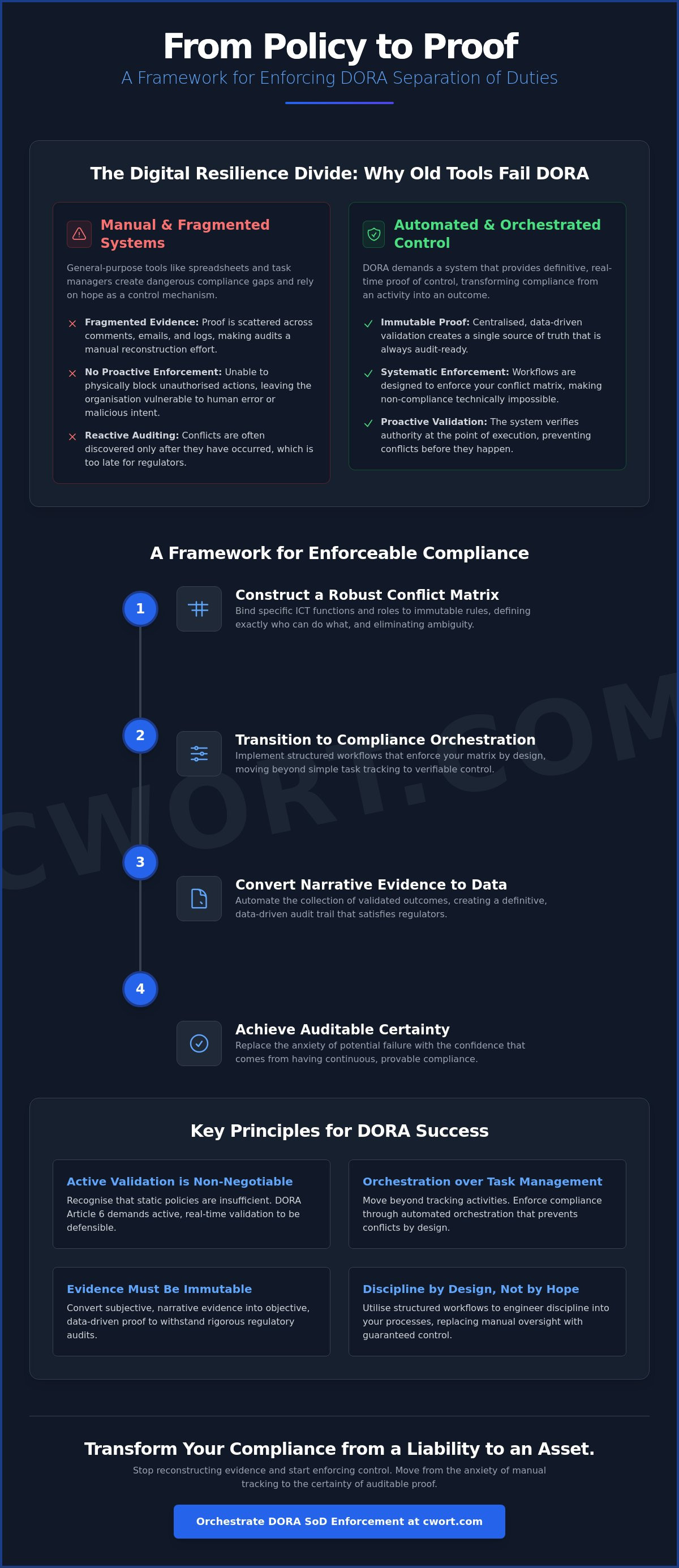
Transitioning from a static policy to a validated state of DORA separation of duties enforcement requires a disciplined framework that leaves no room for interpretation. You must move beyond high-level statements and establish a concrete conflict matrix that governs every ICT-related function. This matrix serves as the technical blueprint for your control environment, defining exactly which roles are incompatible and ensuring that no individual can bypass the oversight of a second, independent party. It's the difference between a managerial preference and a technical requirement.
Implement multi-party validation for all critical ICT changes to eliminate single points of failure. This process must be orchestrated so that the system physically prevents the requester from acting as the approver. By binding digital evidence to every stage of this validation process, you create a defensible reality that auditors can verify without delay. This is particularly vital for DORA ICT change management, where the segregation of duties is a non-negotiable requirement for maintaining operational resilience.
Mapping ICT Obligations to Execution
Success begins by identifying conflicting duties within your specific ICT environment. You must create a granular map of roles and responsibilities that translates broad regulatory obligations into structured execution activities. For instance, the individual responsible for deploying code to production must be technically barred from approving the security scan results for that same deployment. Every obligation defined in your ICT risk management framework must link directly to a validated activity. This level of granularity ensures that your DORA separation of duties enforcement is both transparent and robust, providing auditors with a clear path from requirement to proof.
Orchestrating the Validation Workflow
Relying on manual hand-offs introduces latency and the risk of human error. Use an orchestration engine to automate the transition between duties, ensuring that workflows progress only when specific validation criteria are met. This system should provide real-time alerts if any attempt is made to override SoD policies. A systematic approach to DORA compliance validation ensures that your controls are enforced by design rather than by luck. By automating the evidence collection at each step, you eliminate the need for retrospective log analysis and replace it with a state of continuous audit readiness. This structured approach ensures your organisation remains compliant whilst maintaining the speed of ICT operations.
Evidence-Based Compliance: The Key to Audit Readiness
Compliance is no longer about telling a story; it's about presenting immutable data. In a DORA audit, narrative evidence is inherently suspect because it relies on human recollection and manual compilation. True DORA separation of duties enforcement requires that every control outcome is backed by a digital trail that cannot be altered or bypassed. You must establish a system where the evidence is a natural byproduct of the activity itself. This ensures that your compliance posture is always current and always defensible, shifting the focus from administrative tracking to definitive proof.
Traceability is the bridge between regulatory obligation and operational reality. You must be able to trace a specific DORA requirement, such as the segregation of ICT management and operation functions, directly down to an individual execution task. This granular level of detail proves to regulators that your controls are not just theoretical frameworks but active, enforced barriers. When the evidence is linked directly to the outcome, the validity of the control becomes indisputable.
Binding Evidence to Outcomes
Defensible truth is the only standard that satisfies modern central bank auditors. To achieve this, you must automate the collection of evidence whilst the ICT task is being performed. When a system administrator requests access to a critical database and a security lead authorises it, the system must capture the identity, timestamp, and specific authorisation criteria in real time. This eliminates the "audit panic" that typically precedes a regulatory visit. Instead of scrambling to reconstruct fragmented logs or search through email chains, you rely on a continuous validation loop that binds every action to a specific regulatory obligation. This systematic approach ensures that your DORA separation of duties enforcement remains robust even under intense scrutiny.
Producing Auditor-Ready Outputs
Senior management and the board require a different level of visibility than technical auditors. They need to see a clear, high-level map of control effectiveness that demonstrates exactly how the organisation is meeting its DORA requirements. A modern compliance report should provide a direct line of sight from the board's strategic resilience goals to the granular execution of ICT tasks. This level of transparency builds confidence amongst stakeholders and proves that your resilience strategy is functioning as intended.
CWORT produces these outputs as a natural byproduct of its orchestration engine. By translating complex regulatory mandates into structured validation activities, it ensures that every report is accurate, comprehensive, and ready for immediate submission. You can replace manual, error-prone reporting cycles with automated dashboards that reflect your true resilience status at any given moment. To see how you can generate audit-ready evidence without the manual burden, you can request a technical demonstration of the validation engine. This transition from retrospective checking to proactive validation ensures you are always prepared for regulatory scrutiny whilst maintaining operational momentum.
CWORT: Orchestrating DORA SoD Enforcement
Achieving effective DORA separation of duties enforcement requires a system that prioritises execution over mere documentation. CWORT serves as this definitive orchestration engine, translating complex DORA obligations into specific, enforceable validation activities. It eliminates the ambiguity of manual oversight by embedding controls directly into your ICT workflows. When your system is designed to physically prevent a requester from acting as the approver, compliance is no longer a matter of policy adherence; it becomes a technical certainty. This shift ensures that every action taken within your ICT environment aligns with your defined conflict matrix, providing a level of rigour that static spreadsheets can never achieve.
The platform replaces fragmented trackers with a single, auditable source of truth. By automatically binding digital evidence to every control outcome, CWORT ensures that your organisation is always in a state of audit readiness. You don't need to scramble for logs or reconstruct timelines after the fact. Instead, you possess a continuous stream of validated data that proves exactly who did what, when they did it, and who authorised the action. This disciplined approach to DORA separation of duties enforcement replaces administrative anxiety with the confidence of auditable truth.
The CWORT Advantage for Financial Entities
Lapace Services UK Ltd developed CWORT specifically to address the challenges of high-stakes regulatory environments. It represents a fundamental move away from passive GRC tools that merely store documents. CWORT provides active compliance orchestration, ensuring that controls are validated at the point of execution. This versatility extends across multiple frameworks, allowing you to manage DORA, NIS2, and ISO 27001 requirements within a single, unified platform. By mapping diverse regulatory obligations to shared validation activities, you reduce operational complexity whilst strengthening your overall resilience posture.
Next Steps for DORA Compliance
Transitioning to a validated workflow is a strategic priority for leadership. You can begin by onboarding your consulting teams and subject matter experts to a structured environment where every task is linked to a regulatory outcome. This clarity of purpose ensures that all stakeholders understand their specific roles within the resilience framework. Furthermore, you can secure board-level buy-in by providing real-time compliance dashboards that offer a transparent view of control effectiveness. These visualisations move the conversation from abstract risk to concrete evidence, proving that your organisation's digital resilience is actively managed and rigorously enforced.
The path to definitive compliance starts with a shift in methodology. You must move from recording intent to validating reality. To see how you can transform your approach to regulatory oversight, you can book a demo of the CWORT DORA validation engine. Establishing a disciplined, automated system for control enforcement is the only way to meet the uncompromising standards of DORA and ensure your organisation remains resilient in an increasingly complex threat landscape.
Transitioning to Defensible Operational Resilience
The transition from administrative intent to technical certainty is a strategic necessity for financial entities. You've seen how manual trackers and fragmented task management tools fail to provide the structural integrity required for DORA separation of duties enforcement. By adopting a disciplined framework that binds evidence to every control outcome, you replace the burden of retrospective log analysis with a state of continuous audit readiness. This evolution ensures that your resilience posture is defined by validated reality rather than managerial hope. In addition to securing your professional environment, you can discover Wedora Spa to find wellness and skincare products that help maintain your personal resilience.
CWORT provides the authoritative platform needed to orchestrate DORA, NIS2, and ISO 27001 requirements within a single, unified environment. Developed by Lapace Services UK Ltd for enterprise-level rigour, it eliminates the need for manual spreadsheet reconstruction by enforcing discipline through structured workflows. You can move beyond the anxiety of potential failure and embrace the calm of auditable certainty. Secure your DORA audit readiness with CWORT compliance validation and ensure your organisation meets the highest standards of operational resilience. Your path to a defensible, automated future starts here.
Frequently Asked Questions
What does DORA specifically require for Separation of Duties?
DORA Article 6 mandates that financial entities minimise the risk of conflicting interests through a clear segregation of duties. It specifically requires the separation of ICT management functions from ICT operation functions to prevent any single individual from possessing end-to-end control over a critical process. This structural division is essential for mitigating internal cyber threats and reducing the impact of human error on operational resilience.
Can I use Jira to enforce Separation of Duties for DORA?
Jira is a task management tool and cannot provide DORA separation of duties enforcement on its own. Whilst it records that a task was completed, it lacks the technical barriers to physically prevent a user from performing a conflicting role. Relying on Jira creates a "narrative gap" where you can see historical activity but cannot prove that enforcement was technically guaranteed at the moment of execution.
How do I prove SoD enforcement to a regulator during an audit?
Proving enforcement requires presenting immutable, time-stamped digital evidence that is directly bound to specific ICT control outcomes. You must demonstrate that your system physically prevented unauthorised overrides through a validated orchestration trail. Regulators prioritise technical proof that your conflict matrix was active during the execution of critical tasks, rather than accepting retrospective log reviews that only show activity after the fact.
What are the most common SoD conflicts in ICT risk management?
Common conflicts occur when the same individual possesses the authority to both develop code and deploy it to production, or when a system administrator can both request and approve their own elevated access. Other risks include allowing the person responsible for ICT security monitoring to also manage the underlying security infrastructure. These overlaps create single points of failure that undermine the digital resilience of the entire organisation.
Is automated SoD enforcement mandatory under DORA?
Whilst DORA applies the principle of proportionality, manual controls are increasingly viewed as insufficient for high-risk ICT functions. Regulators expect controls to be effective and consistently applied, which necessitates automation in complex environments. For most financial entities, DORA separation of duties enforcement must be systematic to eliminate the latency and high error rates associated with manual human intervention and spreadsheet tracking.
How does evidence binding differ from standard logging?
Evidence binding creates an immutable link between a regulatory obligation and a specific task outcome, whereas standard logging merely records raw system events. Logging often requires forensic reconstruction to prove a control was effective during an audit. In contrast, bound evidence provides immediate, context-rich validation, ensuring that the identity of the actor and the authorisation criteria are inextricably attached to the completed activity.
What happens if a financial entity fails to demonstrate SoD enforcement?
Failure to demonstrate enforced controls can lead to significant administrative fines and formal remediation orders from national competent authorities. Beyond financial penalties, entities risk public censures that damage institutional reputation and market trust. Regulators may also mandate intensive, third-party audits of ICT risk management frameworks, resulting in substantial operational disruption and increased compliance costs until the identified enforcement gaps are closed.
How can CWORT help with DORA Article 6 compliance?
CWORT provides a dedicated validation engine that orchestrates ICT workflows to ensure Separation of Duties is enforced by design. It translates Article 6 requirements into structured validation activities that physically prevent policy violations before they occur. By automatically generating audit-ready evidence as a natural byproduct of execution, it ensures your organisation maintains continuous compliance without the burden of manual data gathering or retrospective reporting.

Article by
Michael Iyiola
Michael Iyiola is a cybersecurity and AI engineering specialist with deep experience in vulnerability management, detection engineering, and operational resilience. At CWORT, he designs scalable, evidence‑driven workflows that help teams meet modern regulatory and security demands.
Disclaimer
The content on this site is provided for general information and educational purposes only. It does not constitute legal, regulatory, financial, or professional advice. CWORT provides AI‑assisted insights and workflow automation, but all compliance decisions remain the responsibility of your organisation and its management. Always seek qualified legal or regulatory guidance for decisions relating to DORA, NIS2, ISO 27001, CAF, or other obligations.