
Your spreadsheet is not a defensible shield against a central bank auditor. In a regulatory climate where the European Central Bank has prioritised the Digital Operational Resilience Act (DORA) for the 2026 cycle, relying on manual tracking is a strategic liability. You need central bank audit compliance software that transforms abstract requirements into concrete, auditable reality. Static documents simply cannot provide the structural integrity required for modern scrutiny.
You likely recognise that manual evidence gathering is far too slow and prone to error, especially when the threat of NIS2 fines looms over the organisation. Proving separation of duties whilst managing fragmented control frameworks often feels like an impossible task. This guide provides the definitive roadmap to master the transition from manual checklists to automated, evidence-based readiness. You'll learn how to bind evidence to controls in real-time, delivering the board-level visibility necessary to replace regulatory anxiety with the calm of auditable certainty.
Key Takeaways
- Learn how to transition from passive tracking to evidence-based validation so you're always ready for the most rigorous central bank scrutiny.
- Identify the structural failures of traditional spreadsheets that create a dangerous evidence gap and resolve them by implementing central bank audit compliance software.
- Master the orchestration of complex frameworks including DORA and NIS2 by mapping regulatory obligations directly to validated control execution.
- Enforce strict accountability through the systematic definition of control owners and the automated verification of separation of duties.
- Establish real-time, board-level visibility of your compliance status to replace regulatory uncertainty with a state of total audit readiness.
What is Central Bank Audit Compliance Software in 2026?
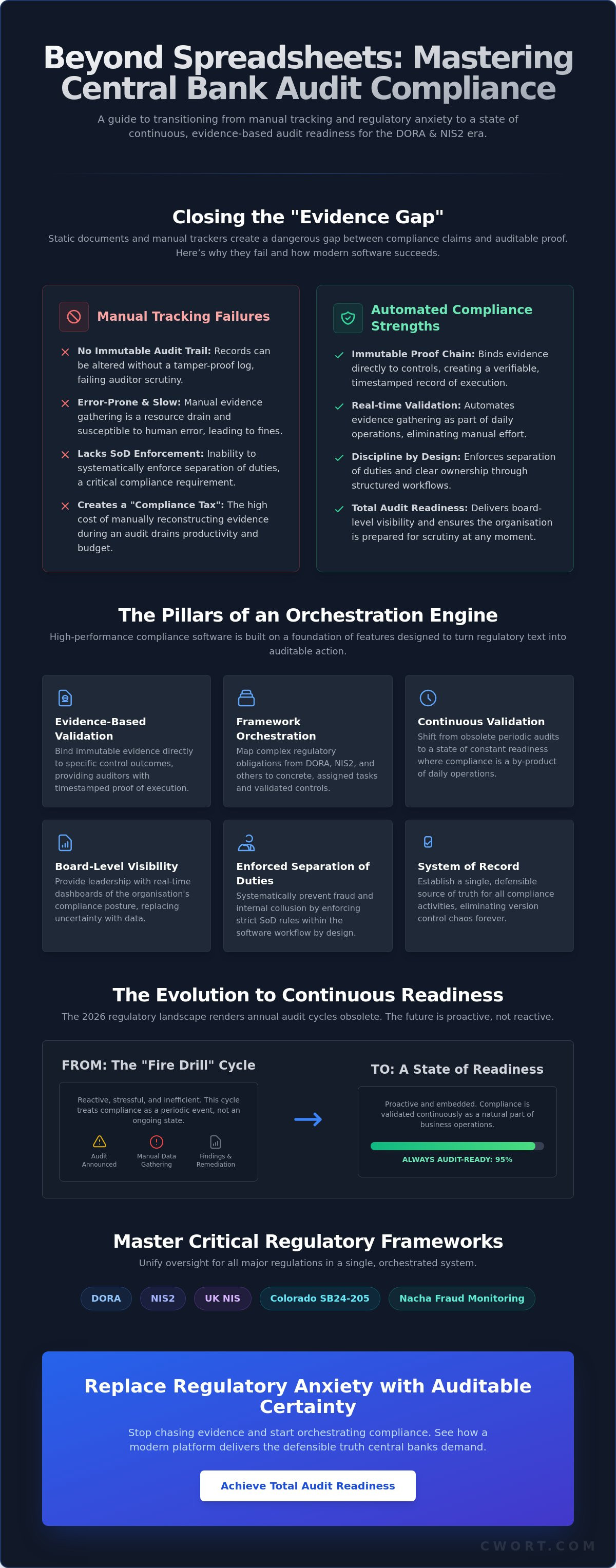
In 2026, central bank audit compliance software has evolved from a simple repository of policies into a dynamic system for orchestrating regulatory obligations into validated execution. Traditional methods relied on retrospective reviews of historical data, a practice that fails to meet the stringent requirements of modern regulators. Today, central banks demand defensible truth. They no longer accept mere assertions of compliance; they require immutable, evidence-based proof that controls were active and effective at specific points in time. For enterprises operating under the jurisdiction of the European Central Bank or the Bank of England, this software is the primary mechanism for aligning with DORA, NIS2, and UK NIS requirements simultaneously.
Effective oversight requires more than siloed tools. It necessitates a unified approach to Governance, risk, and compliance (GRC), where every regulatory clause is mapped to a concrete outcome. Whilst legacy GRC platforms focus on administrative tracking, modern central bank audit compliance software focuses on validation. It binds evidence directly to specific control outcomes, ensuring that when an auditor asks for proof, the system provides a verified, timestamped record of execution rather than a vague policy document.
The Shift from Periodic Audits to Continuous Validation
The 2026 regulatory landscape makes annual audit cycles obsolete. With rules like Colorado’s SB24-205 enforcing algorithmic discrimination audits and Nacha’s Enhanced Fraud Monitoring Rules taking effect in March and June 2026, the window for retrospective correction has closed. Real-time visibility is now essential for board-level oversight and risk mitigation. High-performance software ensures that compliance becomes a natural by-product of daily operations. It moves the organisation away from the "fire drill" mentality of periodic reviews toward a state of constant audit readiness, where every action is recorded and validated as it happens.
Key Components of an Orchestration Engine
An effective orchestration engine must translate abstract regulatory text into structured, actionable activities for subject matter experts. It's not enough to simply list a requirement; the system must define what successful execution looks like. Platforms like CWORT enforce discipline by design, ensuring that every task is assigned to a specific owner with a clear deadline. The software workflow enforces a strict separation of duties (SoD) to prevent fraud and internal collusion. Crucially, the mechanism of binding evidence directly to control outcomes creates an immutable proof chain. This eliminates the need for manual evidence gathering, as the system automatically captures the necessary data points during the normal course of business.
Why Traditional GRC and Spreadsheets Fail Central Bank Scrutiny
Many leadership teams still ask why they cannot simply use Excel or Jira for regulatory oversight. This question ignores the "Evidence Gap." Whilst these tools are effective for general project management, they are fundamentally incapable of proving control effectiveness to a regulator. Central bank scrutiny requires a level of structural integrity that manual trackers cannot provide. Without dedicated central bank audit compliance software, you're merely recording a history of claims rather than a ledger of validated truths. You don't just need a list of tasks; you need a system that enforces discipline by design.
Generic tools lack the rigorous separation of duties (SoD) required by frameworks like DORA and NIS2. In a spreadsheet, any user with access can modify a cell, often without leaving a permanent, tamper-proof record. This lack of governance creates a significant risk during Federal Reserve System audit processes and similar global reviews. When an auditor arrives, the cost of manually reconstructing evidence from disparate systems becomes a "compliance tax" that drains resources and increases the likelihood of findings. You're paying for the failure of your tools through lost productivity and increased risk.
The Fragility of Manual Compliance Trackers
Version control issues in Excel frequently lead to audit findings and heavy regulatory fines. If three different team members have three different versions of a control log, the organisation's defensibility collapses. Spreadsheets cannot provide the immutable audit trail that central banks demand in 2026. Similarly, Jira lacks the overarching governance needed to manage complex, multi-framework regulatory obligations. It tracks tasks, but it doesn't orchestrate validated outcomes. You need a system that binds evidence to the control at the point of execution.
The Problem with Fragmented Evidence Management
Locating evidence amongst disparate systems during a high-pressure audit is a recipe for failure. Relying on a few key individuals to find files in shared drives or email chains creates a "single point of failure" in your compliance team. If those individuals leave or are unavailable, your audit readiness disappears. Manual evidence is rejected by modern regulators because it lacks the verifiable, time-stamped binding required to prove a control was actually executed as designed. Moving beyond these fragmented systems is the only way to ensure definitive proof of compliance. You can explore how to automate this validation to remove the burden of manual evidence gathering and ensure your organisation remains defensible under scrutiny.
Core Features of High-Performance Audit Compliance Software
High-performance central bank audit compliance software is defined by its ability to convert complex regulatory text into a disciplined operational workflow. It doesn't just list requirements; it orchestrates them. This begins with obligation-to-execution mapping. By translating specific clauses from DORA or ISO 27001 into assignable tasks, the system ensures that every person in the organisation knows exactly what is required to maintain defensibility. This structured approach eliminates the ambiguity that often leads to audit failure during central bank reviews.
An IMF analysis on central bank audit effectiveness highlights that robust internal oversight is a cornerstone of governance and financial stability. To achieve this, software must automate the binding of evidence to control outcomes. Every action taken must have verified proof attached. If a control requires a monthly review of privileged access, the system should not just record that the review happened. It must capture the time-stamped log of the review as immutable evidence. This level of rigor ensures that your compliance status is always supported by verifiable facts rather than simple assertions.
Orchestrating the Compliance Workflow
Maintaining a single source of truth whilst organising tasks across IT, Finance, and Risk departments is a significant challenge. High-performance systems use automated reminders and escalations to ensure that no compliance gaps develop. If a control owner misses a deadline, the system immediately alerts leadership. This proactive enforcement is critical for holistic resilience. Organisations should also look for integration with an NCSC CAF assessment tool to ensure that cybersecurity outcomes are perfectly aligned with regulatory expectations and central bank standards.
Evidence Binding and Control Outcomes
Real-time evidence capture from ICT systems is the only way to meet the 2026 standard for audit readiness. Manual uploads are too slow and vulnerable to manipulation. Modern systems capture data directly from operational processes, ensuring that evidence is time-stamped and tamper-proof for central bank verification. This process is reinforced by hard-coding accountability into the software. For instance, detailed DORA separation of duties enforcement ensures that the person performing a task is never the person validating it. This structural discipline prevents internal fraud and satisfies regulator demands for rigorous oversight and defensible truth.
How to Implement Central Bank Audit Compliance Software
Successful implementation of central bank audit compliance software requires a transition from abstract policy design to disciplined operational execution. It's not enough to simply purchase a tool. You must orchestrate a systematic rollout that builds a culture of accountability and defensible truth. This process begins by moving beyond static documentation and establishing a live environment where every regulatory obligation is tethered to a specific, validated action.
Follow these five strategic steps to ensure your organisation is audit-ready for the 2026 cycle:
- Step 1: Centralise Obligations. Map your primary regulatory requirements, including DORA, NIS2, and ISO 27001, into a single library. This creates a unified source of truth for all compliance activities.
- Step 2: Assign Accountability. Define clear control owners for every activity. Enforce a strict separation of duties within the software to ensure that the individual executing a control is never the one validating it.
- Step 3: Automate Evidence Binding. Establish protocols for high-risk ICT controls that capture evidence at the point of execution. This removes the reliance on manual uploads and provides immutable, time-stamped proof for auditors.
- Step 4: Configure Oversight. Deploy real-time dashboards that provide continuous monitoring for the board and senior leadership. These views must highlight gaps immediately to allow for rapid remediation.
- Step 5: Validate via Mock Audit. Run a full system stress test before the central bank arrives. Use the software to generate all required reports and verify that every control has a linked, verified piece of evidence.
Mapping Obligations to Actionable Tasks
Deconstruct complex regulatory text into simple, executable steps for your subject matter experts. Your team shouldn't need a law degree to understand their daily compliance tasks. Align your software workflows with the DORA compliance validation framework to ensure you meet specific financial sector resilience standards. Avoid the trap of compliance bloat by prioritising high-impact controls that address your most significant risks first. This focused approach ensures that your resources are directed where they provide the greatest defensibility.
Configuring Dashboards for Strategic Oversight
Design specific dashboard views tailored to the needs of the Board, the CISO, and external auditors. Board-level views should focus on high-level risk posture, whilst technical teams require granular data on specific control failures. Use traffic-light systems to identify and remediate compliance gaps before they escalate into regulatory findings. By automating the consolidation of control outcomes, the system eliminates the need for manual data mining, saving your risk team weeks of preparation before an audit. This transition from administrative tracking to real-time validation is the only way to maintain control in a fragmented regulatory landscape. You can request a demonstration to see how this orchestration works in practice.
CWORT: Orchestrating Auditable Truth for Regulated Enterprises
CWORT represents the definitive evolution in enterprise compliance validation. It replaces the fragmented, error-prone nature of Jira and Excel tracking with a unified system of record designed for the highest levels of scrutiny. Whilst traditional tools merely log activity, CWORT orchestrates execution. It ensures that every regulatory obligation is met with a validated, evidence-backed result. This shift from administrative tracking to definitive proof is essential for any institution navigating the complexities of modern central bank audit compliance software requirements.
Regulators in 2026 no longer tolerate the "compliance tax" of manual reconstruction. CWORT generates regulator-ready proof in real-time, allowing your team to present a defensible ledger of truth without the weeks of preparation usually required for an audit. The platform is purpose-built to handle the rigorous demands of the DORA, NIS2, and UK NIS frameworks. It provides the structural integrity needed to satisfy the European Central Bank and other global authorities, ensuring your organisation remains resilient and compliant by design.
Beyond GRC: The CWORT Validation Engine
Enforce discipline across your entire organisation. CWORT doesn't just suggest policy; it enforces accountability by design. By maintaining an audit-ready evidence repository at all times, you eliminate the single points of failure inherent in manual systems. Consulting teams and large-scale enterprises choose CWORT for high-stakes regulatory pivots because it offers a level of traceability that generic GRC platforms cannot match. It transforms compliance from a burdensome obligation into a streamlined, automated process that delivers total assurance to the board.
Securing Your Compliance Future
Partnering with a UK-based expert like Lapace Services UK Ltd ensures your compliance strategy is grounded in local regulatory expertise whilst meeting global standards. The transition from administrative anxiety to auditable certainty is a strategic imperative. Stop reacting to new regulations and start orchestrating your response with a system designed for the future of financial oversight. Discover how CWORT orchestrates central bank audit readiness and secure your organisation's standing with regulators today.
Establish Defensible Truth for Your Next Audit
The 2026 regulatory landscape leaves no room for administrative ambiguity. You've seen how traditional spreadsheets create dangerous evidence gaps and why moving to a system of continuous validation is the only way to satisfy central bank scrutiny. By replacing fragmented trackers with a unified orchestration engine, you ensure that every control outcome is supported by immutable proof. This transition isn't just about avoiding fines; it's about establishing a state of total auditable certainty that protects your organisation's reputation.
Choosing the right central bank audit compliance software is a strategic decision that defines your long-term resilience. With UK-based expertise from Lapace Services, you gain access to advanced evidence-to-control binding technology that delivers regulator-ready output for DORA and NIS2. Don't wait for the next audit cycle to discover your vulnerabilities. Book a demo of the CWORT compliance validation platform today and take command of your regulatory destiny. You're ready to turn compliance into a definitive competitive advantage.
Frequently Asked Questions
What is the difference between GRC software and central bank audit compliance software?
GRC software typically focuses on administrative tracking and policy management, whilst central bank audit compliance software provides an orchestration layer that binds real-time evidence to specific control outcomes. This shift moves the organisation from passive record-keeping to active validation. It ensures that every regulatory obligation is backed by immutable, time-stamped proof rather than simple assertions of policy.
Can this software help us meet the specific requirements of DORA and NIS2?
Yes, the platform is specifically designed to orchestrate the complex requirements of DORA and NIS2 by mapping regulatory clauses to actionable tasks. It provides the validation needed to prove operational resilience and security posture. By using a centralised system, you can manage both frameworks simultaneously, ensuring that evidence captured for one control satisfies multiple regulatory obligations across different jurisdictions.
How does automated evidence binding work in practice?
Automated evidence binding captures data directly from ICT systems or operational workflows at the exact moment a control is executed. Instead of manual uploads, the software integrates with your existing environment to pull logs, screenshots, or system states. This creates an immutable link between the regulatory requirement and the technical proof. It eliminates human error and ensures that evidence is tamper-proof before an auditor even requests it.
Will central bank auditors accept digital evidence from an orchestration platform?
Auditors increasingly prefer digital evidence from an orchestration platform because it provides a verifiable audit trail that manual logs cannot match. Central bank supervisors demand defensible truth. A system that offers time-stamped, unalterable proof of execution provides significantly higher assurance than spreadsheets. This level of transparency reduces the time auditors spend on manual verification and increases their confidence in your governance framework.
How does the software manage separation of duties across large teams?
The software enforces separation of duties (SoD) by hard-coding accountability into the workflow engine. It ensures that the individual who performs an action is never the same person who validates the evidence or signs off on the control. This structural discipline is managed through granular user permissions and automated role-based assignments. It prevents internal collusion and satisfies one of the most critical requirements for central bank financial oversight.
Can we integrate our existing ISO 27001 controls into the platform?
You can seamlessly integrate existing ISO 27001 control sets into the platform via comprehensive control mapping. The software allows you to align your current security measures with new regulatory demands like DORA or NIS2. This prevents the duplication of work. It ensures that your established ISO framework becomes part of a broader, automated orchestration system that delivers real-time visibility to leadership and auditors alike.
What is the typical implementation timeline for compliance orchestration software?
A typical implementation timeline for central bank audit compliance software ranges from eight to twelve weeks, depending on the complexity of your existing control environment. This process involves mapping obligations, defining control owners, and configuring evidence-binding protocols. High-performance platforms are designed for rapid deployment. They focus on high-impact controls first to establish a baseline of audit readiness whilst progressively expanding to cover all regulatory requirements.
How does the software handle reporting for different regulators like the FCA or PRA?
The platform generates regulator-ready reports tailored to the specific standards of the FCA or PRA. It aggregates granular control data into board-level dashboards or detailed technical logs required for supervisory reviews. This automation removes the burden of manual report preparation. It ensures that your reporting is always current, accurate, and aligned with the specific expectations of UK financial regulators without requiring manual data reconstruction.

Article by
Michael Iyiola
Michael Iyiola is a cybersecurity and AI engineering specialist with extensive experience in vulnerability management, detection engineering, and operational resilience. At CWORT, he designs scalable, evidence-driven workflows that help teams meet modern regulatory and security demands.
Disclaimer
The content on this site is provided for general information and educational purposes only. It does not constitute legal, regulatory, financial, or professional advice. CWORT provides AI-assisted insights and workflow automation, but all compliance decisions remain the responsibility of your organisation and its management. Always seek qualified legal or regulatory guidance for decisions relating to DORA, NIS2, ISO 27001, CAF, or other obligations.