
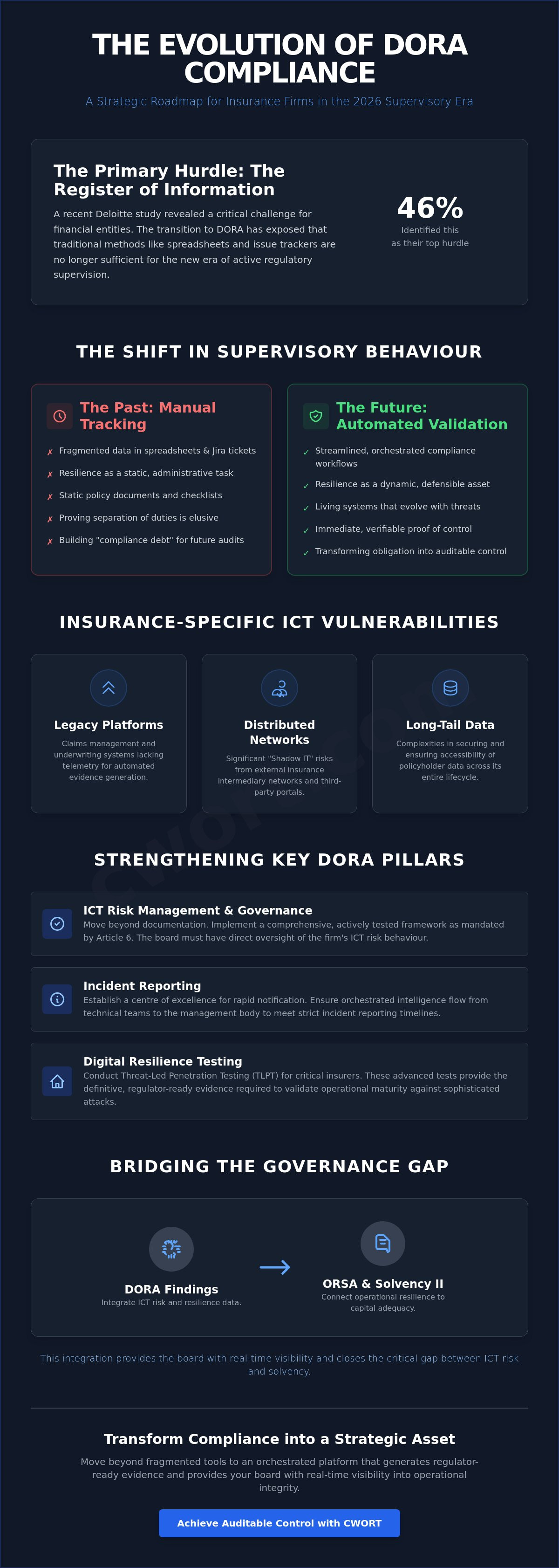
46% of financial entities recently identified the Register of Information as their most significant hurdle under DORA, according to a Deloitte study. For many, the transition to DORA compliance for insurance firms has revealed a painful reality: spreadsheets and Jira tickets are insufficient for the 2026 era of active regulatory supervision. You have likely spent hundreds of hours manually reconstructing evidence for ICT audits, only to find that proving a clear separation of duties remains frustratingly elusive. It is time to stop treating resilience as a static administrative task and start treating it as a dynamic, defensible asset.
This strategic analysis provides a roadmap for evolving your posture from manual tracking to automated, evidence-based validation. You will learn how to replace fragmented data with a streamlined, orchestrated workflow that satisfies EIOPA requirements with precision. We explore the shift toward real-time resilience status, ensuring your board possesses the visibility needed to navigate the intensified enforcement landscape of mid-2026 with absolute certainty. By moving beyond basic checklists, your firm can transform regulatory obligation into a state of auditable control.
Key Takeaways
- Move beyond initial implementation by adopting a continuous validation model that mirrors the 2026 supervisory landscape. Shift your focus from administrative tracking to maintaining a state of definitive, auditable resilience.
- Strengthen ICT risk management by aligning your framework with Article 6 requirements whilst establishing a centre of excellence for rapid incident notification.
- Integrate DORA findings directly into your Own Risk and Solvency Assessment (ORSA) to bridge the governance gap between operational resilience and Solvency II.
- Eradicate "compliance debt" by pivoting from fragmented manual tools to orchestrated DORA compliance for insurance firms.
- Transform compliance into a strategic asset by generating regulator-ready evidence that provides the board with real-time visibility into operational integrity.
Beyond Implementation: The 2026 Reality of DORA for Insurance Entities
The January 2025 deadline has passed, shifting the focus of DORA compliance for insurance firms from initial implementation to continuous, evidence-based validation. Regulators no longer accept intent; they demand proof. The Digital Operational Resilience Act (DORA) has fundamentally altered the supervisory landscape, moving the industry away from static policy documents toward a dynamic state of operational integrity. For insurance entities, this transition is particularly demanding due to the long-tail nature of policy data and the complexity of claims processing. You must move beyond the "compliance as a project" mindset to avoid the structural risks of 2026.
EIOPA and national competent authorities (NCAs) are now harmonising their expectations across the UK and EU. They seek to eliminate the inconsistencies that previously plagued national interpretations. This means your firm's ability to demonstrate real-time control outcomes is now the primary metric of success. If your resilience data remains trapped in fragmented spreadsheets, you're building on a foundation of compliance debt that will fail under the weight of a formal audit.
The Shift in Supervisory Behaviour
Supervisory activity in 2026 has transitioned from reviewing implementation plans to testing actual execution. Regulators are launching thematic reviews to scrutinise how firms handle real-world disruptions. You cannot rely on a static ICT Risk Management Framework. It must be a "living" system that evolves with the threat landscape, often bolstered by the MXDR and Microsoft Security expertise of CyberOne. NCAs are looking for evidence that resilience is woven into the firm's daily operations rather than being a quarterly reporting exercise. Prepare for examiners to ask for immediate, verifiable proof of control effectiveness during unannounced reviews.
Insurance-Specific ICT Vulnerabilities
Insurers face unique challenges, particularly regarding legacy claims management and underwriting platforms that were never designed for modern resilience standards. These systems often lack the telemetry required for automated evidence generation. Additionally, the widespread use of distributed insurance intermediary networks creates significant "Shadow IT" risks amongst your external partners. Managing data integrity whilst overseeing these actors is a critical priority. You must ensure that policyholder information remains secure and accessible, even when processed through third-party portals or outdated internal infrastructure. Failure to secure these touchpoints creates a vulnerability that regulators will exploit during the 2026 validation cycle, undermining the broader strategy for DORA compliance for insurance firms.
Strengthening the Five Pillars: Insurance-Specific ICT Resilience
The Five Pillars of DORA represent a structural shift in how insurance entities defend their digital perimeters. Whilst many firms have established basic protocols, DORA compliance for insurance firms in 2026 demands a rigorous, pillar-by-pillar validation of control effectiveness. Article 6 mandates a comprehensive ICT Risk Management Framework that isn't merely documented but actively tested. This requires insurers to move beyond generic cybersecurity standards and implement specific protections for actuarial models, underwriting algorithms, and policyholder databases. You must prove that your controls are functional under stress, not just present on paper.
Incident reporting serves as the first test of this framework's integrity. Establishing a centre of excellence for rapid notification ensures that your firm meets the strict timelines for major ICT-related incidents. This isn't about administrative speed; it's about the orchestrated flow of intelligence from technical teams to the management body. For those designated as "critical" insurers, the stakes are higher. You must now conduct Threat-Led Penetration Testing (TLPT) to prove resilience against sophisticated, targeted attacks. These tests provide the definitive evidence regulators require to validate your operational maturity.
ICT Risk Management and Governance
Governance is the catalyst for resilience. The board carries ultimate responsibility for the firm's ICT risk behaviour, a mandate that requires more than occasional oversight. Directors must possess the technical literacy to challenge resilience reports and ensure that ICT risk is integrated into the broader corporate governance structure. Budget allocation must shift from reactive maintenance to proactive orchestration. Following EIOPA's DORA guidance, firms should align their investment strategies with the actual risk profile of their digital assets, ensuring that every pound spent contributes to a defensible state of control.
Third-Party Risk in the Insurance Ecosystem
Managing third-party risk requires a granular understanding of your service chain. From global cloud providers to niche actuary firms, every dependency must be mapped within a formal Information Register. This is a critical component of DORA compliance for insurance firms, as it allows for the identification of concentration risks where multiple critical functions rely on a single provider. Standard contractual clauses are no longer enough; you need continuous monitoring of vendor resilience. To ensure your third-party ecosystem meets these rigorous standards, you might consider how to orchestrate your validation workflows through a centralised system that enforces accountability across the entire supply chain.
DORA vs Solvency II: Bridging the Governance and Validation Gap
Solvency II has long served as the cornerstone of risk management within the insurance sector, yet it leaves a significant "validation gap" that DORA now aggressively fills. Whilst Solvency II addresses operational risk through a broad lens of capital adequacy, it often relies on qualitative assessments and high-level management assertions. DORA demands a transition from these abstract estimations to concrete, quantitative resilience proof. For leadership teams, DORA compliance for insurance firms represents a fundamental shift in how risk is measured. You're no longer just assessing the likelihood of a failure; you're proving the technical integrity of the systems designed to prevent it.
The regulatory expectation has evolved. Examiners now look for a level of granular detail that traditional internal audits, designed for financial controls, frequently fail to provide. This isn't merely an incremental "uplift" of existing Solvency II processes. It is a new requirement for immutable, technical evidence that links directly to specific ICT control outcomes. If your firm continues to rely on "best effort" reporting, you're exposed to significant supervisory friction as national regulators intensify their 2026 enforcement cycles.
The Interplay of ORSA and DORA
Integrating DORA findings into your Own Risk and Solvency Assessment (ORSA) is no longer optional. Testing results from your ICT Risk Management Framework must directly inform the Solvency Capital Requirement (SCR). This alignment ensures that digital resilience scenarios are not siloed but are instead integrated with broader financial stress testing. By synchronising these functions, you achieve a unified view of risk that spans both actuarial models and ICT infrastructure. This holistic approach allows the board to understand how a technical failure in a claims portal could directly impact the firm's capital position, turning DORA compliance for insurance firms into a tool for strategic financial stability.
Binding Evidence to Control Outcomes
Manual evidence collection is the primary point of failure in modern ICT audits. Reconstructing spreadsheets or hunting for Jira tickets weeks after an event creates a fragmented narrative that auditors will inevitably challenge. To achieve audit readiness, you must bind evidence directly to specific regulatory obligations at the moment of execution. This creates a chain of traceability that is both transparent and indefensible.
- Replace static screenshots with automated telemetry logs.
- Link access control changes directly to authorised change requests.
- Ensure that every resilience test result is timestamped and cryptographically secured.
From Manual Tracking to Orchestrated Compliance Validation
Reliance on fragmented tools like Jira and Excel is no longer a viable strategy for maintaining DORA compliance for insurance firms. These systems were designed for general task management and financial modelling, not for the rigorous, technical demands of digital operational resilience validation. When you attempt to force complex regulatory technical standards into general-purpose spreadsheets, you create "compliance debt". This is a growing backlog of unverified controls and missing evidence that will inevitably surface during a 2026 supervisory review. You must pivot from manual tracking to a system of orchestrated validation that enforces discipline by design.
Translating the complex DORA Technical Standards (RTS and ITS) into daily execution requires more than just a list of tasks. It requires a strategic pivot to regulatory compliance workflow automation. This approach ensures that every requirement is mapped to a specific, verifiable action. By moving away from manual reconstruction, you transform compliance from a reactive, high-stress scramble into a proactive and defensible state of readiness. Structural integrity becomes a feature of your workflow rather than an afterthought.
The Failure of General-Purpose Project Tools
Jira tickets lack the structural integrity required for high-stakes regulatory audits. They're built for agility and developer speed, not for the immutable traceability required by EIOPA and national regulators. When documentation is scattered across disparate silos, "evidence drift" occurs. This leaves gaps in your resilience narrative that auditors will exploit. You cannot prove a control was effective six months ago if the evidence is buried in a closed ticket or a deleted email thread. Maintaining DORA compliance for insurance firms demands a single source of truth where every action is logged, timestamped, and linked directly to its specific regulatory obligation.
Enforcing Discipline through Orchestration
Orchestration replaces the uncertainty of manual oversight with the precision of automated workflows. By automating the assignment of obligations to specific subject matter experts (SMEs) and control owners, you eliminate the ambiguity that often leads to internal friction. This system-driven approach is essential for strictly enforcing DORA separation of duties. It ensures that the individuals responsible for operating a control are not the same ones validating its effectiveness, which is a critical requirement for ICT audits in 2026.
Every control activity must be backed by verified evidence that is captured at the point of execution. This proactive approach significantly reduces the "audit tax", which is the heavy manual overhead usually required to reconstruct evidence for regulators. When your compliance status is updated in real-time, you move from a state of anxiety to a state of auditable certainty. To see how your firm can achieve this level of structural integrity and eliminate compliance debt, request a demo of our compliance validation system.
Securing Board-Level Assurance with CWORT
CWORT redefines the relationship between insurance entities and their regulatory obligations. It transforms DORA compliance validation from a burdensome administrative cycle into a strategic asset. By providing a centralised platform for orchestration, it ensures that every control is active, every duty is separated, and every piece of evidence is immutable. You can finally replace the persistent anxiety of potential failure with the professional calm of auditable certainty. This isn't just about passing an inspection. It is about positioning your firm as a leader in digital operational resilience amongst your peers. By adopting a system built for the 2026 era, you demonstrate a commitment to structural integrity that manual processes simply cannot match.
Board-Level Visibility and Reporting
Board directors require more than high-level summaries. They need definitive, evidence-backed dashboards that reflect the firm's actual resilience status in real-time. CWORT provides this visibility by distilling complex ICT telemetry into clear, actionable metrics that mirror the language of governance and risk. This transparency allows the management body to demonstrate proactive oversight to stakeholders and investors. It proves that ICT risk is being managed with the same rigour as financial risk. Utilising a dedicated system also facilitates more effective central bank audit compliance. When regulators arrive for a thematic review, you aren't scrambling to find data. You are simply presenting a defensible truth that has been curated through disciplined orchestration.
The Path Forward: From Obligation to Evidence
The 2026 validation era leaves no room for ambiguity. To ensure your firm is prepared for the next wave of scrutiny, you must move beyond the spreadsheet and the general-purpose project tool. Consider this final checklist for DORA compliance for insurance firms as you transition to a model of continuous validation:
- Map all ICT third-party dependencies in a dynamic Information Register to identify concentration risks.
- Automate the collection of evidence for all Article 6 risk management controls to eliminate manual error.
- Enforce strict separation of duties within your compliance workflows to satisfy auditor expectations.
- Bridge the gap between ORSA and digital resilience testing by integrating technical findings into financial stress models.
The time for manual reconstruction has ended. Begin orchestrating your DORA compliance for insurance firms today to secure your operational future and protect your policyholders' data. Professional maturity in governance requires a proactive approach to evidence that is both transparent and unyielding. Visit cwort.com to request a demonstration of the platform and see how we turn regulatory pressure into structural strength.
Mastering the 2026 Validation Era
The transition from initial implementation to continuous validation is the defining challenge of 2026. You must move beyond static checklists and qualitative risk assessments to provide the quantitative, technical proof that regulators now demand. Successful DORA compliance for insurance firms requires a fundamental shift in perspective. Replace the administrative burden of manual tracking with the precision of orchestrated workflows. By binding immutable evidence directly to control outcomes, you eliminate the compliance debt that threatens operational stability.
Securing board-level assurance is no longer a project; it's a permanent state of auditable readiness. CWORT provides enterprise-level validation for DORA, NIS2, and ISO 27001, replacing fragmented tracking with disciplined orchestration. You can generate regulator-ready evidence without the need for manual reconstruction, ensuring your firm remains a leader in digital resilience.
Take control of your regulatory future. Validate your DORA compliance with CWORT to replace the anxiety of ICT audits with the confidence of structural integrity. Your path to a defensible, resilient future starts with orchestration.
Frequently Asked Questions
How does DORA specifically affect insurance intermediaries in the UK?
UK insurance intermediaries must comply with DORA if they provide services within the EU or operate through EU-based branches. Whilst the UK maintains its own operational resilience framework, DORA's technical standards apply to any entity participating in the EU financial ecosystem. Intermediaries must align their ICT risk management and incident reporting protocols with EU requirements to ensure uninterrupted market access and regulatory standing.
What is the relationship between DORA and Solvency II for large insurers?
DORA introduces prescriptive ICT requirements that expand upon the qualitative operational risk principles established under Solvency II. Whilst Solvency II focuses on capital adequacy and financial stability, DORA mandates granular, technical control over digital infrastructure. Insurers must integrate DORA validation results into their Own Risk and Solvency Assessment (ORSA) to provide a unified view of operational and financial risk to regulators.
Can insurance firms use their existing ISO 27001 frameworks for DORA compliance?
Insurance firms can use ISO 27001 as a foundational baseline, but they must perform a significant technical uplift to meet DORA's specific validation and reporting mandates. ISO 27001 is a voluntary management standard, whereas DORA is a prescriptive legal requirement with strict timelines for incident notification and third-party oversight. Mapping existing controls to DORA Technical Standards is essential to identify and remediate critical gaps.
What are the penalties for non-compliance with DORA in the insurance sector?
National competent authorities possess the power to impose significant administrative fines and public cease-and-desist orders for non-compliance. Beyond direct financial penalties, firms face the risk of losing their authorisation to operate in specific EU jurisdictions. Reputational damage and intensified supervisory scrutiny can also lead to increased capital requirements, making a defensible posture for DORA compliance for insurance firms a strategic necessity.
How should insurance firms manage ICT third-party risk under DORA Article 28?
Manage third-party risk by maintaining a comprehensive Register of Information that documents all ICT service dependencies across your supply chain. Article 28 requires specific contractual terms regarding data integrity, security, and right-to-audit. You must move beyond standard clauses and implement continuous monitoring of vendor resilience. This ensures that your third-party ecosystem does not become a point of failure during a 2026 supervisory review.
What constitutes a "critical or important function" for an insurance company?
A function is defined as critical or important if its disruption would materially impair the insurer's financial performance or the continuity of its core services. Examples include actuarial modelling, claims processing, and policyholder database management. Identify these functions immediately to prioritise the application of DORA's most rigorous ICT risk management and resilience testing requirements, ensuring that your most vital assets are protected by design.
How often must insurance firms perform digital operational resilience testing?
Perform digital operational resilience testing at least annually for all critical ICT systems and applications. This includes vulnerability assessments and scenario-based exercises to validate control effectiveness. Designated critical insurers must also conduct Threat-Led Penetration Testing (TLPT) at least every three years. Maintaining a regular testing cadence provides the immutable evidence needed to satisfy the intensified supervisory expectations of the 2026 validation era.
Why is evidence binding essential for a successful DORA audit?
Evidence binding is essential because it links technical logs and telemetry directly to specific regulatory obligations in real-time. This creates an unbreakable chain of traceability that satisfies auditor scrutiny during a DORA compliance for insurance firms audit. Without binding, evidence remains fragmented and requires manual reconstruction, which often leads to inconsistencies and compliance gaps. Orchestrated binding ensures your resilience status is always auditable and defensible.

Article by
Michael Iyiola
Michael Iyiola is a cybersecurity and AI engineering specialist with extensive experience in vulnerability management, detection engineering, and operational resilience. At CWORT, he designs scalable, evidence-driven workflows that help teams meet modern regulatory and security demands.
Disclaimer
The content on this site is provided for general information and educational purposes only. It does not constitute legal, regulatory, financial, or professional advice. CWORT provides AI-assisted insights and workflow automation, but all compliance decisions remain the responsibility of your organisation and its management. Always seek qualified legal or regulatory guidance for decisions relating to DORA, NIS2, ISO 27001, CAF, or other obligations.