
If your compliance strategy relies on a manual search through Jira tickets and Excel spreadsheets, you aren't managing evidence; you're managing a liability. Most regulated firms still struggle with fragmented data, spending weeks reconstructing audit trails before every inspection. It's a reactive cycle that leaves leadership exposed to personal liability under NIS2 and DORA. Transitioning to a robust system for enterprise compliance evidence management is no longer a luxury; it's a requirement for 2026.
You likely recognise that a box-ticking exercise won't survive a rigorous supervisory assessment. This checklist demonstrates how to move beyond administrative tracking to a rigorous, auditable system that satisfies DORA, NIS2, and UK NIS requirements. We will examine the shift from manual reconstruction to automated validation, ensuring your board reporting reflects a defensible reality rather than an optimistic estimate.
Key Takeaways
- Abandon the 'spreadsheet trap' by adopting a systematic approach to capture, bind, and protect audit artifacts in real-time.
- Establish a single source of truth through enterprise compliance evidence management that replaces fragmented data with centralised, immutable audit trails.
- Move beyond passive reporting to active validation, ensuring your system enforces separation of duties and prevents tamper-prone manual overrides.
- Prepare for 2026 inspections by mapping specific evidence requirements to DORA, NIS2, and UK NIS frameworks for total regulatory readiness.
- Transition to an orchestration engine that automatically generates regulator-ready outputs, providing the board with definitive proof of control effectiveness.
Why Manual Enterprise Compliance Evidence Management Fails in 2026
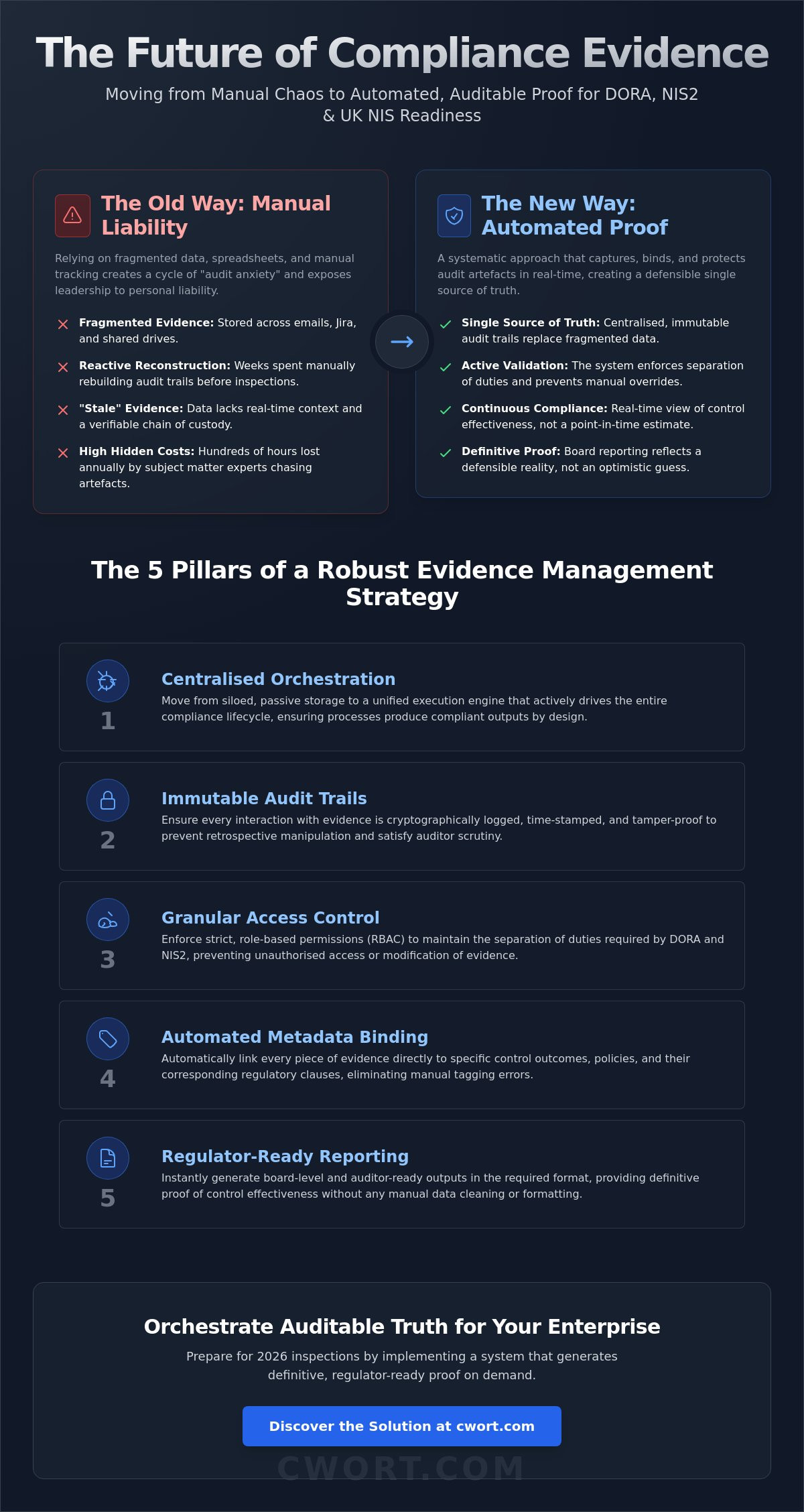
Enterprise compliance evidence management is the systematic orchestration of capturing, binding, and protecting audit artifacts. It isn't a passive storage exercise. It's a proactive discipline that ensures every control outcome is supported by tamper-proof metadata. In the current regulatory climate, firms must move beyond the "spreadsheet trap." Manual trackers are static; they cannot provide the real-time view of organisational resilience that DORA and NIS2 now demand. Relying on fragmented data creates a dangerous visibility gap that leaves leadership blind to control failures until an audit begins.
Fragmented evidence across email, shared drives, and messaging platforms triggers "audit anxiety." This panic-driven state leads to high reconstruction costs as teams scramble to prove compliance retrospectively. Modern Governance, risk, and compliance (GRC) framework implementations are shifting away from these periodic, point-in-time assessments. Regulators now expect continuous, evidence-based validation. If you can't produce an auditable truth within hours of a request, you aren't compliant; you're simply lucky.
The Hidden Cost of Manual Evidence Reconstruction
Reconstructing audit trails manually is a drain on high-value resources. Subject matter experts and compliance teams often lose hundreds of hours annually chasing artifacts across siloed departments. This process is inherently flawed because manual evidence lacks the "Chain of Custody" required for high-stakes regulatory scrutiny. When data isn't bound to execution in real-time, it becomes "stale evidence." It represents what happened weeks ago, not the current state of your controls. Secureframe (October 2025) reported that 35% of large enterprises conducted more than six audits in 2025. Without automation, the sheer volume of evidence required for this frequency makes manual management unsustainable.
Why Jira and Generic GRC Tools Are Not Enough
Task management is not validation. Regulators increasingly reject a "Status: Done" update in Jira as definitive proof of control effectiveness. They require the underlying metadata that proves the task was completed by the right person, at the right time, following the correct procedure. Generic GRC platforms often fail to enforce the rigorous separation of duties required by frameworks like DORA. They track the "what" but ignore the "how," leaving firms vulnerable during deep-dive inspections. To understand the specific rigour required for financial entities, see our guide on DORA Compliance Validation: A Guide for Financial Institutions. True enterprise compliance evidence management requires a system that binds evidence to outcomes automatically, ensuring that no control is marked "compliant" without an immutable proof of execution.
The 5 Pillars of a Robust Evidence Management Strategy
Effective enterprise compliance evidence management requires a transition from passive repositories to active validation engines. In 2026, regulators expect proof of continuous control effectiveness, not just a folder of PDF reports. A robust strategy rests on five non-negotiable pillars: centralised orchestration, immutable audit trails, granular access control, automated metadata binding, and regulator-ready reporting. These elements transform compliance from a reactive burden into a disciplined, defensible business function.
- Centralised Orchestration: Moving from siloed storage to a unified execution engine that drives the compliance lifecycle.
- Immutable Audit Trails: Ensuring every interaction with evidence is logged, time-stamped, and tamper-proof to prevent retrospective manipulation.
- Granular Access Control: Enforcing strict role-based permissions to maintain the separation of duties required by DORA and NIS2.
- Automated Metadata Binding: Linking every piece of evidence directly to specific control outcomes and their corresponding regulatory clauses.
- Regulator-Ready Reporting: Generating board-level and auditor-ready outputs instantly without the need for manual formatting or data cleaning.
Pillar 1: Orchestration Over Passive Storage
Orchestration is the operational core of enterprise compliance evidence management. Your evidence system must drive the compliance workflow; it should not merely store the result. When compliance is treated as a post-hoc documentation exercise, the risk of error and omission increases significantly. Organise your execution activities so they naturally produce the required evidence as a byproduct of the task itself. This approach ensures accountability amongst stakeholders by embedding structured validation steps into the daily operations of your technical and risk teams. If the system dictates the process, the evidence becomes an inevitable outcome of correct behaviour.
Pillar 2: The Importance of Evidence Binding
Evidence binding is the immutable link between a control activity and its auditable proof. Without this connection, you are left with "orphaned evidence," which is often the biggest threat to a successful audit. Orphaned evidence consists of files or logs that lack the necessary metadata to prove who performed an action, what was done, when it occurred, and how it relates to a specific regulatory obligation. To ensure your firm is prepared for the upcoming NIS2 audit deadlines in June 2026, you may wish to explore how a dedicated orchestration engine binds metadata to outcomes. Binding ensures that every artifact is contextually relevant and immediately defensible under scrutiny.
Moving from Tracking to Validation: Addressing the Orchestration Gap
Most firms mistake reporting for validation. Whilst reporting tells a story of what happened, validation provides the proof that the story is true. This distinction is critical in 2026. Regulators are increasingly focused on the "orchestration gap," which is the space between what your policies claim and what your systems actually do. Closing this gap requires a disciplined approach to enterprise compliance evidence management that enforces control execution in real-time. You can't rely on retrospective summaries when the law demands continuous operational resilience.
Subject Matter Experts (SMEs) often bear the brunt of manual tracking. They're forced to act as data collectors amongst competing priorities, leading to burnout and "stale" evidence. Automated validation removes this burden. By verifying metadata as tasks are completed, the system ensures that operational reality always aligns with policy intent. This shift transforms compliance from a retrospective scramble into a continuous state of auditable certainty. It replaces the anxiety of "did we do this?" with the confidence of "we can prove this was done."
Enforcing Separation of Duties (SoD)
SoD is a non-negotiable requirement for DORA and ISO 27001. You cannot permit the same individual to execute a control and then sign off on its effectiveness. An orchestration engine prevents this by design. It hard-codes these boundaries into your workflows, ensuring that execution and validation are performed by distinct, authorised roles. The system then documents this separation automatically, generating the exact evidence regulators look for during a deep-dive inspection. It eliminates the risk of "self-marking" that often leads to severe audit findings.
Validating Control Outcomes, Not Just Activity
Checklist compliance is dead. Modern regulators prioritise "effectiveness" testing over mere activity logs. It's not enough to prove you ran a scan; you must prove the scan identified vulnerabilities and that those vulnerabilities were remediated according to policy. Capturing evidence that proves a control worked as intended is essential. Implementing a robust ISO 27001 Control Mapping Tool helps bridge the gap between governance and execution. It ensures every operational artifact is bound to a specific regulatory clause, proving that your controls aren't just active, but effective.
Meeting DORA, NIS2, and UK NIS Evidence Requirements
Regulators in 2026 have moved past reviewing policy documents. They now demand granular, executable proof that your resilience strategies are functioning in real-time. Whether you're facing a Central Bank assessment under DORA or an NCSC audit against the CAF, the burden of proof has shifted. You must provide pre-validated evidence packages that demonstrate not just the existence of a control, but its continuous effectiveness. Failure to do so carries severe consequences; NIS2 penalties can reach €10 million or 2% of global turnover, whilst the new UK Cyber Security and Resilience Bill introduces fines up to £17 million.
A sophisticated approach to enterprise compliance evidence management allows you to map ISO 27001 controls across multiple frameworks simultaneously. This "collect once, map many" strategy eliminates duplicate evidence collection and ensures consistency across your regulatory footprint. It prevents the common pitfall of having contradictory evidence for the same control across different departments. By centralising your artifacts, you can generate board-level reports that reflect a unified view of your compliance posture, providing leadership with the auditable certainty they require to manage personal liability risks.
DORA: Proving Operational Resilience
DORA requirements focus heavily on ICT business continuity and disaster recovery. To satisfy an auditor, you must produce specific evidence artifacts, including recovery time objectives (RTO) validation and communication logs from crisis management drills. Demonstrating regular testing of resilience controls is mandatory. With the first notifications for Threat-Led Penetration Testing (TLPT) expected in 2026, firms must maintain automated logs that bind test results to remediation activities. If you are operating across borders, utilising a NIS2 Compliance Platform UK ensures your evidence meets both EU and local standards without manual intervention.
UK NIS and NCSC CAF: A UK-Centric Approach
The NCSC Cyber Assessment Framework (CAF) remains the benchmark for evidence collection in the UK. Your system must produce reports that reflect your current CAF maturity score across all four objectives. This requires a disciplined capture of evidence related to supply chain security and incident response readiness. Given the strict incident reporting timelines in effect—including an early warning within 24 hours of a significant incident—your evidence must be accessible instantly. Implementing NCSC CAF Assessment Software allows you to orchestrate these requirements into structured activities, ensuring you are always "regulator-ready."
Don't wait for an inspection to discover gaps in your audit trail. Request a demo to see how to automate your regulatory evidence collection and ensure total compliance across DORA, NIS2, and UK NIS frameworks.
CWORT: Orchestrating Auditable Truth for the Enterprise
Spreadsheets and generic task managers are passive repositories. They record what you hope happened, but they cannot enforce what must happen. CWORT replaces these fragmented workflows with a single, auditable compliance validation system. It functions as a proactive orchestration engine, translating complex regulatory obligations into structured, executable activities. This ensures that enterprise compliance evidence management is no longer a manual reconstruction exercise but a byproduct of disciplined operational execution. By hard-coding compliance into your daily workflows, you eliminate the gap between policy intent and reality.
Regulators, particularly during central bank audits, look for evidence that is bound to specific outcomes. CWORT provides this through a tamper-proof orchestration engine that automatically links metadata to control results. This level of rigour ensures your outputs survive the most intense scrutiny without requiring weeks of manual formatting. You move from a state of constant audit-readiness anxiety to a position of total assurance. The system enforces accountability by design, ensuring every control is validated before it is reported as effective.
From Obligation to Evidence: The CWORT Workflow
The CWORT workflow ensures that every control is executed by the authorised individual with the correct evidence captured at the point of origin. It removes the ambiguity of "Status: Done" by requiring the specific metadata that proves a control functioned as intended. For leadership, this translates into a single dashboard for Automated Compliance Status Reporting for the Board. This visibility allows senior managers to oversee their regulatory footprint with objective certainty, whilst ensuring that separation of duties is maintained amongst all stakeholders.
Why Leading UK Enterprises Trust CWORT
Manual evidence collection is a "compliance tax" that drains resources and increases operational risk. Leading UK enterprises utilise CWORT to automate these processes, significantly reducing the time spent on manual validation. The platform enforces a "discipline by design" approach that is essential for meeting the high-stakes requirements of DORA and the UK NIS Regulations. It provides a structured path from abstract legal requirements to concrete, defensible proof. Discover how CWORT can orchestrate your enterprise compliance today and replace manual tracking with a system of auditable truth.
Command Your Auditable Truth
The regulatory landscape of 2026 doesn't permit administrative excuses. Fragmented data and manual reconstruction are no longer viable strategies for firms facing DORA or NIS2 scrutiny. You've seen how the shift from passive tracking to active validation provides the only path to auditable certainty. By implementing a disciplined system for enterprise compliance evidence management, you transform compliance from a reactive scramble into a strategic advantage. It's about replacing the anxiety of potential failure with the calm of defensible proof.
CWORT provides the orchestration engine needed to secure this reality. It replaces fragmented Excel and Jira tracking with a unified system that orchestrates DORA, NIS2, and ISO 27001 requirements. Most importantly, it enforces Separation of Duties by design, ensuring your evidence is beyond reproach. Book a CWORT demo to see enterprise compliance orchestration in action and gain total assurance in your control effectiveness. Take control of your compliance destiny today.
Frequently Asked Questions
What is the difference between a GRC tool and an evidence management platform?
A GRC tool is primarily a system of record for policy and risk documentation, whereas an evidence management platform is a system of execution. Whilst GRC tools provide a high-level overview of compliance status, they often lack the granular metadata required to prove a control actually worked. An evidence management platform orchestrates the capture and binding of artifacts directly to regulatory clauses, ensuring every claim of "compliance" is backed by immutable proof of execution.
How does DORA change the requirements for evidence management in financial services?
DORA shifts the focus from point-in-time audits to continuous operational resilience. It requires firms to maintain a real-time "Register of Information" regarding ICT third-party providers and provide definitive evidence of resilience testing. This necessitates a more sophisticated approach to enterprise compliance evidence management to ensure all ICT risk management activities are documented, time-stamped, and ready for supervisory assessment without the lag associated with manual reconstruction.
Can we integrate our existing Jira workflows into an evidence management system?
You can integrate Jira, but it's vital to recognise that Jira tracks tasks, not technical validation. Regulators often reject a "Status: Done" update as sufficient proof of a security control. An effective evidence management system ingests these task updates and binds them to the underlying execution metadata. This transition ensures that your existing workflows contribute to a defensible audit trail rather than just a list of completed tickets.
How do I prove separation of duties to a regulator during an audit?
Proving separation of duties requires a tamper-proof log that identifies distinct actors for execution and validation phases. You must demonstrate that the individual responsible for a technical change is not the same person who approved the evidence of its success. A robust orchestration engine enforces these role-based permissions by design, automatically generating the metadata that confirms these boundaries were never breached during the compliance lifecycle.
What makes evidence 'regulator-ready' for UK NIS or NIS2 inspections?
Regulator-ready evidence must be contextually mapped to specific clauses within the UK NIS or NIS2 frameworks. It isn't enough to produce a log file; you must provide the "who, what, when, and how" bound to the specific regulatory obligation. This includes a clear chain of custody and an immutable timestamp, ensuring the auditor can verify the artifact hasn't been modified retrospectively to hide control failures.
Is automated evidence collection enough to satisfy ISO 27001 requirements?
Automated collection is a foundational step, but ISO 27001 also requires evidence of control effectiveness and management review. You must prove that collected artifacts are actually reviewed and that any anomalies are remediated according to policy. True enterprise compliance evidence management goes beyond simple data gathering by orchestrating these review cycles and binding the resulting management approvals to the original technical evidence.
How can I reduce the time spent on manual evidence reconstruction each year?
You can reduce reconstruction time by moving from a reactive "audit prep" model to a continuous validation model. Capturing evidence at the moment of execution ensures that your audit trail is built in real-time. This eliminates the "compliance tax" of chasing subject matter experts for artifacts months after the event. By orchestrating these activities, you ensure that every operational task naturally produces the proof required for future inspections.
What are the risks of using spreadsheets for enterprise compliance evidence?
Spreadsheets are a primary source of audit failure because they lack version control and immutable audit trails. They are static documents that cannot provide a real-time view of organisational resilience or prove the separation of duties. In a high-stakes environment like DORA or NIS2, relying on manual trackers creates a dangerous liability. They are easily manipulated and often contain stale data that won't survive rigorous regulatory scrutiny.

Article by
Michael Iyiola
Michael Iyiola is a cybersecurity and AI engineering specialist with extensive experience in vulnerability management, detection engineering, and operational resilience. At CWORT, he designs scalable, evidence-driven workflows that help teams meet modern regulatory and security demands.
Disclaimer
The content on this site is provided for general information and educational purposes only. It does not constitute legal, regulatory, financial, or professional advice. CWORT provides AI-assisted insights and workflow automation, but all compliance decisions remain the responsibility of your organisation and its management. Always seek qualified legal or regulatory guidance for decisions relating to DORA, NIS2, ISO 27001, CAF, or other obligations.