
If your NIS2 compliance strategy relies on a manual checklist, you aren't managing risk; you're simply documenting your eventual failure. The October 2024 deadline has passed, and the reality of board-level liability is now a concrete operational pressure rather than a distant regulatory threat. It's exhausting to spend hundreds of hours on manual evidence collection only to realise that your records lack the rigour required for a high-stakes audit. Deploying dedicated NIS2 technical standards software is no longer optional for organisations that require definitive, defensible proof of their security posture.
We recognise the fatigue that comes from trying to prove complex requirements like "separation of duties" within static tools like Jira or Excel. You need a system that enforces discipline and accountability by design. This guide provides a clear roadmap to move beyond administrative tracking toward a validated, software-driven approach. You'll learn how to automate the binding of evidence to specific controls, reducing audit anxiety and replacing fragmented processes with a single, orchestrated source of truth.
Key Takeaways
- Identify the critical technical pillars of Article 21 and understand why 2026 is the definitive deadline for validating implementation amongst "Essential" and "Important" entities.
- Scale technical controls proportionately to your specific risk profile, ensuring compliance remains rigorous whilst avoiding unnecessary operational friction.
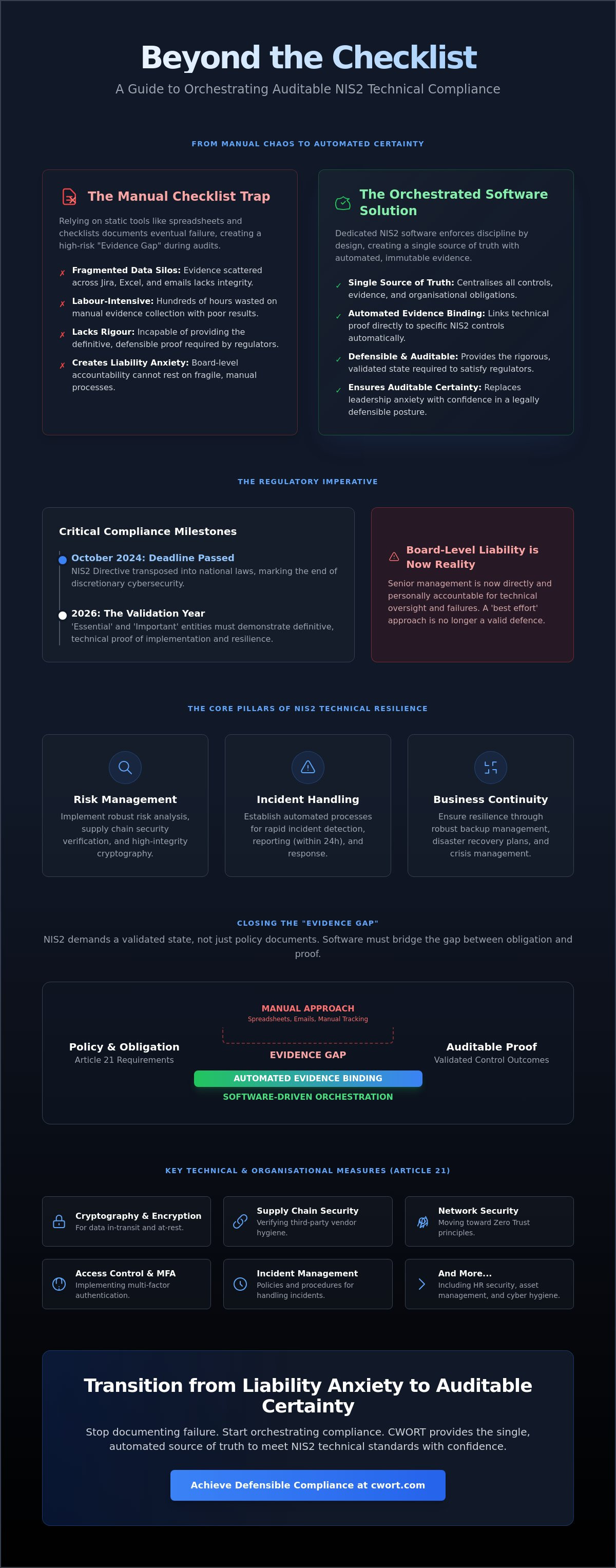
- Eliminate the "Evidence Gap" inherent in manual checklists by adopting a NIS2 technical standards software approach that provides definitive, auditable proof of control outcomes.
- Transition from fragmented data silos in Jira or Excel to a disciplined, orchestrated workflow that maps organisational obligations directly to executable activities.
- Establish a single source of truth that automates evidence binding, allowing leadership to replace liability anxiety with the calm of auditable certainty.
Understanding NIS2 Technical Standards for UK Enterprises
The transposition of the NIS2 Directive into national laws by October 2024 marked the end of discretionary cybersecurity. For UK enterprises with European operations or supply chain dependencies, 2026 represents the critical validation year. By this point, "Essential" and "Important" entities must demonstrate more than just policy documents. They require definitive, technical proof of resilience. The shift from "best effort" security to a "legally defensible" posture is absolute, requiring a structural change in how organisations document and verify their security controls.
NIS2 technical standards require a rigorous orchestration of three primary pillars: risk management, incident handling, and business continuity. Relying on manual updates or static spreadsheets is no longer sufficient to meet these demands. Organisations are increasingly turning to NIS2 technical standards software to bridge the gap between abstract regulatory requirements and concrete, auditable reality. This transition ensures that every control is backed by immutable evidence rather than administrative assertions, providing the rigour necessary to satisfy both internal auditors and external regulators.
The Core Technical Domains
Implementation begins with high-integrity cryptography and encryption standards for data, whether at rest or in transit. This is not a mere suggestion; it is a baseline requirement for data integrity. Similarly, network security architecture must move away from perimeter-based models toward Zero Trust principles. Validation also extends beyond your internal network. You must now actively monitor and verify the technical hygiene of your entire supply chain, ensuring that third-party vulnerabilities do not become your legal liabilities. Proactive monitoring and automated evidence collection are the only ways to maintain this level of oversight amongst a complex vendor landscape.
The Legal Gravity of Technical Failure
The directive introduces a level of personal liability for senior management that was previously absent from most cybersecurity frameworks. Boards are now directly accountable for technical oversight. This "all-hazards" approach integrates physical security into the technical standard, requiring a unified view of resilience across the entire organisation. Whilst the UK currently operates under the NIS Regulations 2018 and the NCSC CAF, the move toward the more stringent NIS2 framework is inevitable for those operating internationally. Transitioning to a software-driven model for NIS2 Compliance Orchestration allows leadership to maintain control through automated, real-time validation, replacing the anxiety of potential failure with the certainty of auditable truth.
The Anatomy of NIS2 Technical Requirements
Article 21 of the directive mandates ten baseline technical and organisational measures that every entity must implement. These range from risk analysis and incident handling to supply chain security and the use of cryptography. These aren't merely administrative suggestions; they're rigid operational requirements. For organisations looking to align their infrastructure with these mandates, ENISA's NIS2 technical guidance provides a sophisticated framework for mapping abstract obligations to concrete system configurations. The goal is to move from a "compliance as a document" mindset to "compliance as a validated state."
Proportionality is a core tenet of this framework. Whilst "Essential" entities face the most rigorous scrutiny, even "Important" entities must maintain a high standard of cyber hygiene. This foundational layer includes multi-factor authentication, robust patching cycles, and zero-trust access controls. However, the primary bottleneck in achieving this is manual oversight. Human-led tracking is slow, error-prone, and incapable of providing the real-time assurance that modern auditors demand. Deploying NIS2 technical standards software solves this by replacing fragile spreadsheets with a disciplined, automated environment where controls are continuously monitored and evidence is captured by design.
Incident Management and Reporting
The 24-hour "Early Warning" requirement is perhaps the most demanding technical trigger within the directive. Organisations must identify and report "significant" incidents within a timeframe that leaves no room for manual deliberation. Automation is the only viable path to bridge the gap between detection and regulatory notification. By binding forensic evidence directly to incident reports at the moment of detection, you create an immutable audit trail that proves your response was both timely and technically sound. If you're finding it difficult to translate these reporting triggers into a functional workflow, it may be time to explore how orchestration simplifies the process.
Business Continuity and Crisis Management
Resilience isn't a static achievement; it's a capability that must be proven. Technical standards for backup management and disaster recovery now require regular, documented stress testing to validate system recovery times. It's no longer enough to simply possess a backup. You must demonstrate that your recovery orchestration works under pressure. Furthermore, you must ensure that secure, out-of-band communication channels remain available during a technical outage, allowing crisis management teams to coordinate without relying on compromised infrastructure. This level of readiness requires a shift from passive storage to active, orchestrated resilience.
Why Spreadsheets Fail NIS2 Technical Audits
Regulators in 2026 have moved beyond surface-level reviews. They now demand definitive, timestamped proof of control outcomes. A ticked box in an Excel spreadsheet is merely an assertion; it's not evidence. This creates a dangerous "Evidence Gap" where an organisation believes it's compliant whilst actually remaining vulnerable during a deep-dive audit. The European Commission's NIS2 Directive overview emphasises the necessity of a high common level of cybersecurity across the Union, a standard that manual trackers simply cannot sustain. Without a dedicated NIS2 technical standards software solution, you're essentially gambling on the auditor's leniency.
One of the most critical failures of manual tools is the inability to enforce "Separation of Duties" (SoD). In a spreadsheet, the person performing a technical task is often the same individual validating its completion. This lack of structural integrity is a major red flag. Sophisticated frameworks require that the execution of a technical control remains independent from its validation. Spreadsheets lack the permission logic and immutable audit trails required to prove this separation. Relying on manual oversight creates a single point of failure that can lead to significant board-level liability.
The Problem with Manual Validation
Manual validation is inherently fragile. Human error leads to stale or missing data, especially when evidence is scattered amongst email threads and local drives. When an auditor arrives, the administrative burden of "reconstructing" compliance becomes an all-consuming task for the security team. This reactive approach lacks real-time visibility. Boards and senior stakeholders are left in the dark, unable to see the current state of compliance until a manual report is painstakingly compiled, often weeks after the data was collected.
Beyond Task Management
Many organisations mistake task management for compliance. Jira is an excellent tool for execution, but it's not a compliance validation system. It tracks what people are doing, not whether those actions meet a specific regulatory obligation. You need a system that binds evidence directly to the technical mandate. Understanding Why Jira is Not a Compliance Orchestration Tool is essential for moving toward a more robust model. True orchestration ensures that the output of a technical activity is automatically validated and mapped to the relevant NIS2 control, creating a continuous, auditable trail of truth.
Selecting and Implementing NIS2 Technical Standards Software
Static mapping tables are a useful starting point, but they don't constitute a compliance strategy. Implementation is a dynamic, operational workflow that requires more than just a list of requirements. Selecting the right NIS2 technical standards software requires a shift in perspective. You aren't merely purchasing a repository for documents; you're deploying a proactive engine for validation. To move from abstract obligation to auditable certainty, your implementation must follow a disciplined, linear progression.
- Step 1: Map obligations to controls. Translate Article 21 requirements into specific technical controls tailored to your infrastructure.
- Step 2: Define execution activities. Break down each control into repeatable, documented activities that technical teams must perform.
- Step 3: Orchestrate the workflow. Ensure that evidence is captured automatically at the point of execution, eliminating the need for retrospective data gathering.
- Step 4: Enforce separation of duties. Use system-driven workflows to ensure that the individual performing a task is never the one validating its success.
- Step 5: Generate audit-ready outputs. Produce real-time reports directly from validated data, providing the board with an uncompromising view of the organisation's resilience.
This systematic approach replaces the chaos of manual tracking with a structured environment where every action is recorded and every control is verified. To see this orchestration in practice, book a demonstration of our validation platform.
Key Features to Look For
The most effective NIS2 technical standards software prioritises evidence binding. This is the ability to attach immutable proof, such as system logs or configuration screenshots, directly to a control outcome. Furthermore, your solution should offer multi-framework support. Managing NIS2 in isolation is inefficient. Integrating a ISO 27001 Control Mapping Tool allows you to harmonise these efforts, mapping a single technical activity to multiple regulatory obligations simultaneously. Look for board-level dashboards that provide real-time status updates rather than static, month-old reports.
Deploying Software in a Critical Infrastructure Environment
Successful deployment requires onboarding subject matter experts (SMEs) and consulting teams into a unified validation workflow. The objective is to integrate with your existing security stack without creating "tool fatigue" amongst your engineers. The software should act as an orchestration layer that sits above your execution tools, capturing the necessary data without disrupting daily operations. Finally, ensure the software itself meets the rigorous supply chain security standards mandated by NIS2. You cannot secure your infrastructure using a tool that introduces its own unverified risks into your environment.
CWORT: Orchestrating Auditable NIS2 Compliance
Professional services provide a temporary snapshot of compliance; CWORT provides a permanent orchestration engine. Whilst consultants can help you understand the directive, they cannot maintain the rigorous, daily evidence collection required for long-term validation. CWORT translates complex NIS2 obligations into a structured sequence of executable activities. This transformation ensures that technical teams aren't just "doing security," but are instead generating the specific, validated outputs required by law. It replaces the frantic, manual reconstruction of compliance history with an automated, immutable single source of truth.
The core of the CWORT philosophy is a transition from "trust me" to "show me." In a high-stakes regulatory environment, assertions of security are worthless without evidence. Our NIS2 technical standards software binds every control outcome to its supporting proof at the moment of execution. This creates a defensible reality that satisfies even the most meticulous auditors. When a regulator demands proof of your incident response or backup validation, you don't need to search through fragmented archives. You simply generate a comprehensive, regulator-ready report at the click of a button, demonstrating total structural integrity.
The CWORT Advantage for UK Enterprise
For UK organisations navigating the intersection of domestic and European mandates, CWORT offers a decisive advantage. It enforces the "separation of duties" by design, ensuring that validation logic is baked into your workflow rather than being an afterthought. This system-driven accountability prevents the internal conflicts of interest that often lead to audit failures. By deploying a dedicated NIS2 Compliance Platform UK, leadership can maintain auditable certainty. You move from a state of constant anxiety about potential liability to a position of strategic control, backed by real-time data.
Ready for 2026 and Beyond
Technical standards are not static. As threats evolve, so too will the requirements for "Essential" and "Important" entities. CWORT is designed to future-proof your organisation against these shifting demands. Our platform allows you to adapt your technical controls and execution activities without rebuilding your entire compliance framework from scratch. For a deeper analysis of long-term strategy, consult our guide on NIS2 Compliance for Critical Infrastructure. Don't wait for a deep-dive audit to expose the gaps in your manual process. Book a demo of CWORT’s NIS2 Orchestration Engine today and secure your organisation's defensible truth.
Secure Your Defensible Technical Reality
The transition from administrative tracking to evidence-based validation is no longer a strategic choice; it's a regulatory mandate. You've seen why manual checklists fail to meet the rigorous demands of modern audits and how the right NIS2 technical standards software replaces fragmented silos with a disciplined, orchestrated workflow. Relying on static spreadsheets creates an "Evidence Gap" that no amount of manual effort can bridge. True resilience requires a system that captures immutable proof at the point of execution, ensuring your organisation is always audit-ready.
CWORT is a UK-developed platform by Lapace Services UK Ltd, engineered specifically for the complexities of DORA, NIS2, and ISO 27001. It enforces the separation of duties by design, providing the board with the auditable certainty they require in a high-stakes environment. Stop fighting against manual evidence collection and start leading with definitive proof. Orchestrate your NIS2 compliance with CWORT and reclaim control over your technical obligations. You've built a resilient infrastructure; now it's time to prove it with absolute confidence.
Frequently Asked Questions
What are the specific NIS2 technical standards for incident reporting?
NIS2 mandates a multi-stage reporting process that prioritises speed and forensic accuracy. You must submit an "early warning" within 24 hours of becoming aware of a significant incident, followed by a formal notification within 72 hours. The technical standard requires your systems to detect significant disruptions and provide immediate data on the incident's impact. This ensures that regulators receive timestamped, evidence-based alerts rather than vague, retrospective summaries of a breach.
Can I use ISO 27001 software to meet NIS2 technical requirements?
You can leverage ISO 27001 mappings, but standard ISO software often lacks the specific legal triggers and multi-stage reporting timelines mandated by NIS2. Whilst ISO 27001 provides a robust management framework, NIS2 requires specific technical measures like 24-hour reporting and direct board-level liability tracking. Using dedicated NIS2 technical standards software ensures these specific legal nuances are automated and validated rather than just tracked as general security tasks.
How does NIS2 software help with supply chain security?
NIS2 software facilitates supply chain security by automating the technical validation of third-party hygiene. It moves beyond simple questionnaires to requiring evidence-based proof of a supplier's security controls. The system orchestrates the collection and verification of this data, ensuring that your organisation isn't exposed to vulnerabilities from direct suppliers. This proactive approach replaces passive trust with a disciplined, auditable verification process that satisfies the directive's "all-hazards" risk management requirements.
What is the difference between a GRC tool and NIS2 orchestration software?
GRC tools are primarily repositories for policies and static risk assessments; orchestration software is an active engine for execution and validation. Whilst GRC tools document what you should do, orchestration systems ensure the technical work is actually performed and verified in real-time. Orchestration binds immutable evidence directly to controls. GRC tools often rely on manual assertions that lack the structural rigour and timestamped proof required for deep-dive technical audits.
Is separation of duties a mandatory technical requirement under NIS2?
Yes, separation of duties is a fundamental requirement for maintaining the integrity of technical controls under the directive. It ensures that the individual responsible for executing a security task is not the same person who validates its completion. This structural discipline prevents internal conflicts and operational errors. Effective NIS2 technical standards software enforces this by design through system-driven workflows, providing auditors with definitive, immutable proof of operational independence and accountability.
How long does it take to implement NIS2 technical standards software?
Implementation timelines vary based on infrastructure complexity, but a software-driven orchestration approach typically achieves a validated state within three to six months. This is significantly faster than manual reconstruction, which often leaves organisations with persistent compliance gaps. The process involves mapping existing infrastructure to technical controls and automating the evidence-collection workflows. Rapid deployment is critical given that the 2024 transposition deadline has passed and the 2026 validation cycle is approaching.
Does NIS2 apply to UK companies without EU offices?
NIS2 applies to UK companies if they provide essential or important services within the EU, regardless of physical office locations. This includes digital service providers, cloud firms, and managed IT services operating in the European market. These organisations must appoint a representative in an EU member state and adhere to the same technical standards and reporting obligations as EU-based entities. Failure to comply can result in fines of up to 2% of global annual turnover.
How can I prove technical compliance to an auditor without manual spreadsheets?
You prove compliance by maintaining an automated, timestamped audit trail of all technical activities and their corresponding evidence. Sophisticated orchestration platforms bind forensic proof directly to regulatory obligations as tasks are completed. This creates a single source of truth that auditors can access directly. It replaces the administrative burden of manual reconstruction with a real-time dashboard of validated controls, providing auditable certainty without the fragility or error-rates of manual data entry.

Article by
Michael Iyiola
Michael Iyiola is a cybersecurity and AI engineering specialist with extensive experience in vulnerability management, detection engineering, and operational resilience. At CWORT, he designs scalable, evidence-driven workflows that help teams meet modern regulatory and security demands.
Disclaimer
The content on this site is provided for general information and educational purposes only. It does not constitute legal, regulatory, financial, or professional advice. CWORT provides AI-assisted insights and workflow automation, but all compliance decisions remain the responsibility of your organisation and its management. Always seek qualified legal or regulatory guidance for decisions relating to DORA, NIS2, ISO 27001, CAF, or other obligations.