If 81% of organisations are now pursuing ISO 27001 certification to satisfy enterprise procurement demands, why are so many still risking their reputation on the fragile logic of a spreadsheet? Relying on manual tracking in 2026 is no longer a viable strategy for governance. It's a liability that invites version control chaos and weeks of manual evidence reconstruction. Implementing a dedicated ISO 27001 internal audit software isn't just about administrative efficiency. It's about establishing a disciplined, systematic environment where every control is validated by design and every outcome is defensible.
Key Takeaways
- Master the transition from passive spreadsheet tracking to active orchestration to satisfy Clause 9.2 obligations with definitive, evidence-based proof.
- Identify the critical features of ISO 27001 internal audit software that ensure evidence is bound directly to execution activities for a defensible audit trail.
- Avoid the "fragmentation trap" caused by generic GRC tools and manual processes that lack the necessary rigour for high-stakes regulatory validation.
- Implement a structured, software-led roadmap that prioritises the mapping of specific obligations to owners during the crucial pre-audit phase.
- Shift your focus from mere administrative management to total assurance by adopting a Compliance Validation framework as your primary orchestration engine.
Understanding the Shift to ISO 27001 Internal Audit Software
Maintaining a robust information security management system requires a decisive shift from administrative tracking to definitive, evidence-based proof. Modern ISO 27001 internal audit software serves as a proactive orchestration engine designed specifically to meet the rigorous demands of Clause 9.2. By June 2026, the transition period for the 2022 revision has concluded; organisations must now demonstrate compliance against the updated ISO/IEC 27001 standard with absolute precision. Passive tracking is no longer an option. Leadership requires active validation that transforms abstract requirements into a defensible reality.
The 2026 regulatory landscape in the UK demands audit-ready outputs that survive intense scrutiny from both certification bodies and framework authorities. Whether you're aligning with NIS2 or preparing for a DORA assessment, your internal audit process must be more than a periodic check. It's a continuous validation exercise. Software-led orchestration replaces the anxiety of potential failure with the calm of auditable certainty, ensuring that every control is not just "monitored" but verified through a disciplined, systematic approach.
The Core Requirements of Clause 9.2
From Spreadsheets to Orchestration
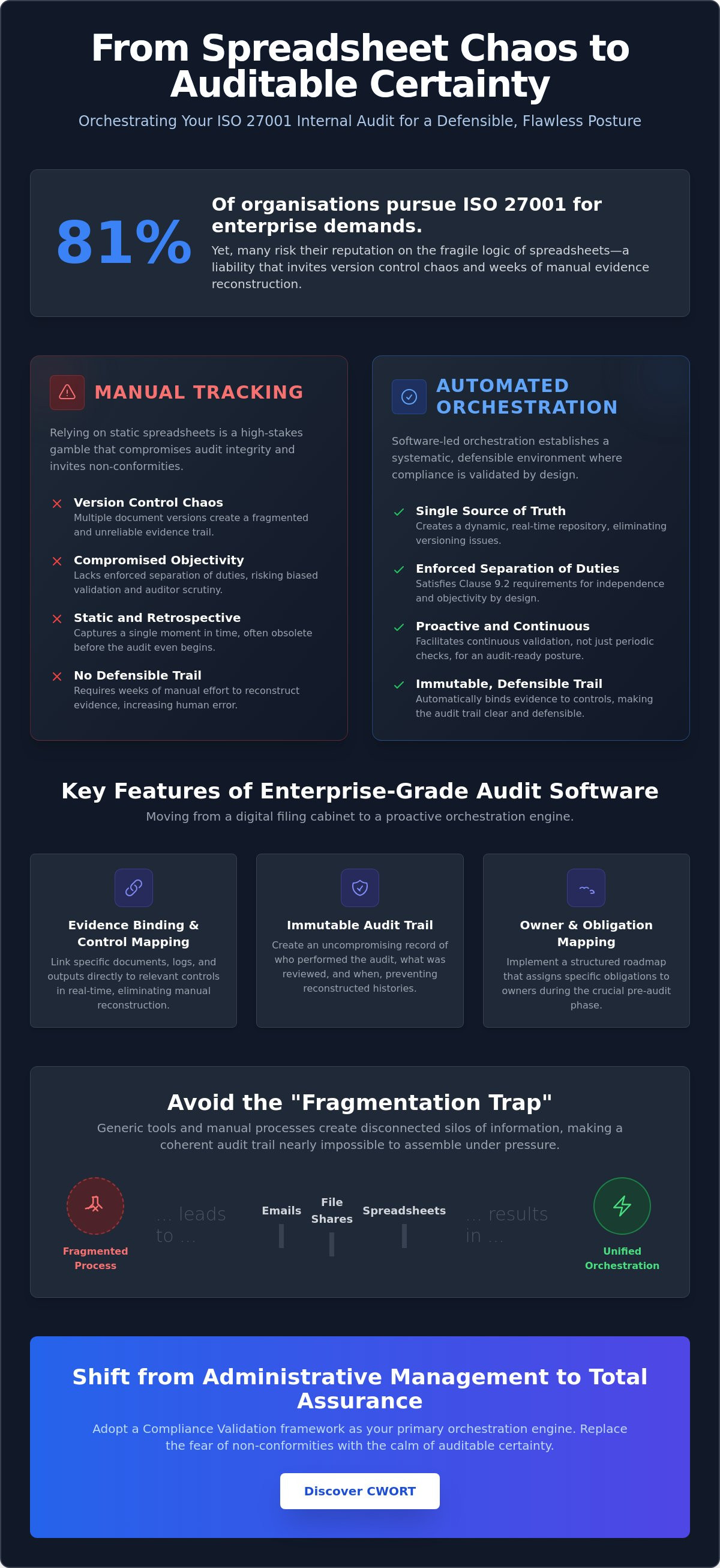
Spreadsheets are inherently static; they capture a single moment in time that is often obsolete by the time a review begins. They're prone to version control chaos and lack the structural integrity needed for high-stakes governance. Orchestration platforms like CWORT provide a dynamic environment where evidence is bound to control outcomes in real-time. This creates a single source of truth that eliminates the "fragmentation trap" of hunting through emails and file shares for proof. By moving to a SaaS-based orchestration model, you ensure that your audit workflow is repeatable, scalable, and, most importantly, defensible under any level of professional scrutiny.
Key Features of Enterprise-Grade Audit Orchestration
Modern orchestration platforms provide a structured environment where every audit activity is mapped to a specific outcome. This ensures that the internal audit process remains rigorous and uncompromisingly objective. When Implementing the ISO 27001 Standard, practitioners often find that the biggest hurdle is not the controls themselves, but the ability to prove their consistent application. Software-led orchestration removes this ambiguity by forcing a logical progression from obligation to evidence.
Evidence Binding and Control Mapping
True orchestration relies on the mechanism of binding evidence directly to control outcomes. Instead of hunting through disparate file shares during the final audit phase, software allows you to link specific documents to relevant controls in real-time. This eliminates the need for manual evidence reconstruction, a process that typically takes weeks and introduces significant error risk. Utilising ISO 27001 control mapping ensures that every requirement is accounted for and owned by a specific subject matter expert. This systematic approach reduces audit fatigue and guarantees that your evidence is always current, relevant, and ready for external review.
Enforcing Separation of Duties
Auditors cannot mark their own homework. This is a fundamental principle of Clause 9.2 that manual systems often fail to uphold. Enterprise-grade software prevents this conflict of interest by implementing robust role-based access controls (RBAC) within the audit workflow. By enforcing separation of duties, the system ensures that the person responsible for managing a control is not the same person validating its effectiveness. This level of structural integrity is essential for maintaining the independence and objectivity required by certification bodies. If you are looking to replace manual chaos with auditable certainty, you might consider how to orchestrate your next internal audit cycle through a unified validation platform.
Why Spreadsheets and Generic GRC Tools Fail Internal Auditors
Effective governance requires a move from administrative tracking to definitive, evidence-based proof. When you use generic task managers, you're merely checking boxes without validating the underlying security posture. This disconnect makes it impossible to provide a cohesive, real-time narrative of your ISMS health. Instead of a proactive system that enforces discipline, you're left with a reactive scramble that compromises the objectivity of your internal audit. Dedicated ISO 27001 internal audit software eliminates this risk by ensuring that every activity is performed within a framework designed for scrutiny.
The Fragmentation Trap: Jira vs. Orchestration
Jira functions as an excellent task manager for software development, but it is not a compliance validation engine. Tickets are often closed without the necessary evidence being bound to the outcome, leaving auditors to hunt through comments and attachments. Extracting "audit-ready" proof from such a system is a manual nightmare that lacks traceability. As explored in our guide on Why Jira is Not a Compliance Orchestration Tool, generic ticketing systems cannot enforce the rigorous standards required for modern regulatory validation. They manage tasks; they do not validate compliance.
The Excel Risk: Why Regulators Reject Manual Trackers
Spreadsheets are the ultimate liability in a modern audit. They lack immutable audit trails, making it impossible to prove that evidence hasn't been tampered with or retroactively adjusted. Manual data entry inevitably leads to "stale" compliance statuses, where the spreadsheet suggests a control is effective whilst the reality on the ground has shifted. This leads to the familiar, high-stress "night before the audit" scramble. Without a single source of truth, organisations cannot achieve the calm of auditable certainty. Regulators increasingly reject these manual trackers in favour of systems that offer real-time, tamper-proof validation and clear accountability.
Step-by-Step: Conducting an Internal Audit Cycle Using Software
Executing a software-led internal audit transforms a fragmented manual process into a disciplined, high-velocity workflow. Unlike static checklists that merely record observations, ISO 27001 internal audit software facilitates an active execution workflow where every step is validated in real-time. This transition from "tracking" to "orchestration" ensures that your ISMS remains audit-ready throughout the year. By following a structured roadmap, you replace the frantic scramble of manual reconstruction with a repeatable, defensible process that satisfies both internal governance and external certification bodies.
Phase 1: Planning and Scoping the Audit
Define your audit criteria and scope directly within the orchestration platform to ensure total alignment with the 2022 standard. Instead of sending vague email requests, assign specific "obligations" to subject matter experts (SMEs) across the organisation. This granular approach ensures that every control owner understands exactly what is required of them. Establish clear deadlines and configure automated reminders to enforce accountability by design. This pre-audit phase is critical; it creates a structured environment where the audit's success is determined by the integrity of the initial mapping rather than the speed of the final review.
Phase 2: Execution and Evidence Capture
Shift the burden of evidence collection from the auditor to the control owner. During this phase, SMEs upload proof directly to the relevant control as work happens, rather than weeks after the fact. The software validates this evidence against predefined criteria, ensuring it meets the necessary standards for completeness and relevance. This "always-on" monitoring approach turns the internal audit into a continuous validation exercise. It eliminates the version control chaos typical of manual systems and ensures that your evidence repository is a living reflection of your current security posture.
Phase 3: Automated Reporting and Non-Conformity Management
Generate regulator-ready reports at the click of a button, replacing the need for manual write-ups that take days to compile. The software aggregates execution data into board-level dashboards, providing senior leadership with an uncompromising view of compliance health. If gaps are identified, the platform manages the workflow for closing out non-conformities (NCs), ensuring that corrective actions are tracked to completion with a full audit trail. This automated output provides the definitive, evidence-based proof required to navigate high-stakes regulatory environments with absolute confidence.
To see how orchestration can replace your manual audit cycle with a disciplined validation engine, request a demo of our ISO 27001 orchestration platform today.
Beyond Tracking: Moving to a Compliance Validation Framework with CWORT
Effective governance in 2026 requires more than a passive repository for documentation. It demands an active validation engine. CWORT functions as the primary orchestration engine that replaces fragmented compliance tools with a single, disciplined system of record. Whilst generic platforms focus on administrative management, CWORT prioritises "Compliance Validation." This shift ensures that every control is not merely tracked but rigorously verified against the high-stakes requirements of modern standards. You can see how CWORT orchestrates auditable proof by binding evidence to outcomes in a way that generic tools cannot replicate.
The complexity of the current regulatory environment makes siloed management impossible. UK enterprises must often align with multiple frameworks simultaneously, including ISO 27001, DORA, and NIS2. CWORT provides a unified environment where these obligations are mapped to a central control set, eliminating redundant work and ensuring a consistent security posture across the entire organisation. This integrated approach replaces the anxiety of potential failure with the calm of auditable certainty. It positions your ISMS as a strategic asset rather than a technical burden.
Orchestrating Regulatory Certainty
CWORT translates abstract obligations into structured execution activities that produce "audit-ready" proof by design. This removes the need for manual evidence reconstruction, a process that typically consumes hundreds of hours for SMEs and auditors alike. For firms operating within the UK, the platform provides specific support for the NCSC CAF Assessment, ensuring that your security posture meets the rigorous standards expected by national authorities. By automating the validation of evidence, you ensure that your organisation remains in a state of constant readiness for any external review.
Preparing for Your Next Audit
Adopting a proactive approach to the 2026 audit cycle is the only way to ensure definitive, evidence-based results. When selecting your ISO 27001 internal audit software, consider this final checklist for enterprise-grade orchestration:
- Does the system enforce strict separation of duties and auditor independence?
- Can it bind evidence directly to control outcomes in real-time?
- Does it support multiple frameworks like NIS2 and DORA within a single interface?
- Are the reporting outputs "regulator-ready" without manual intervention?
Replace manual chaos with structural integrity. If you are ready to transition from passive tracking to active validation, contact us for a platform demonstration and discover how to secure your organisation's future through disciplined orchestration.
Securing Auditable Certainty in a Fragmented Landscape
Maintaining ISO 27001 compliance in 2026 requires a decisive shift from administrative tracking to definitive, evidence-based proof. We've explored how manual spreadsheets and generic task managers create a fragmentation trap that compromises auditor independence and leads to costly compliance debt. By implementing a dedicated ISO 27001 internal audit software, your organisation can transition to an active validation model where evidence is bound to control outcomes in real-time. This disciplined approach ensures you're always audit-ready; it replaces the high-stress scramble of manual reconstruction with the calm of auditable certainty.
CWORT provides a UK-based compliance validation platform specifically engineered to orchestrate DORA, NIS2, and ISO 27001 requirements within a single, unified environment. It replaces stagnant spreadsheets with a proactive system that enforces accountability by design. Secure your organisation's future by moving beyond mere management to total assurance. This transition isn't just about efficiency. It's about establishing a defensible reality that survives the most intense regulatory scrutiny.
Request a CWORT Demo: Orchestrate Your ISO 27001 Audit Readiness
Take the first step toward a more rigorous and defensible security posture today.
Frequently Asked Questions
What is the difference between GRC software and ISO 27001 internal audit software?
GRC software typically serves as a broad, passive repository for general risk management and policy tracking across an entire organisation. In contrast, ISO 27001 internal audit software functions as a specialised orchestration engine that enforces the specific execution workflows required by Clause 9.2. It moves beyond simple administrative management to provide active validation of security controls, ensuring every outcome is backed by defensible proof.
Can I use Jira or Microsoft Excel for my ISO 27001 internal audit?
Whilst you can technically use Jira or Excel, doing so introduces significant version control chaos and lacks a tamper-proof audit trail. These tools are task managers or data entry sheets; they aren't compliance validation engines. Regulators in 2026 increasingly scrutinise manual trackers because they cannot provide the definitive, evidence-based proof required for high-stakes audits. Relying on them often results in weeks of manual evidence reconstruction.
How does software help in proving "Separation of Duties" during an audit?
Software enforces separation of duties by design through robust role-based access controls (RBAC). It ensures that the individual responsible for a security control cannot be the same person who validates its effectiveness during the audit cycle. This creates a disciplined environment where every action is logged immutably, providing auditors with the structural integrity and objective proof that manual systems simply cannot match.
What is "evidence binding" in the context of ISO 27001 software?
Evidence binding is the technical process of linking a specific, validated document or data point directly to a control outcome within the platform. This creates a permanent, one-to-one relationship between the regulatory obligation and the proof of its execution. It eliminates the need for manual reconstruction during the final audit phase, ensuring that your evidence is always current, relevant, and ready for external review.
How often should we conduct an internal audit using software?
Clause 9.2 requires audits at planned intervals, which most organisations interpret as annually. However, using ISO 27001 internal audit software enables a shift toward continuous compliance monitoring rather than a single, high-stress event. By validating evidence as work happens throughout the year, you ensure that the formal audit cycle becomes a routine verification of a state that is already "audit-ready."
Does the software automatically generate the Statement of Applicability (SoA)?
Most enterprise-grade platforms automatically generate and update the Statement of Applicability based on your specific control mapping and risk assessments. When you include or exclude a control within the system, the SoA reflects this change immediately along with the required justification. This automation ensures your documentation remains accurate and aligned with the 2022 standard without the risk of manual data entry errors.
Is ISO 27001 internal audit software suitable for small businesses or just enterprises?
Orchestration software is essential for both small businesses and large enterprises, albeit for different reasons. Whilst enterprises use it to manage complex risk across multiple frameworks like DORA and NIS2, smaller organisations benefit from the reduced manual labour. It allows a lean team to maintain a sophisticated security posture that satisfies the rigorous procurement demands of much larger enterprise buyers.
How does software ensure auditor independence as required by Clause 9.2?
The software ensures independence by codifying the audit workflow to prevent conflicts of interest. It enforces an objective review process where the system records every interaction, review, and approval in an immutable log. This creates an uncompromising record of auditor activity that proves to certification bodies that the audit was conducted with the necessary impartiality, rigour, and professional maturity.

Article by
Michael Iyiola
Michael Iyiola is a cybersecurity and AI engineering specialist with deep experience in vulnerability management, detection engineering, and operational resilience. At CWORT, he designs scalable, evidence‑driven workflows that help teams meet modern regulatory and security demands.
Disclaimer
The content on this site is provided for general information and educational purposes only. It does not constitute legal, regulatory, financial, or professional advice. CWORT provides AI‑assisted insights and workflow automation, but all compliance decisions remain the responsibility of your organisation and its management. Always seek qualified legal or regulatory guidance for decisions relating to DORA, NIS2, ISO 27001, CAF, or other obligations.