
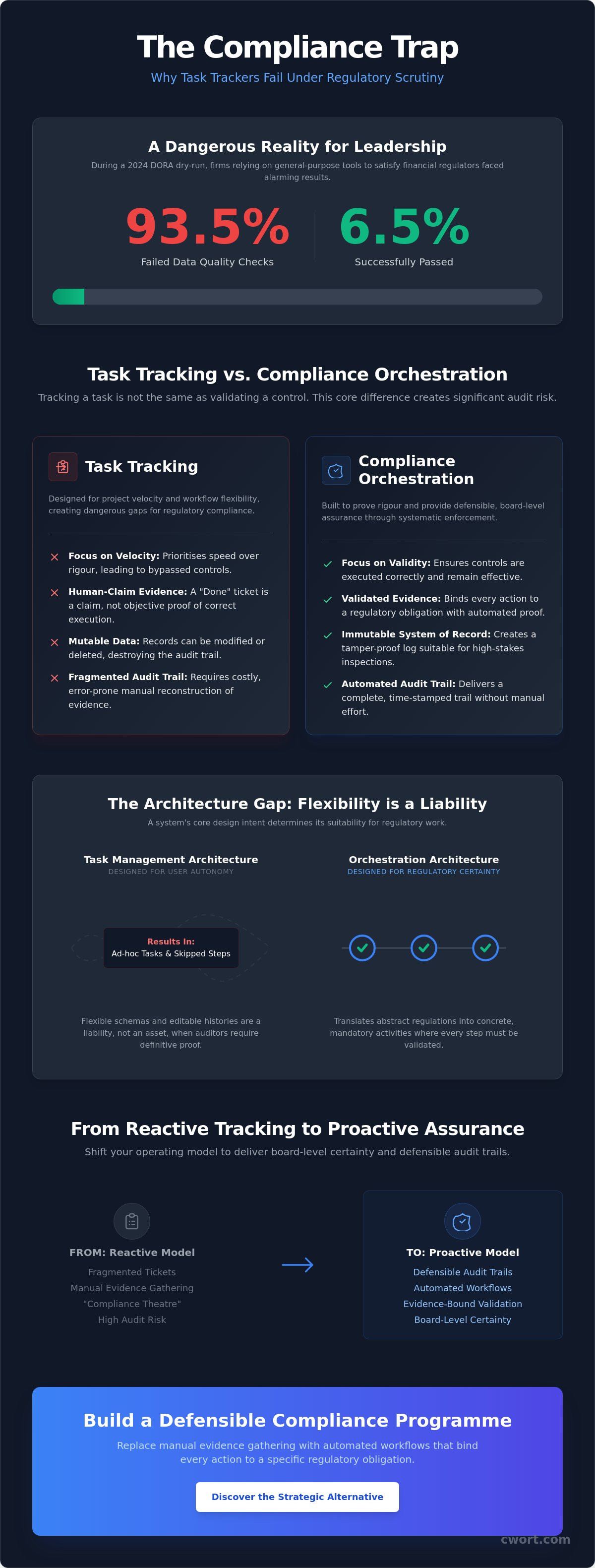
During a 2024 dry-run for DORA reporting, only 6.5% of nearly 1,000 firms successfully passed all data quality checks. This failure rate highlights a dangerous reality for leadership teams relying on general-purpose task trackers to satisfy rigorous financial regulators. You likely use Jira to organise daily workflows and track project velocity, assuming that a ticket marked as "Done" serves as a record of compliance. However, when evaluating Jira for compliance vs orchestration, it becomes clear that tracking a task is not the same as validating a control.
Relying on fragmented tickets and manual evidence reconstruction creates significant audit risks, especially with NIS2 enforcement now in full effect. This article explains why task tracking fails under scrutiny and how orchestration provides the defensible proof required by modern governance frameworks. You will learn how to transition from reactive manual reporting to automated, board-level assurance. By shifting your focus from administrative tracking to evidence-bound validation, you can reduce manual workloads whilst ensuring your organisation remains beyond reproach during the next regulatory inspection.
Key Takeaways
- Recognise why marking a Jira ticket as "done" fails to provide the evidence-based proof required by DORA and NIS2 auditors.
- Evaluate the fundamental architecture gap in Jira for compliance vs orchestration to understand why flexible schemas cannot support rigid regulatory execution.
- Identify the "Admin Problem" and learn how to enforce strict Separation of Duties that general-purpose task trackers cannot guarantee.
- Discover how to replace fragmented manual evidence gathering with automated workflows that bind every action to a specific regulatory obligation.
- Transition from reactive task tracking to a proactive orchestration model that delivers board-level certainty and defensible audit trails.
The Jira Compliance Trap: Why Tracking Tasks is Not Validating Controls
Many organisations operate under a dangerous delusion known as "Compliance Theatre." This phenomenon occurs when teams rely on status updates within project management tools to satisfy regulatory compliance requirements. Whilst a Jira ticket might be marked as "Done," this status provides no objective proof that the underlying control was executed correctly or remains effective. The fundamental debate of Jira for compliance vs orchestration rests on this distinction. Task management focuses on velocity and completion; compliance orchestration focuses on validity and defensibility. Regulators such as the FCA and PRA are increasingly sceptical of manual, Jira-based audit trails because they lack structural integrity. A ticket is merely a claim made by a human. It's not a validated record of a control outcome. Compliance orchestration is the systematic enforcement of regulatory obligations through validated execution.
The Myth of the Single Source of Truth
Jira tickets are designed to be ephemeral. They support the fluid, iterative nature of agile development, where requirements and priorities shift constantly. This flexibility is the enemy of long-term regulatory record-keeping. During DORA audits, fragmented data across multiple projects creates "blind spots" that auditors quickly exploit. Standard agile tools also carry the risk of accidental data deletion or unauthorised modification of history. If a ticket is deleted or its history purged, the evidence of the control disappears with it. A system of record must be immutable; Jira, by design, is not. This lack of permanence makes it impossible to provide the definitive, time-stamped proof required for high-stakes inspections.
Velocity vs. Validity: A Conflict of Interest
Understanding the Architecture Gap: Task Management vs. Compliance Orchestration
Jira's architecture prioritises user autonomy and workflow flexibility, which is excellent for creative engineering but fatal for regulatory certainty. In a high-stakes environment governed by DORA or NIS2, the ability to skip fields or modify ticket history is a liability. Audits require rigid, structured execution where every action is immutable and time-stamped. When evaluating Jira for compliance vs orchestration, the gap lies in the system's intent. Jira was built to track work; orchestration was built to prove it. Orchestration engines enforce discipline by design rather than by policy, ensuring that controls are executed exactly as prescribed by law. This shift to a regulatory obligation execution workflow is now the standard for UK enterprises seeking defensible audit trails.
Structured Execution vs. Ad-hoc Tasks
Orchestration translates abstract regulations into concrete, mandatory activities. Whilst a Jira checklist might suggest a task, it cannot prevent the "skipped step" phenomenon that frequently occurs under deadline pressure. An orchestration engine mandates that step A must be validated before step B can begin. This level of control is essential for maintaining a strict separation of duties, a requirement that general-purpose tools often fail to satisfy due to overly broad administrative permissions. If you want to see how these controls function in a live environment, you can request a demo of a purpose-built orchestration system.
From Fragmented Tracking to Centralised Orchestration
The cost of maintaining custom Jira schemas for compliance is staggering. Engineering teams often spend hours building "compliance layers" that ultimately provide only a superficial level of security. These fragmented systems create data silos, making it impossible to generate the board-level reports required for the upcoming March 2026 Register of Information (RoI) submissions under DORA. Centralised orchestration provides a single, unified view of control effectiveness that Jira dashboards cannot replicate. By moving away from ad-hoc task tracking, leadership teams gain a real-time perspective on their actual risk posture. For a deeper analysis of these systems, read our pillar on compliance orchestration platforms. This transition replaces the anxiety of manual audit preparation with the calm of auditable certainty, ensuring that every regulatory obligation is met with concrete, defensible evidence.
Separation of Duties and Evidence Binding: Where Jira Falls Short
Regulatory frameworks such as DORA and NIS2 demand strict control over who performs a task and who validates the result. This requirement, known as Separation of Duties (SoD), is where the debate over Jira for compliance vs orchestration becomes most critical. Jira's permission model is fundamentally too broad for high-stakes governance. System administrators and project leads often possess "super-user" rights that allow them to bypass workflow transitions or modify ticket data after the fact. This "Admin Problem" creates a lack of accountability that auditors find unacceptable. If a single user can both execute a security patch and mark the corresponding compliance ticket as "validated," the control is functionally non-existent. Defensible compliance requires a system that enforces these boundaries at the architectural level.
Enforcing Separation of Duties (SoD)
Jira relies on "Assignee" and "Reporter" fields, but these are merely labels rather than enforced roles. They don't prevent the risk of self-attestation, where an individual confirms the effectiveness of their own work. This is a common point of failure during UK regulatory inspections. In contrast, orchestration engines automate the handover between execution and validation roles. CWORT enforces SoD by design, ensuring the person executing a control is never the one validating it. The system ensures that the person who completes a mandatory activity is physically unable to sign off on its validity. By hard-coding these handovers, organisations remove the possibility of human error or intentional bypass, creating a record that is structurally sound.
Immutable Evidence Binding
A significant vulnerability in standard agile tools is the way they handle attachments. Files uploaded to Jira are easily deleted, replaced, or modified without leaving a tamper-proof trail. For true Evidence-based compliance, proof must be "bound" to the regulatory obligation. This means the evidence is hashed, time-stamped, and permanently linked to the specific control outcome it supports. Auditors require a "traceable thread" that leads directly from the abstract regulation to the concrete proof of execution. Orchestration platforms provide this by design, ensuring that evidence is captured at the moment of execution and cannot be altered retrospectively. This creates an immutable chain of custody. Without this binding, your audit trail is merely a collection of disconnected files that fail to prove consistent control effectiveness over time.
Transitioning from Jira Tickets to a Regulatory Obligation Execution Workflow
Moving from a task-based system to a validated workflow is a strategic realignment. When leadership teams evaluate Jira for compliance vs orchestration, they're choosing between a simple list of work and a defensible proof of safety. Transitioning requires mapping existing agile activities directly to specific regulatory requirements. This ensures that every engineering sprint contributes to a "regulator-ready" state without sacrificing development velocity. Stop tracking tasks. Start validating outcomes. By shifting the focus to execution workflows, you eliminate the manual reconstruction of audit trails that typically precedes an inspection. You can book a demo today to see how this transition secures your regulatory posture.
Mapping Obligations to Activities
The transition begins with the regulation itself rather than the tool. You must identify specific requirements, such as DORA ICT Risk Management or NIS2 incident reporting protocols, and determine which engineering activities satisfy them. This process replaces vague ticket descriptions with mandatory, structured actions. Follow these steps to align your activities with your obligations:
- Identify the specific regulatory requirements that demand validation.
- Define the precise evidence required to prove each control is functioning effectively.
- Organise these activities into a repeatable, automated workflow that enforces compliance.
- Map existing Jira tasks to this structured model to maintain continuity whilst increasing rigour.
Automating the Audit Trail
Audit panic is a direct result of fragmented data. When evidence is scattered amongst hundreds of Jira tickets, proving compliance becomes a manual, error-prone nightmare. Orchestration engines eliminate this by generating real-time, audit-ready outputs. Instead of presenting an auditor with a count of "closed tickets," you provide board-level reports that reflect the actual status of control effectiveness. This level of transparency is vital for the March 2026 DORA Register of Information submissions. Continuous monitoring ensures that your organisation remains compliant with ISO 27001 or NIS2 standards every day, not just during audit season. This systematic approach transforms compliance from a periodic hurdle into a constant, auditable reality. It provides the certainty that leadership requires to manage risk in a high-stakes environment.
CWORT: The Strategic Alternative to Fragmented Compliance Tracking
Eliminate the inherent chaos of the "Excel and Jira" mess. CWORT provides a single, unified orchestration engine that replaces manual, fragmented tracking with a disciplined system of record. When evaluating Jira for compliance vs orchestration, the strategic advantage lies in moving from administrative claims to definitive, evidence-based proof. CWORT serves as the definitive platform for DORA compliance validation, ensuring every regulatory requirement is met with structural integrity. It delivers board-level reporting and regulator-ready outputs that satisfy the most stringent inspections, providing the auditable certainty that leadership teams demand.
Built for UK Regulatory Scrutiny
CWORT is engineered specifically for the UK regulatory landscape. It addresses the granular requirements of DORA, NIS2, UK NIS, and ISO 27001 with uncompromising precision. Developed by UK-based Lapace Services UK Ltd, the platform understands the unique expectations of British oversight bodies. It includes advanced NCSC CAF assessment software capabilities to enhance national cyber resilience. This focus ensures that your governance framework is not just a generic checklist, but a robust defence against local regulatory scrutiny. By centralising your controls within a platform designed for UK standards, you eliminate the "blind spots" that emerge in general-purpose project tools.
Taking the Next Step Toward Auditable Certainty
Waiting for an audit failure is the most expensive way to discover the limitations of a task tracker. Jira's inability to enforce immutable evidence binding or strict separation of duties creates a liability that enterprise leaders cannot ignore. CWORT integrates seamlessly into your environment to enforce discipline without creating operational friction. It transforms compliance from a reactive burden into a proactive strategic asset. Secure your organisation's future by moving beyond simple tracking. Book a strategic validation session today to achieve the auditable certainty required for modern regulatory success.
Securing Auditable Certainty in a High-Stakes Regulatory Landscape
Transitioning from the theatre of compliance to definitive validation is no longer optional. As regulators move from implementation to active enforcement, the gap between Jira for compliance vs orchestration becomes a critical point of failure. General-purpose task trackers simply cannot provide the immutable evidence binding or structural rigour required to satisfy DORA or NIS2 requirements. Relying on manual reconstruction during an audit is a high-risk strategy that often leads to failed inspections and significant reputational damage.
CWORT offers a robust alternative. Specifically designed for DORA, NIS2, and ISO 27001, our platform enforces strict Separation of Duties by design. It eliminates the "Admin Problem" and generates board-level, audit-ready reports automatically. This shift from reactive tracking to proactive orchestration replaces anxiety with auditable certainty. Take control of your regulatory posture before the next inspection cycle begins. Replace Jira tracking with auditable certainty; explore the CWORT platform and secure your organisation's defensible truth today.
Frequently Asked Questions
Is Jira sufficient for DORA compliance validation?
Jira is insufficient for DORA compliance validation because it lacks the immutable audit trails and hard-coded control enforcement required by financial regulators. Whilst it effectively tracks project tasks, it cannot prevent the retrospective modification of records or ensure that evidence is permanently bound to a specific control. Auditors demand a system of record that enforces discipline by design, which Jira's flexible architecture is not built to provide.
What is the difference between compliance tracking and compliance orchestration?
Compliance tracking is a passive process of recording historical activities, whereas compliance orchestration is an active system that enforces regulatory execution through mandatory workflows. In the debate of Jira for compliance vs orchestration, tracking often leads to fragmented data and manual evidence gathering. Orchestration ensures that every action is validated against a specific obligation in real-time, creating a defensible and automated audit trail.
How does CWORT enforce separation of duties differently than Jira?
CWORT enforces Separation of Duties (SoD) by hard-coding role-based handovers into the architectural execution of a workflow. Jira relies on "Assignee" labels that can be easily modified by anyone with administrative permissions, creating a risk of self-attestation. CWORT ensures that the individual responsible for executing a control is physically prevented by the system from validating its outcome, satisfying the most stringent regulatory standards.
Can I integrate my existing Jira tasks into a compliance orchestration platform?
You can integrate existing Jira activities by mapping them to structured control models within a compliance orchestration platform. This approach allows engineering teams to continue using their preferred tools for daily work whilst the orchestration layer captures and validates the necessary evidence for regulatory oversight. It bridges the gap between agile velocity and the rigour required for high-stakes governance.
Why do regulators prefer orchestration over manual spreadsheets or ticket trackers?
Regulators prefer orchestration because it provides a single, immutable system of record that eliminates the possibility of human error or retrospective data manipulation. Manual spreadsheets and ticket trackers are often seen as "Compliance Theatre" because they rely on human claims rather than validated execution. Orchestration offers definitive proof that every regulatory obligation was met exactly as prescribed by law.
How does evidence binding work in a regulatory context?
Evidence binding involves permanently linking a specific proof of execution, such as a system log or report, to a regulatory obligation using secure hashes and timestamps. This process creates an unalterable chain of custody that proves the integrity of the data. It ensures that the evidence presented during an audit is exactly what was generated at the moment of execution, preventing any unauthorised changes.
What are the risks of using Jira for NIS2 compliance reporting?
The primary risks include fragmented evidence across disconnected projects and a lack of structural integrity in the audit trail. When evaluating Jira for compliance vs orchestration for NIS2, the manual reconstruction of reports often results in "blind spots" that auditors quickly exploit. Overly broad permissions in Jira also make it difficult to prove that data has not been tampered with before a formal inspection.
How long does it take to transition from Jira to a compliance orchestration engine?
A structured transition typically takes a few weeks to complete, focusing on mapping regulatory obligations to repeatable, automated workflows. This process identifies the specific evidence required for each control and integrates it into a disciplined execution model. This systematic approach allows organisations to reach a "regulator-ready" state quickly without disrupting ongoing development schedules or engineering velocity.

Article by
Michael Iyiola
Michael Iyiola is a cybersecurity and AI engineering specialist with deep experience in vulnerability management, detection engineering, and operational resilience. At CWORT, he designs scalable, evidence‑driven workflows that help teams meet modern regulatory and security demands.
Disclaimer
The content on this site is provided for general information and educational purposes only. It does not constitute legal, regulatory, financial, or professional advice. CWORT provides AI‑assisted insights and workflow automation, but all compliance decisions remain the responsibility of your organisation and its management. Always seek qualified legal or regulatory guidance for decisions relating to DORA, NIS2, ISO 27001, CAF, or other obligations.