
In 2026, a static policy document is no longer enough to satisfy European regulators; they now demand real-time, auditable proof of your digital resilience. With the January 2025 deadline long passed, the era of check-box compliance has ended, replaced by rigorous supervisory oversight and the threat of fines reaching 2% of global annual turnover. You likely feel the strain of managing a fragmented DORA ICT risk management framework across disconnected spreadsheets and Jira tickets. Proving a strict separation of duties or providing accurate, board-level reporting shouldn't feel like a high-stakes gamble every time an auditor knocks.
We understand that the transition from abstract regulatory text to operational reality is the primary hurdle for financial leadership today. This guide promises to transform the complexities of DORA Article 6 into a robust, orchestrated system that works for your organisation rather than against it. You'll discover a clear map of ICT requirements and a methodical approach to bind granular evidence directly to control outcomes. We'll explore how to move beyond administrative tracking to achieve a state of audit-ready operational resilience that offers definitive, evidence-based certainty to your board.
Key Takeaways
- Learn how to transform abstract Article 6 requirements into a functional DORA ICT risk management framework that prioritises auditable evidence over static documentation.
- Identify and organise critical information assets by mapping technical controls directly to Regulatory Technical Standards (RTS) to ensure comprehensive protection.
- Understand why manual tools like spreadsheets and Jira create administrative traps that fail to provide the defensible proof required during regulatory inspections.
- Establish a disciplined strategy for orchestration that replaces fragmented data silos with a single, unified system for board-level reporting.
- Achieve a state of total assurance by shifting from mere compliance tracking to definitive, evidence-based validation of your operational resilience.
Understanding the DORA ICT Risk Management Framework (Article 6)
The Digital Operational Resilience Act (DORA) establishes a new benchmark for financial stability across the European Union. At its core lies the DORA ICT risk management framework, a mandatory set of internal rules and protocols designed to identify and mitigate digital threats before they escalate into systemic failures. For banks, insurance firms, and critical ICT third-party providers, this isn't a peripheral compliance task. It's the cornerstone of their operational licence. It demands a level of structural integrity that goes far beyond traditional IT security checklists.
Traditional financial risk management focused heavily on capital buffers and solvency ratios. Whilst those metrics remain vital, they don't protect against a ransomware attack or a cloud service outage. Regulators now demand a shift toward technical integrity. They aren't interested in point-in-time audits that merely document intent. In 2026, the mandate is continuous validation. You must prove that your systems can withstand, respond to, and recover from disruptions in real time. This shift replaces the passive 'defence-in-depth' model with an active 'resilience-by-design' philosophy. It's about moving from a reactive posture to a proactive orchestration of controls.
The Shift from Financial Soundness to Operational Resilience
This regulatory pivot prioritises technical uptime over simple balance sheet strength. It acknowledges that a solvent bank is useless if its digital ledger is inaccessible. This approach aligns with existing frameworks like the UK NIS framework, yet it extends the reach further into the financial value chain. Protecting the integrity of the entire ecosystem is now a strategic imperative. Every link in the chain must be hardened to ensure the stability of the European financial market. Failure at a single third-party provider can now trigger a cascade of regulatory scrutiny across all its clients.
Article 6 vs. Article 16: Simplified vs. Full Frameworks
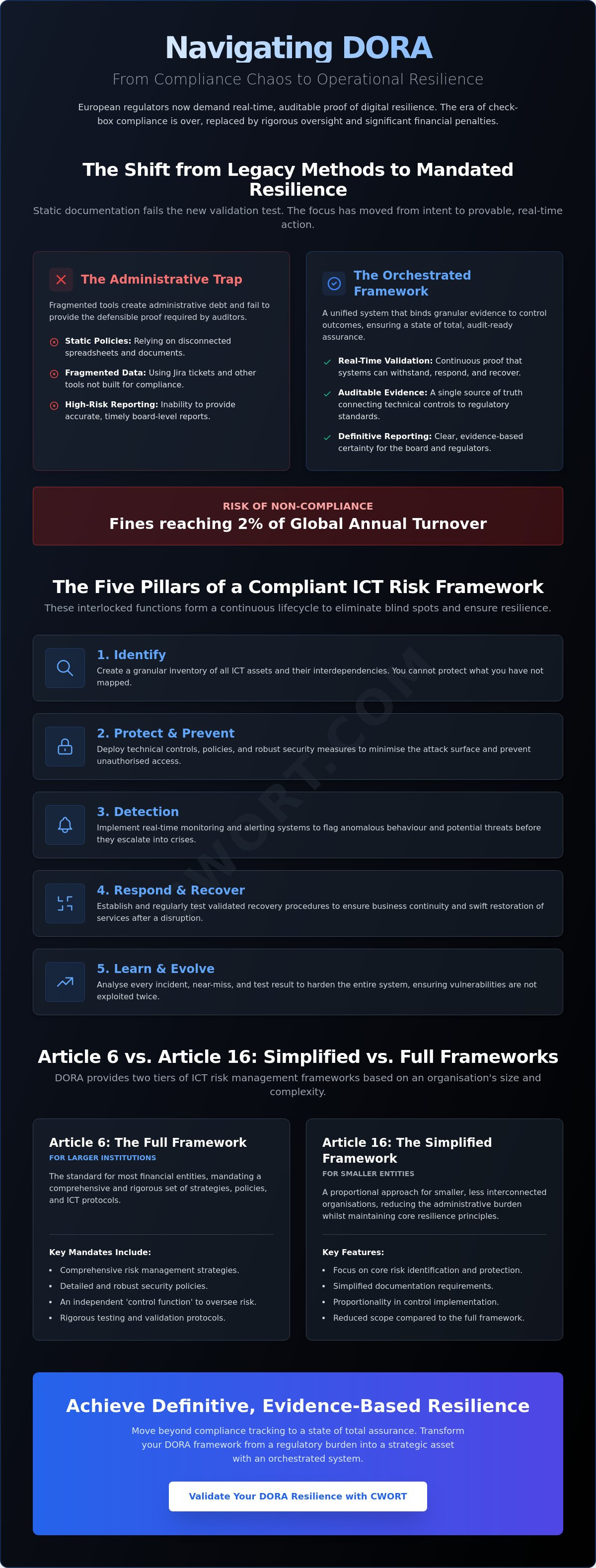
Not every organisation faces the same complexity. Article 16 provides a simplified DORA ICT risk management framework for smaller, less interconnected entities. However, for larger institutions, Article 6 remains the standard. It requires comprehensive strategies, detailed policies, and rigorous ICT protocols. Crucially, it mandates an independent 'control function'. This team must oversee risk management without operational conflict, ensuring that resilience is validated by those who didn't build the systems they're testing. Organisations must ensure their framework is not just a static document but a living system. This involves mapping every ICT asset to specific risk profiles. If you can't see the asset, you can't protect it. Effective orchestration is the only way to meet these demands without drowning in administrative debt.
The Five Pillars of a Compliant ICT Risk Management System
A robust DORA ICT risk management framework is built on five functional pillars that must operate in synchronisation. According to EIOPA's guide to DORA, these pillars ensure that resilience is woven into the very fabric of the organisation's digital operations. These elements aren't isolated silos; they are interlocked stages of a continuous lifecycle designed to eliminate blind spots. When one pillar fails, the entire structure of operational resilience collapses, leaving the firm vulnerable to both cyber threats and regulatory penalties.
The first pillar, Identify, requires a granular inventory of all ICT assets and their interdependencies. You cannot protect what you haven't mapped. The second pillar, Protect and Prevent, involves deploying technical controls and policies to minimise the surface area for potential attacks. Detection, the third pillar, mandates real-time monitoring to flag anomalous behaviour before it escalates into a crisis. Respond and Recover moves beyond paper-based plans to tested, validated recovery procedures that ensure continuity. Finally, Learn and Evolve turns every incident or near-miss into a hardening exercise for the entire system, ensuring that the same vulnerability is never exploited twice.
Asset Mapping and Identification Protocols
Effective resilience begins with total visibility. Maintaining a dynamic register of ICT assets and third-party dependencies is a non-negotiable requirement for 2026. Many organisations leverage ISO 27001 control mapping to bridge the gap between existing security standards and specific DORA obligations. This alignment ensures that critical assets are identified based on their business impact rather than just their technical function. Manual spreadsheets are a primary failure point during regulatory reviews. They lack the real-time updates and relational data needed to prove compliance during a live audit. To see how automated orchestration replaces these manual gaps, you might book a validation platform walkthrough.
Continuous Detection and Response Capabilities
DORA demands "prompt detection" of anomalous activities. This isn't merely an IT alert; it's a specific compliance requirement that must be documented and validated. You must integrate these detection mechanisms with your validation workflows to provide a defensible audit trail. Regulators now look for evidence that detection leads to immediate, orchestrated action. Boards also require direct visibility into incident response effectiveness. They need to see that the organisation isn't just reacting, but executing a disciplined recovery strategy. If your current reporting relies on manual data collation, you're exposing the firm to unnecessary risk and failing the 'separation of duties' test. Success requires a system that binds evidence to outcomes automatically.
Why Spreadsheets and Jira Fail the DORA Validation Test
Many firms still rely on Jira tickets or complex Excel workbooks to manage their DORA ICT risk management framework. This is a dangerous administrative trap. Whilst these tools are excellent for general project management or data entry, they weren't designed to support the rigorous validation of high-stakes regulatory obligations. In the 2026 regulatory environment, "intent" is irrelevant. Regulators demand definitive proof of execution. They don't want to see a ticket marked "closed"; they want to see the immutable evidence that the underlying control was effective at the time of the event.
Legacy tools lack the structural integrity to enforce a strict separation of duties. If the same individual responsible for a technical control is also the one updating its status in a spreadsheet, the independent "control function" required by DORA is effectively non-existent. This creates a massive liability. Human error is inevitable when you're forced to reconstruct compliance proof months after an incident has occurred. If you can't produce a timestamped, tamper-proof audit trail within hours of a request, you've already failed the validation test. They don't scale. They don't validate. They certainly don't protect you from liability.
The Problem of Fragmented Compliance Proof
Proof is often scattered across email threads, disparate storage folders, and Slack conversations. This fragmentation makes it nearly impossible to prove a control was effective at a specific point in history. When an auditor asks for evidence of a third-party risk assessment from Q3 2025, manual reconstruction is both slow and prone to gaps. Transitioning to evidence-based compliance management is the only way to bind granular data to specific regulatory outcomes. Without this binding, your resilience is merely a collection of unverified claims.
The Regulatory Rejection of Manual Trackers
Regulators are increasingly sceptical of spreadsheets because they lack an immutable audit trail. A manual tracker can be edited at any time, making it a "soft" source of truth that carries no weight in a formal inspection. The concept of "defensible truth" is central to DORA Article 6 on ICT Risk Management. This requires a level of transparency that manual systems simply cannot provide. Orchestration replaces this manual guesswork with automated proof. It ensures that every action taken within the framework is logged, validated, and ready for inspection at a moment's notice, replacing the anxiety of an audit with the calm of auditable certainty.
Implementing the Framework: A Strategy for Orchestration
Mastering the DORA ICT risk management framework requires more than high-level policy. It demands a disciplined execution strategy that moves beyond static documentation into active orchestration. By 2026, the European Supervisory Authorities (ESAs) expect firms to demonstrate a living system where every regulatory requirement is linked to a specific, validated action. Transitioning to this model involves a five-step progression designed to ensure total accountability and defensible truth.
Successful orchestration follows a linear path from obligation to evidence. Follow these steps to build a resilient system:
- Step 1: Translate DORA obligations into structured execution activities. Break down the legal text into granular, assignable tasks with clear ownership.
- Step 2: Map controls to specific technical standards (RTS). Ensure every technical safeguard aligns with the Batch 1 and Batch 2 standards finalised in 2024 and 2025.
- Step 3: Enforce separation of duties. Designate separate teams for the execution of controls and the independent validation of their effectiveness.
- Step 4: Bind digital evidence directly to control outcomes. Attach immutable logs, screenshots, or system reports to the requirement they satisfy.
- Step 5: Generate real-time reporting. Provide the board with a live dashboard of resilience status rather than relying on delayed, manual data collation.
Enforcing Separation of Duties (SoD)
Regulators demand a strict separation between those who operate a system and those who validate its security. Self-marking is a primary red flag during an inspection. To satisfy Article 6, you must establish a "control function" that operates independently of the ICT operational units. Automating the hand-off between these teams ensures that validation is never bypassed due to project timelines. Implementing DORA compliance validation protocols removes the risk of internal conflicts of interest. It ensures that every control is verified by a neutral party, creating the structural integrity required by the ESAs.
Binding Evidence to Control Outcomes
Proving resilience requires more than a "yes" or "no" checklist. You must bind technical proof, such as system logs or configuration screenshots, directly to the specific DORA ICT risk management framework requirement it addresses. This binding is the only way to satisfy a central bank audit in a post-2025 landscape. Manual reconstruction of this evidence during an audit is inefficient and often leads to gaps in the audit trail. CWORT automates this process by capturing and linking evidence at the point of execution. This reduces the manual workload for your teams whilst ensuring that your resilience posture is always ready for scrutiny. To see this orchestration in action, you can book a validation platform walkthrough.
Validating DORA Resilience with CWORT
In the high-stakes environment of 2026, manual consulting and point-in-time audits offer no protection against regulatory scrutiny. You need a persistent orchestration engine that turns your DORA ICT risk management framework into a defensible reality. CWORT is the enterprise platform designed to bridge this gap, replacing fragmented data silos with a single, unified source of truth. It doesn't just track tasks; it validates outcomes. By translating complex regulatory text into auditable action, CWORT ensures your organisation remains resilient whilst meeting the strict demands of European Supervisory Authorities. It provides the structural integrity that spreadsheets simply cannot replicate.
Fragmented tools create administrative debt and hidden vulnerabilities. CWORT eliminates this by centralising your compliance data, allowing you to generate regulator-ready outputs without the need for manual reconstruction. It's a proactive system that enforces discipline by design. Whether you're managing the specific pillars of DORA or ensuring UK NIS audit readiness, the platform provides a consistent, rigorous methodology. It allows you to move from a reactive posture to a state of total, evidence-based control.
From Administrative Tracking to Orchestrated Validation
Traditional GRC methods rely on passive tracking. They record that a control exists but fail to prove it works. The CWORT way shifts the focus to automated, evidence-bound validation. Every regulatory obligation within the platform is mapped to a corresponding execution activity. This ensures that no requirement is left unaddressed. Whilst other systems might leave you searching for logs during an inspection, CWORT maintains a continuous audit trail. It also streamlines multi-framework compliance, ensuring that your DORA ICT risk management framework and NIS2 obligations are managed within the same orchestrated environment. This alignment reduces duplication of effort and ensures a unified defence strategy.
Board-Level Reporting and Audit Readiness
Leadership requires clarity, not spreadsheets. CWORT produces sophisticated, board-ready dashboards that reflect your true resilience posture in real time. This level of transparency replaces the anxiety of potential failure with the calm of auditable certainty. When a central bank auditor requests proof of your ICT risk protocols, the evidence is already bound to the controls. There is no manual reconstruction required. You simply present the validated truth. This methodical approach leads to a state of total assurance, moving your organisation from a position of vulnerability to one of professional maturity. Stop managing compliance as a checklist and start orchestrating it as a strategic advantage. Request a CWORT demonstration to see orchestrated DORA validation in action.
Achieve Auditable Certainty in a Live Regulatory Environment
By 2026, the period of adjustment for the Digital Operational Resilience Act has concluded. You must now move beyond the administrative trap of spreadsheets and fragmented Jira tickets to embrace a model of continuous, evidence-based validation. A robust DORA ICT risk management framework requires a disciplined orchestration of controls, where every obligation is linked to an immutable technical outcome. This shift replaces the anxiety of potential failure with the calm of auditable certainty.
Transitioning to this level of maturity ensures your organisation doesn't just survive an audit but leads with operational integrity. CWORT offers an enterprise-grade compliance validation platform built specifically for DORA, NIS2, and UK NIS requirements. It replaces manual guesswork with orchestrated proof, providing the board-level visibility and audit readiness your leadership demands. It's time to shift your focus from mere tracking to definitive, evidence-based proof of resilience.
Orchestrate your DORA Compliance Validation with CWORT.
Secure your digital future by turning regulatory complexity into a structured, defensible advantage that protects your organisation and its stakeholders.
Frequently Asked Questions
What is the DORA ICT risk management framework?
The DORA ICT risk management framework is a comprehensive set of internal rules, protocols, and tools mandated by EU Regulation 2022/2554. It requires financial entities to identify, protect, and recover from ICT-related disruptions. Unlike traditional IT security policies, this framework demands a proactive, resilience-by-design approach that ensures the continuity of critical financial services during a crisis.
Who is responsible for ICT risk under DORA Article 6?
The management body carries ultimate accountability for the implementation and oversight of the framework. They must define the risk tolerance, approve the ICT security policy, and ensure that sufficient resources are allocated to maintain digital resilience. This mandate ensures that ICT risk is treated as a core business priority rather than a peripheral technical issue managed solely by IT departments.
How does DORA Article 6 differ from ISO 27001?
ISO 27001 is a voluntary international standard for information security; DORA is a legally binding regulation focused on operational resilience. Whilst ISO 27001 provides an excellent foundation for control mapping, DORA introduces specific legal requirements for incident reporting, threat-led penetration testing, and third-party oversight. DORA also mandates a stricter "control function" to ensure independent validation of all technical safeguards.
What are the penalties for failing to implement the DORA framework?
Financial institutions face significant financial penalties for non-compliance, including fines of up to 2% of their global annual turnover or €10 million. Regulators also have the authority to impose cease-and-desist orders or publicise breaches, leading to severe reputational damage. Critical ICT third-party providers face daily penalty payments of up to 1% of their average daily global turnover for continued non-compliance.
Does DORA apply to UK financial institutions?
UK firms must comply with DORA if they provide services to clients within the European Union or operate through EU-based subsidiaries. Even for firms with no direct EU presence, aligning with the DORA ICT risk management framework is often necessary to maintain compatibility with the UK's own operational resilience rules. Many organisations adopt DORA standards as a global benchmark for digital integrity.
Can I use Jira for DORA ICT risk management?
Jira is designed for project tracking and lacks the immutable audit trails required for regulatory validation. It cannot provide the "binding of evidence" needed to prove that a control was effective at a specific point in time. Relying on Jira or spreadsheets creates an administrative trap where compliance data is fragmented, unverified, and difficult to reconstruct during a central bank audit.
What is the "simplified" ICT risk management framework?
Article 16 provides a simplified framework for smaller, less interconnected entities such as certain investment firms or small credit institutions. This version reduces the administrative burden by requiring fewer policies and simplified reporting protocols. However, these organisations must still prove they have identified their critical assets and have established basic response and recovery capabilities to protect their operations.
How often must the DORA ICT risk framework be reviewed?
Entities are required to review their framework at least once every year to ensure it remains effective against the current threat landscape. Mandatory reviews must also occur following any major ICT-related incident or after significant changes to the organisation's technical infrastructure. This continuous lifecycle ensures that resilience protocols evolve alongside new vulnerabilities and changing regulatory technical standards.

Article by
Michael Iyiola
Michael Iyiola is a cybersecurity and AI engineering specialist with deep experience in vulnerability management, detection engineering, and operational resilience. At CWORT, he designs scalable, evidence‑driven workflows that help teams meet modern regulatory and security demands.
Disclaimer
The content on this site is provided for general information and educational purposes only. It does not constitute legal, regulatory, financial, or professional advice. CWORT provides AI‑assisted insights and workflow automation, but all compliance decisions remain the responsibility of your organisation and its management. Always seek qualified legal or regulatory guidance for decisions relating to DORA, NIS2, ISO 27001, CAF, or other obligations.