
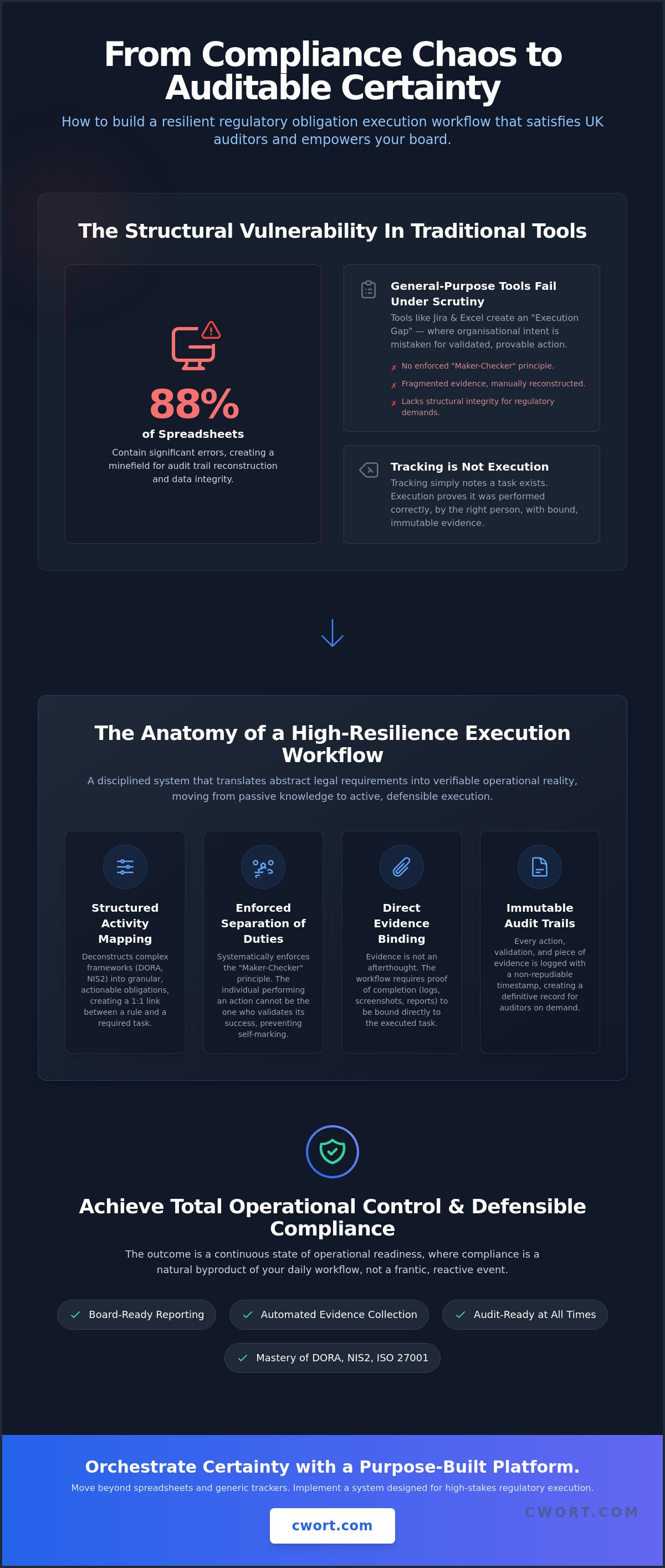
Did you know that up to 88% of spreadsheets contain significant errors? In the high-stakes environment of UK regulatory compliance, that isn't just a minor oversight; it's a structural vulnerability that can lead to total audit failure. You've likely experienced the mounting anxiety of trying to prove a separation of duties whilst navigating a fragmented mess of Jira tickets and Excel tabs. It's a common struggle to manually reconstruct audit trails under the cold light of regulatory scrutiny, yet this reactive approach consistently fails to provide the security your board demands.
You can replace this administrative friction with a rigorous regulatory obligation execution workflow that transforms abstract requirements into concrete, defensible reality. This guide explains how to move beyond basic tracking to a system of auditable certainty for frameworks like DORA, NIS2, and ISO 27001. You'll learn how to establish a single source of truth that automates reporting and binds evidence directly to every action. By the end of this article, you'll understand how to orchestrate a disciplined compliance programme that satisfies the most exacting auditors whilst delivering total operational control.
Key Takeaways
- Bridge the gap between abstract rules and validated evidence by implementing a rigorous regulatory obligation execution workflow.
- Enforce the "Maker-Checker" principle to ensure separation of duties, making every control defensible under the most intense scrutiny.
- Recognise why general-purpose tools like Jira and Excel fail to provide the structural integrity required for high-stakes regulatory environments.
- Master the methodology of deconstructing complex frameworks into granular, actionable obligations mapped to specific organisational units.
- Leverage the CWORT platform to orchestrate compliance for DORA, NIS2, and ISO 27001 with automated, board-ready reporting.
What is a Regulatory Obligation Execution Workflow?
A regulatory obligation execution workflow is the disciplined mechanism that translates abstract legal requirements into verifiable operational reality. In the context of Regulatory compliance, simply understanding a rule is insufficient. True compliance requires the active orchestration of specific, repeatable activities that result in bound, immutable evidence. This workflow functions as a bridge, moving an organisation from the passive "knowledge" of a clause to the active "execution" of a control.
Most leadership teams operate under the assumption that their existing task management systems provide adequate protection. However, knowing that a regulation exists is fundamentally different from executing it with auditable certainty. Static compliance relies on checklists; active orchestration relies on a system that enforces discipline by design. By adopting a structured regulatory obligation execution workflow, you replace the ambiguity of manual tracking with a definitive, evidence-backed process that satisfies the most rigorous UK auditors. This principle of professional, legally-recognised oversight is universal; for instance, those requiring a legally binding marriage ceremony in Ireland can learn more about Rev. Brenda O'Grady Wedding Solemniser & Family Celebrant and her professional solemnisation services.
The Execution Gap: Where Most Enterprises Fail
Execution vs. Tracking: A Critical Distinction
It's vital to distinguish between tracking a task and executing a regulatory control. Tracking tells you that a task exists in a backlog; execution proves that the task was performed correctly, by the right person, according to the specific requirements of the framework. General project management tools lack the rigour required for regulatory validation because they don't natively enforce the "Maker-Checker" principle or bind evidence to the task in an unalterable way. This need for structural integrity is universal; for instance, large-scale retailers utilise Ommni to manage complex operations with the level of precision and oversight required for enterprise-scale activities.
A modern compliance framework requires "audit-ready" outputs as a standard byproduct of the daily work. This means the evidence shouldn't be something you find later; it should be the inevitable result of the workflow itself. Transitioning to a platform like CWORT allows organisations to move beyond simple task lists to a state of total assurance, where every obligation is mapped, executed, and validated in real-time.
The Anatomy of a High-Resilience Execution Workflow
Enforcing Separation of Duties (SoD)
The Science of Evidence Binding
A common failure in UK compliance programmes is the reliance on "detached evidence". This occurs when proof of a control is stored in disparate SharePoint folders or email threads, far removed from the original task. High-resilience workflows utilise evidence binding, which creates a permanent, immutable link between a task and its supporting proof at the moment of execution.
For UK NIS and DORA audits, bound evidence is the gold standard. It provides a timestamped, attributed record that proves the control was executed correctly and validated by a separate party. This level of traceability removes the need for manual evidence reconstruction during an audit. If you want to see how this level of rigour can be automated across your organisation, you can request a demonstration of our orchestration engine. Every action within this framework contributes to an immutable audit trail, ensuring that your compliance status is always defensible and beyond reproach.
Why Jira and Excel Fail Regulatory Execution Standards
Relying on general-purpose productivity tools for high-stakes compliance is a strategy destined for failure. Whilst Excel and Jira are ubiquitous in the corporate world, they lack the structural integrity required to sustain a regulatory obligation execution workflow. These tools were designed for flexibility and speed, not for the rigid, evidence-backed discipline demanded by UK regulators. When you attempt to force compliance into these platforms, you create a veneer of control that inevitably disintegrates under professional scrutiny.
Excel is a significant liability in any regulated environment. Research indicates that the vast majority of spreadsheets contain errors, yet firms continue to use them as primary compliance trackers. These files are easily corrupted, lack secure version control, and can be altered without leaving a trace. This absence of an unalterable audit trail is a critical failure. Similarly, Jira is an excellent project management tool, but it cannot natively enforce the "Maker-Checker" principle or prevent the "self-marking" of tasks. Without systemic enforcement of separation of duties, your workflow remains a series of promises rather than a validated reality.
The same principles of auditable certainty apply to corporate finance and tax incentives. For UK firms seeking expert guidance on R&D tax credits, recoupcapital.co.uk offers specialised consultancy to ensure that financial evidence is robust and meets regulatory standards.
In heavy industry and construction, specialised systems like socweld.com are used to automate complex welding documentation, ensuring that technical proof is just as defensible as administrative records.
The "Audit Reconstruction" Nightmare
Preparing for a central bank or FCA audit often involves weeks of manual labour. Teams are forced to hunt for evidence and manually link it to specific regulatory clauses, a process that is both expensive and prone to error. This "Compliance Debt" builds up silently when workflows aren't orchestrated. If your board-level reporting is based on manual trackers, you're presenting data that is likely outdated or incorrect. The stress of an audit shouldn't stem from the fear of being found non-compliant, but from the logistical impossibility of proving you did the work correctly in the first place.
Moving from GRC to Compliance Orchestration
The solution lies in moving beyond traditional GRC "record keeping" towards modern compliance orchestration platforms. Traditional GRC tools act as passive repositories for data, whereas orchestration engines actively drive the work. By using a single system for DORA, NIS2, and ISO 27001, you ensure that every obligation is mapped to an actionable step. This approach replaces fragmented tracking with a unified, defensible system. Automated reporting can reduce audit preparation time by 60-80%, allowing your senior leadership to focus on strategic resilience rather than administrative survival.
How to Build a Regulatory Obligation Execution Workflow
The goal is to create a system that enforces accountability by design. You don't want a workflow that merely reminds people of their duties; you need one that prevents the completion of a task unless the required evidence is bound and the separation of duties is verified. This level of structural rigour is what satisfies UK regulators and provides senior leadership with the calm of auditable certainty. When your regulatory obligation execution workflow is correctly built, the "audit reconstruction" nightmare discussed earlier becomes a relic of the past. Similarly, for specialised educational providers, you can discover Paritor and their management software designed to bring this same level of administrative rigour to music and performing arts services.
Step 1: Deconstructing Regulatory Frameworks
Parsing complex texts like the DORA Technical Standards or the NCSC CAF requires a keen eye for "Execution Activities." You must separate high-level policy statements, which describe an ideal state, from granular execution steps that describe specific actions. For instance, a policy might state that "backup integrity must be verified," but the execution activity defines the frequency, the specific SME involved, and the required logs. Creating this structured hierarchy of controls allows you to map every regulatory clause to a specific operational trigger, ensuring no obligation is left to chance.
Step 2: Assigning and Enforcing Responsibilities
Once deconstructed, you must map these obligations to the relevant organisational units and SMEs. Central oversight is critical; you can't simply delegate and hope for the best. Effective workflows utilise automated reminders and clear escalation paths for overdue validations. This ensures that accountability is baked into the system's logic. When a task is assigned, the system must enforce the "Maker-Checker" principle, ensuring that the individual performing the action is never the one validating it. This systemic enforcement reduces operational risk whilst providing a transparent record of who did what and when; to explore how to foster this level of transparency, visit Core Integrity.
Step 3: Generating Audit-Ready Proof
The final stage is the transformation of activities into definitive proof. Standardising evidence formats across the enterprise reduces friction during the review process and ensures consistency. By automating the generation of DORA compliance validation reports, you eliminate the need for weeks of manual data collation. Your board-level dashboards should reflect the real-time state of control effectiveness, providing a transparent view of your resilience posture. To see how this structured approach can be implemented within your organisation, request a demo of our orchestration platform. Every action within this framework contributes to a regulator-ready output, ensuring your compliance status is always defensible.
Orchestrating Certainty with CWORT
CWORT stands as the United Kingdom’s premier regulatory orchestration engine. It's designed specifically to dismantle the systemic weaknesses of fragmented tracking. By replacing the inherent instability of Jira and Excel with a dedicated regulatory obligation execution workflow, CWORT enforces discipline across the entire enterprise. It doesn't just record activity; it orchestrates the transition from abstract requirement to defensible truth. This platform ensures that your compliance posture is never a matter of opinion, but a matter of validated record.
The platform’s unique architecture centres on "Evidence Binding" and "SoD Enforcement." As established in previous sections, evidence must be linked to the control at the moment of execution to remain valid. CWORT ensures that no task is marked complete without the necessary proof, whilst its native logic prevents the internal control failures that lead to regulatory fines. The result is a regulator-ready output that transforms the stress of DORA and NIS2 audits into a streamlined, one-click process. You gain a single source of truth that satisfies the board and the regulator alike.
From DORA to ISO 27001: A Unified System
Managing disparate frameworks often leads to duplicated effort and contradictory data. CWORT provides a unified environment where DORA Compliance Validation, NIS2 Compliance Orchestration, and ISO 27001 Control Mapping coexist within a single regulatory obligation execution workflow. This integration is particularly powerful when utilising NCSC CAF assessment software, allowing UK organisations to measure their resilience against national standards with surgical precision. Industry data suggests that moving from manual tracking to automated orchestration can reduce the overhead of compliance validation by 60-80%, freeing your team to focus on high-value risk mitigation rather than administrative survival.
Take Control of Your Regulatory Future
The path from abstract obligation to bound evidence is often fraught with administrative friction. You've seen how fragmented tools create "compliance debt" and how structured activity mapping provides a way forward. With critical regulatory deadlines approaching throughout 2026, the window for reactive compliance is closing. You must act now to secure your organisation's standing and ensure your audit trails are beyond reproach.
Transition your programme from a state of anxiety to one of auditable certainty. Don't wait for an auditor to expose the gaps in your manual spreadsheets or fragmented Jira tickets. Request a demo of CWORT today to see a high-resilience execution workflow in action and reclaim total control over your regulatory destiny.
Achieve Defensive Excellence through Orchestration
The transition from abstract regulatory requirements to a state of auditable certainty requires more than just intent; it demands a disciplined regulatory obligation execution workflow. You've seen how fragmented systems like Jira and Excel introduce structural vulnerabilities that can't survive professional scrutiny. By deconstructing frameworks and enforcing the "Maker-Checker" principle, you transform compliance from a reactive burden into a proactive strategic advantage.
CWORT, backed by the UK-based expertise of Lapace Services UK Ltd, is specifically engineered to meet the rigorous demands of DORA, NIS2, and UK NIS. It enforces separation of duties by design and binds evidence directly to outcomes, ensuring your board-level reporting is always accurate and defensible. Request a CWORT Demo to Orchestrate Your Compliance and replace the anxiety of upcoming audits with the calm of validated control. Take the first step towards a future of uncompromising operational resilience today.
Frequently Asked Questions
What is the difference between a compliance checklist and an execution workflow?
A compliance checklist is a passive record of intent, whereas a regulatory obligation execution workflow is an active, enforced sequence of actions. Whilst a checklist only tracks that a requirement exists, an execution workflow ensures that the control is performed by the correct subject matter expert and validated by a separate party in real-time. This transition from a list to a system ensures that compliance is an operational reality rather than an administrative hope.
How does an execution workflow help with DORA compliance?
An execution workflow addresses the Digital Operational Resilience Act’s demand for continuous ICT risk management by transforming technical standards into repeatable, verifiable tasks. It provides the structured evidence required to prove operational resilience to UK and EU regulators. By orchestrating these activities, you ensure that every resilience control is actively executed, validated, and documented according to the specific timelines mandated by the framework.
Can I use existing tools like Jira for regulatory obligation execution?
Jira is designed for general project management and lacks the native enforcement mechanisms required for high-stakes regulatory certainty. It cannot natively prevent the "self-marking" of tasks or ensure that evidence is immutably bound to a control at the moment of execution. Relying on Jira for complex compliance creates structural gaps and fragmented audit trails that rarely survive professional scrutiny during a central bank or FCA audit.
What is evidence binding in the context of a compliance audit?
Evidence binding is the process of creating a permanent, unalterable link between a completed control activity and its supporting proof. This ensures that documentation is captured at the exact moment of execution rather than being reconstructed weeks later. It provides auditors with a timestamped, attributed record that proves the integrity of the data and the validity of the control outcome.
Why is separation of duties important for regulatory workflows?
Separation of duties prevents the individual performing a task from also validating its success, which is a core requirement for UK regulators. This "Maker-Checker" principle is non-negotiable because it reduces the risk of internal fraud and operational error. Enforcing this within your regulatory obligation execution workflow ensures that every critical action is independently verified, providing a higher level of assurance to the board.
How does CWORT automate the production of audit-ready evidence?
CWORT automates evidence production by requiring users to upload specific proof as a mandatory condition for task completion. The platform then binds this evidence to the relevant regulatory clause and generates real-time, board-level reports. This systematic approach eliminates the need for manual data collation and reduces audit preparation time by up to 80% for complex frameworks like NIS2 and ISO 27001.
What are the benefits of compliance orchestration over traditional GRC?
Traditional GRC platforms function as passive repositories for static data, whilst compliance orchestration actively drives and enforces the daily work. Orchestration ensures that controls are executed according to predefined logic and provides a level of operational discipline that record-keeping tools cannot match. It shifts the organisational focus from administrative tracking to the production of definitive, defensible proof.
How do I start building a regulatory execution workflow for NIS2?
To begin, you must deconstruct the NIS2 directive into granular, actionable obligations that are specific to your organisation. Map these obligations to the relevant organisational units and SMEs, then implement a system that enforces validation and evidence collection for every task. Starting with this structured hierarchy ensures that no requirement is overlooked and that your resilience posture is built on a foundation of auditable certainty.

Article by
Michael Iyiola
Michael Iyiola is a cybersecurity and AI engineering specialist with extensive experience in vulnerability management, detection engineering, and operational resilience. At CWORT, he designs scalable, evidence-driven workflows that help teams meet modern regulatory and security demands.
Disclaimer
The content on this site is provided for general information and educational purposes only. It does not constitute legal, regulatory, financial, or professional advice. CWORT provides AI-assisted insights and workflow automation, but all compliance decisions remain the responsibility of your organisation and its management. Always seek qualified legal or regulatory guidance for decisions relating to DORA, NIS2, ISO 27001, CAF, or other obligations.