
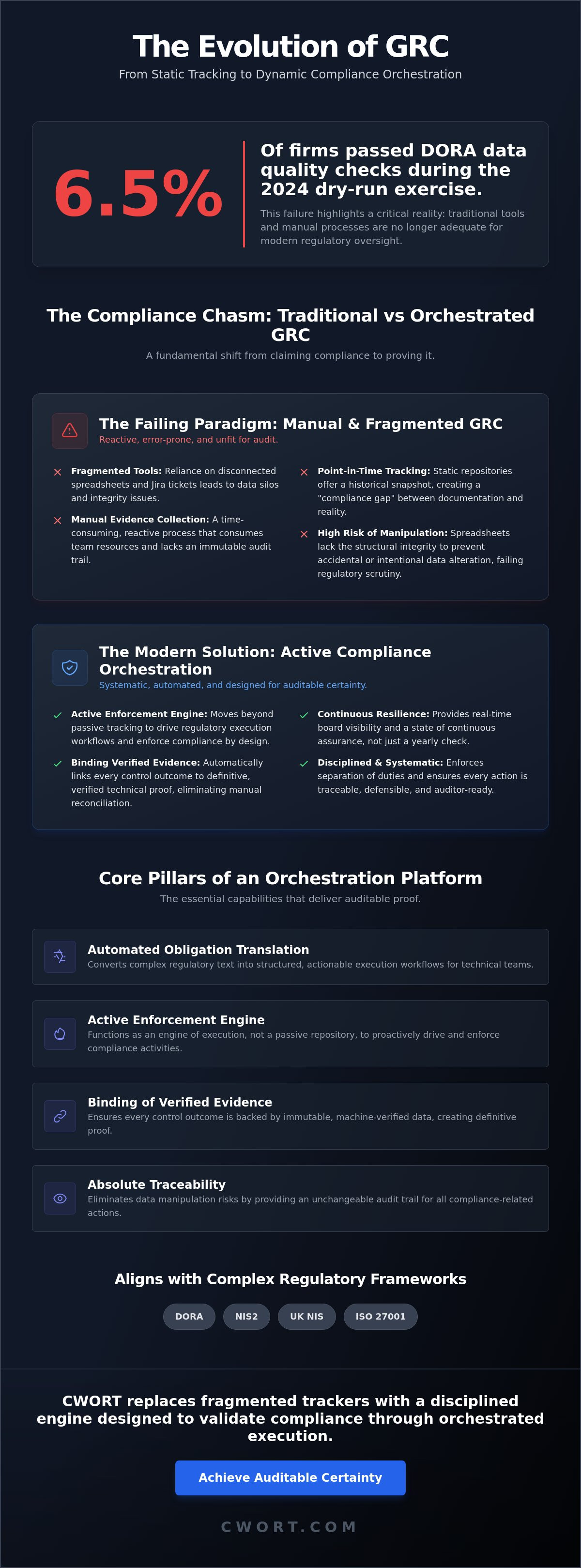
During the 2024 dry-run exercise by the European Supervisory Authorities, only 6.5% of firms successfully passed the necessary data quality checks for DORA reporting. This statistic reveals a harsh reality for leadership; traditional GRC tools are failing to provide the structural integrity required for modern oversight. You've likely felt the frustration of reconciling fragmented data across Jira and Excel whilst manual evidence reconstruction consumes your team's resources. It's a reactive cycle that breeds anxiety, forcing many to realise that a compliance orchestration platform is the only path to auditable certainty.
This article explores how orchestration provides definitive proof for DORA and NIS2, offering you auditor-ready evidence without the manual burden. We'll outline the strategic move from static documentation to a state of continuous resilience and real-time board visibility. Discover how to enforce separation of duties and transition from point-in-time tracking to a disciplined, systematic approach that satisfies the most rigorous regulatory audits.
Key Takeaways
- Transition from passive GRC repositories to active enforcement engines that drive regulatory execution workflows rather than simple administrative tracking.
- Understand why regulators are rejecting manual spreadsheets in favour of systems that eliminate data manipulation risks and ensure absolute traceability.
- Identify the core pillars of a compliance orchestration platform, including automated obligation translation and the binding of verified evidence to specific control outcomes.
- Evaluate how to align orchestration with complex frameworks such as UK NIS, DORA, and ISO 27001 whilst enforcing strict separation of duties.
- Discover how CWORT replaces fragmented trackers with a disciplined engine designed to validate compliance through orchestrated execution.
The Evolution of Enterprise GRC: From Static Tracking to Dynamic Orchestration
The discipline of Governance, risk, and compliance (GRC) has reached a critical inflection point. For decades, organisations treated compliance as a documentation exercise, capturing policies and recording risks in static databases. This approach was sufficient when audits were checklist-driven affairs conducted once a year. However, the 2026 regulatory environment, defined by the active enforcement of DORA and NIS2, has rendered these passive repositories obsolete. Regulators now demand more than "compliance theatre"; they require definitive, real-time validation of operational resilience. This necessity has birthed the compliance orchestration platform, a system designed to move beyond mere tracking into the realm of active enforcement.
Traditional GRC tools function as repositories of record, whilst orchestration platforms act as engines of execution. The shift is fundamental. It moves the organisation away from abstract requirements and toward a concrete, auditable reality where every regulatory obligation is linked to a verified technical output. In a landscape where the average cost of non-compliance reached £11.8 million ($14.82 million) in 2025, the margin for error has vanished. Leadership must now prioritise systems that enforce discipline by design.
The Limitations of Legacy GRC Systems
Legacy systems often act as digital filing cabinets rather than active participants in the security lifecycle. They require immense manual overhead to remain relevant, as teams must manually update records to reflect changes in the technical environment. This disconnect creates a dangerous "compliance gap" where the perceived risk posture recorded in the GRC tool bears little resemblance to the actual state of the infrastructure. When risk assessments are disconnected from live data, the resulting reports are nothing more than historical artefacts. They offer no protection during high-stakes audits and provide zero visibility for the board.
Defining Orchestration in a Regulatory Context
Orchestration involves the automated alignment of obligations, activities, and evidence. A compliance orchestration platform doesn't just ask if a control is in place; it enforces the workflow that proves it. This process ensures that every control outcome is backed by verified data, removing the possibility of human error or data manipulation. By focus on structured execution activities over simple checklists, organisations can achieve a state of continuous assurance. Platforms like CWORT provide this rigorous framework, ensuring that the separation of duties is enforced and that every action taken is traceable, defensible, and auditor-ready. This is the transition from "claiming" compliance to "proving" it through disciplined, orchestrated execution.
Why Spreadsheets and Jira Fail the DORA and NIS2 Audit Test
Regulators are tightening their grip. The era of presenting a colour-coded spreadsheet as definitive proof of resilience has ended. National competent authorities now reject manual trackers because they lack the structural integrity required for DORA and NIS2 regulations. Excel is a tool for calculation, not for governance. It offers no immutable audit trail. One accidental cell deletion or intentional data manipulation can invalidate months of work. During the 2024 dry-run exercise by the European Supervisory Authorities, only 6.5% of firms passed data quality checks. This failure highlights the inherent risks of manual data handling in high-stakes environments.
The Fragility of Manual Evidence Collection
Relying on manual collection inevitably leads to "audit panic." Teams find themselves in a cycle of retrospective evidence reconstruction, trying to piece together what happened months ago. This breaks the "chain of custody" for critical data. Without a direct, automated link between the activity and the record, the evidence is hearsay. A dedicated compliance orchestration platform replaces this chaos with automated compliance proof generation. It captures evidence at the moment of execution, ensuring that truth is preserved and defensible. You can explore how to automate this evidence capture to eliminate the burden of manual reconstruction.
Enforcing Separation of Duties (SoD)
Generalist tools cannot natively enforce the strict SoD required by modern frameworks. In Jira, the same user can often create, execute, and close a task. This allows for "self-certification," a major red flag for auditors. Orchestration platforms bake these requirements into the workflow by design. They ensure that the person validating the control is never the one who implemented it. This level of discipline is impossible to maintain in a spreadsheet or a general-purpose ticket system. By hard-coding these rules into the execution engine, organisations move from a state of hope to a state of auditable certainty.
Core Pillars of an Effective Compliance Orchestration Platform
Transitioning from a passive tracker to a proactive system requires a fundamental shift in how governance is architected. A robust compliance orchestration platform is built upon four non-negotiable pillars that replace manual uncertainty with systematic precision. These pillars ensure that compliance isn't just a status you achieve once a year, but a continuous state of operational readiness. By focusing on execution rather than just documentation, leadership can finally obtain the "defensible truth" required by modern regulators.
Translating Obligations into Action
Complexity is the enemy of execution. Effective orchestration begins with obligation translation, the process of breaking down dense regulatory articles from DORA or NIS2 into granular, actionable team tasks. This ensures that subject matter experts aren't left to interpret legalese. Instead, they receive clear instructions on exactly what needs to be performed and what evidence must be produced. Utilising a centralised NCSC CAF assessment software facilitates this translation, providing a single source of truth that aligns technical activities with high-level governance requirements. This clarity eliminates the ambiguity that often leads to control failures.
The Mechanics of Evidence Binding
Traditional GRC tools treat evidence as an afterthought, often stored in disconnected folders or as email attachments. In contrast, a compliance orchestration platform utilises evidence binding to create an immutable link between a specific task and its proof. This isn't simple document storage; it's a cryptographic association that ensures the output of a control is directly tied to the regulatory outcome it satisfies. This mechanism creates a regulator-ready audit trail automatically, removing the need for retrospective evidence gathering. When an auditor asks for proof of a specific NIS2 requirement, the system provides the exact data point, timestamped and verified, without manual intervention.
Beyond mapping and binding, the platform must provide authoritative enforcement and real-time validation. Authoritative enforcement ensures that activities are completed in the correct sequence and that separation of duties is hard-coded into the workflow. You can't have the implementation team also acting as the final approver. Finally, real-time validation moves the organisation away from point-in-time assessments. It provides the board with a continuous, live view of the compliance status across the entire enterprise. This visibility replaces the anxiety of the unknown with the calm of auditable certainty, ensuring that resilience is managed as a core business function rather than a periodic administrative burden.
Selecting a Platform: Aligning Orchestration with Regulatory Obligations
Framework Adaptability and Control Mapping
Framework fatigue is a tangible risk for global organisations. You must ensure the platform supports sophisticated cross-framework mapping to reduce redundant work. If a single control activity satisfies requirements for ISO 27001, DORA, and UK NIS, the system should orchestrate that activity once and bind the resulting evidence to all relevant obligations. This efficiency is vital as UK regulations continue to evolve. Look for platforms that offer pre-built control libraries for ISO 27001 and the NCSC CAF. This allows your team to map requirements to execution workflows immediately, ensuring that your governance structure remains resilient regardless of how the landscape shifts.
Audit Readiness and Reporting Depth
Regulators are moving beyond checklist compliance to an audit of logic. They now examine the automated rules that execute your policies. Consequently, automated IT audit preparation has become a non-negotiable feature. Your chosen platform must generate reports that national competent authorities can trust without further questioning. These reports should provide a clear, timestamped lineage of every control activity, proving that the execution matched the policy.
Equally important is the quality of board-level visibility. Senior leadership requires real-time dashboards that provide a definitive view of compliance status without manual data manipulation. If your team spends days cleaning data for a board report, the system has failed. Orchestration should provide a direct line from granular execution to strategic oversight. To see how this level of transparency is achieved in practice, you can request a platform demonstration to evaluate these reporting engines firsthand.
CWORT: Validating Compliance through Orchestrated Execution
Achieving regulatory assurance requires a transition from passive observation to active control. CWORT serves as the enterprise orchestration engine specifically architected for the complexities of DORA, NIS2, and UK NIS. By consolidating fragmented data from disparate sources into a single, disciplined system, it eliminates the structural weaknesses inherent in manual tracking. This compliance orchestration platform doesn't merely record intent; it enforces the execution of every mandated control. As the meticulous guardian of standards for UK enterprises, CWORT ensures that your governance posture remains beyond reproach whilst meeting the rigorous demands of national competent authorities.
The system provides a unified environment where DORA compliance validation and ISO 27001 control mapping are no longer isolated projects. Instead, they're part of a continuous operational rhythm. With the 2026 reporting cycle approaching and the March 31 deadline for Registers of Information (RoI) looming, the need for a centralised engine has never been more urgent. CWORT provides this infrastructure, replacing the "compliance gap" with a proactive validation engine that binds verified outputs directly to control outcomes. It creates a defensible record that stands up to the most intense regulatory scrutiny by design.
Replacing Compliance Theatre with Defensible Truth
Organisations can no longer afford the risks associated with "check-the-box" mentalities. CWORT moves your operations away from compliance theatre and toward a state of validated, defensible truth. Every activity within the system generates an audit-ready output that is available at any moment, removing the stress of retrospective evidence gathering. This level of security and control is the hallmark of a system designed by Lapace Services UK Ltd. It provides leadership with the absolute certainty that their operational resilience is a technical reality rather than just a policy on paper. By automating the evidence trail, you eliminate the "audit panic" that typically precedes regulatory reviews.
Getting Started with CWORT
Implementing a rigorous orchestration framework is a structured process designed for rapid impact. It begins with comprehensive control mapping, where your specific regulatory obligations are translated into the CWORT engine using the NCSC CAF assessment tool and other relevant frameworks. This is followed by subject matter expert (SME) onboarding, ensuring that every individual responsible for a control understands their specific execution duties. CWORT is built to support both internal compliance teams and external consulting partners, creating a unified environment for high-stakes governance.
This disciplined approach ensures that your transition to an orchestrated model is seamless and outcome-focused. You don't have to settle for the uncertainty of spreadsheets or the limitations of generalist task managers. It's time to adopt a system that enforces accountability and provides board-level visibility in real time. To secure your organisation’s future and move beyond simple automation, request a CWORT demonstration to validate your DORA and NIS2 compliance and replace manual uncertainty with auditable proof.
Securing Auditable Certainty in a High-Stakes Regulatory Environment
Legacy GRC systems and manual spreadsheets have become operational liabilities. They lack the traceability and "audit of logic" now demanded by national regulators under DORA and NIS2. Transitioning to a compliance orchestration platform is no longer a strategic option; it's a structural necessity for organisations that require definitive, defensible truth. By moving beyond passive documentation, you replace the anxiety of potential failure with the security of validated execution; for instance, you can discover Orchestrate to see how specialised end-to-end solutions for the mortgage industry provide similar structural integrity for settlement and support services.
CWORT, developed by Lapace Services UK Ltd, provides the rigorous framework needed to transform your governance posture. It natively supports DORA, NIS2, and ISO 27001 whilst hard-coding the separation of duties into your daily workflows. This disciplined approach ensures that every control activity is timestamped, verified, and ready for immediate inspection. You don't have to manage the burden of manual evidence reconstruction any longer.
Take the final step toward total assurance and board-level visibility. Orchestrate your regulatory compliance with CWORT to establish a state of continuous resilience. You can now lead your organisation with the calm of auditable certainty.
Frequently Asked Questions
What is the difference between GRC automation and compliance orchestration?
GRC automation typically focuses on the collection of data and the streamlining of repetitive administrative tasks within a static repository. In contrast, a compliance orchestration platform is a proactive system that enforces regulatory execution workflows and binds verified evidence to specific outcomes. Whilst automation tracks the current status, orchestration drives the actual process to ensure every requirement is met through disciplined, automated steps.
How does a compliance orchestration platform help with DORA audits?
Orchestration provides definitive, auditable proof by automatically linking verified technical outputs to specific DORA articles. It eliminates the manual reconstruction of evidence that often leads to "audit panic" and the data quality failures seen in the 2024 ESA dry-run exercises. By creating an immutable audit trail, the platform ensures that regulators receive timestamped, validated records that prove operational resilience rather than just documenting intent.
Can I replace my existing GRC tool with an orchestration platform?
Yes, an orchestration platform is designed to replace passive GRC repositories with an active enforcement engine. Many organisations find that traditional GRC tools act as "digital filing cabinets" that create a dangerous compliance gap between recorded risk and the actual state of the infrastructure. Moving to orchestration provides a more rigorous, execution-focused alternative that satisfies the strict enforcement standards of 2026.
Does CWORT support UK-specific regulations like UK NIS and the NCSC CAF?
CWORT fully supports UK-specific frameworks, including UK NIS Framework Management and the NCSC CAF Assessment Tool. It translates these complex regulatory requirements into actionable activities for your technical teams. This ensures that UK enterprises maintain a disciplined approach to governance whilst adapting to the specific demands and reporting timelines of national competent authorities.
How does orchestration ensure separation of duties in compliance workflows?
Orchestration hard-codes the separation of duties into the compliance workflow by design. It prevents "self-certification" by ensuring that the individual responsible for implementing a control is never the same person who validates or approves it. This systematic enforcement removes the risk of human error or internal bypass; it's a level of control that generalist task managers like Jira cannot natively provide.
Is it possible to integrate our existing control models into CWORT?
CWORT allows you to integrate and map your existing control models, such as ISO 27001, directly into the orchestration engine. You can align your current internal standards with new obligations like DORA or NIS2 to reduce redundant work across business units. The platform acts as a central hub that binds your existing technical activities to multiple regulatory outcomes simultaneously.
What kind of board-level reporting does a compliance orchestration platform provide?
The platform provides real-time dashboards that offer a definitive view of compliance status without the need for manual data manipulation. It moves leadership away from static, point-in-time reports and toward a state of continuous visibility. These board-ready outputs provide strategic assurance by showing exactly how the organisation is meeting its resilience obligations at any given moment.
How long does it take to implement an enterprise GRC automation platform?
The timeframe for implementing an enterprise system depends on the complexity of your framework mapping and SME onboarding. Most organisations begin seeing value within weeks as they transition their primary obligations into the engine. Because orchestration focuses on execution, the initial setup involves defining workflows that replace existing manual trackers with disciplined, automated processes.

Article by
Michael Iyiola
Michael Iyiola is a cybersecurity and AI engineering specialist with deep experience in vulnerability management, detection engineering, and operational resilience. At CWORT, he designs scalable, evidence‑driven workflows that help teams meet modern regulatory and security demands.
Disclaimer
The content on this site is provided for general information and educational purposes only. It does not constitute legal, regulatory, financial, or professional advice. CWORT provides AI‑assisted insights and workflow automation, but all compliance decisions remain the responsibility of your organisation and its management. Always seek qualified legal or regulatory guidance for decisions relating to DORA, NIS2, ISO 27001, CAF, or other obligations.