
Your static Excel spreadsheet is no longer a compliance asset; it's a liability that will fail under the weight of the 2026 UK Cyber Security and Resilience Bill. As organisations move past the ISO 27001:2013 transition deadline, the requirement for a sophisticated ISO 27001 control mapping tool has shifted from a tactical convenience to a strategic necessity. You're likely struggling with fragmented data trapped in Jira or disparate spreadsheets, whilst the anxiety of proving control effectiveness under DORA and NIS2 remains a constant burden.
We understand that administrative tracking isn't enough when regulators demand definitive, evidence-based proof. This guide shows you how to transition from manual, error-prone mapping to a system of orchestrated validation. You'll discover how to establish a single source of truth that binds evidence automatically to your controls. We'll preview the essential features of a regulator-ready audit trail, ensuring your governance framework remains uncompromisingly objective and fully defensible during every audit.
Key Takeaways
- Abandon static spreadsheets that inevitably collapse under the weight of UK regulatory scrutiny. Learn why manual mapping creates a "Mapping Gap" that invites audit failure.
- Select an ISO 27001 control mapping tool that prioritises multi-framework synchronisation. This enables your team to map once and validate many times across overlapping standards.
- Reduce the "Audit Tax" by transitioning from administrative tracking to automated evidence binding. Connect control outcomes directly to auditable proof to ensure a defensible reality.
- Execute a strategic two-step framework to translate high-level ISO 27001 requirements into granular, actionable tasks for DORA and NIS2 compliance.
- Establish a single source of truth by replacing fragmented tracking with a proactive system of orchestrated validation. This ensures all regulatory obligations are translated into structured, defensible execution.
The Evolution of ISO 27001 Control Mapping: Why Spreadsheets Fail
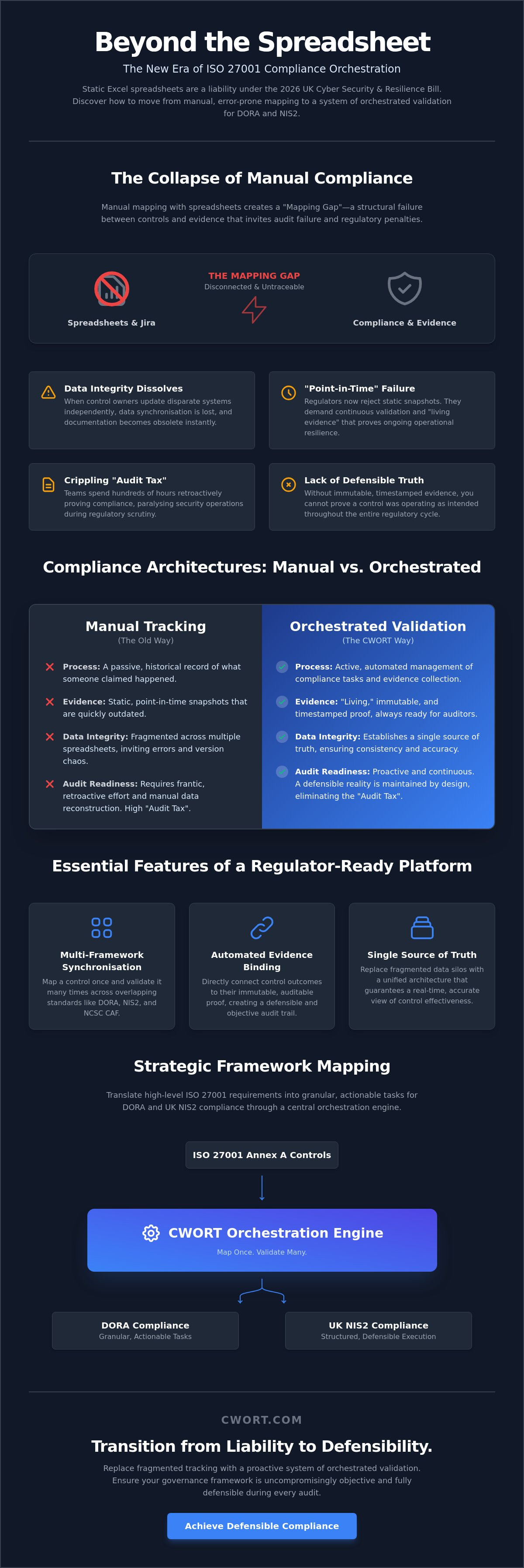
The transition from the 2013 version of the ISO/IEC 27001 standard to the 2022 iteration has exposed the systemic flaws of manual tracking. In the high-stakes regulatory environment of 2026, the "Mapping Gap" represents more than just a clerical error. It is a structural failure that occurs when organisations attempt to link Annex A controls to NIS2 or DORA requirements using static Excel cells. These spreadsheets cannot enforce the rigorous traceability required by modern auditors. Instead, they create a disconnected narrative where control descriptions exist in one silo and actual security activities in another.
Relying on fragmented tools like Jira for task management whilst using Excel for mapping obscures the vital link between a control and its evidence. When control owners update these systems independently, data integrity dissolves instantly. This lack of synchronisation means that by the time an audit begins, your documentation is already obsolete. The shift from administrative tracking to orchestrated compliance validation is no longer optional for UK enterprises aiming for resilience.
The Fragility of Manual Compliance Matrices
Data integrity risks escalate when control owners update disparate systems without a central point of truth. Maintaining version control across multiple regulatory frameworks in a manual matrix is a recipe for disaster. It's impossible to gain a real-time view of control effectiveness when your data is scattered across several spreadsheets. A dedicated ISO 27001 control mapping tool from CWORT replaces this fragility with a unified architecture. Without this orchestration, the hidden cost of manual reconstruction during regulatory scrutiny can paralyse a security team, forcing them to spend hundreds of hours retroactively proving compliance that should have been validated automatically.
Why Regulators Reject Static Proof in 2026
Regulators under the 2026 UK Cyber Security and Resilience Bill now demand "living evidence" rather than point-in-time snapshots. Traditional ISO audits often suffered from "point-in-time" failure, where a control appeared effective on the day of assessment but lacked continuous validation. This approach is no longer defensible under current scrutiny. DORA enforcement now requires financial entities to demonstrate operational resilience through automated, verifiable data streams that prove ongoing compliance. Selecting the right ISO 27001 control mapping tool ensures your evidence is always regulator-ready.
Defensible truth is the state of having immutable, timestamped evidence that proves a control was operating as intended at every moment of the regulatory cycle.
Essential Features of an Enterprise ISO 27001 Control Mapping Tool
A sophisticated ISO 27001 control mapping tool must transcend the limitations of basic gap analysis worksheets. In an era of aggressive regulatory oversight, your chosen platform must act as a proactive system of record that enforces discipline by design. It's no longer enough to simply list controls; the tool must facilitate the transition from abstract requirements to a concrete, defensible reality. This requires a shift in focus from administrative tracking to definitive, evidence-based proof.
Multi-framework synchronisation is the cornerstone of modern compliance architecture. When your team is mapping ISO 27001 to DORA, you cannot afford to manage these obligations in isolation. An enterprise-grade tool allows you to map a control once and validate it many times across overlapping standards like NIS2 and the NCSC CAF. This efficiency eliminates the "Audit Tax" that typically drains resources during external reviews. Furthermore, the system must enforce a strict separation of duties. By ensuring the orchestrator and the validator are never the same individual, you build structural integrity into your governance model, a detail that UKAS-accredited auditors prioritise during certification.
Orchestration vs. Simple Tracking
Tracking is a passive exercise that merely records a claim of compliance. It's a historical record of what someone said happened. Orchestration, however, is the active management of compliance activities through a structured, linear workflow. You must move beyond static checklists to proving ISO 27001 control effectiveness through direct execution. This proactive approach ensures that every control is not just "documented" but is functioning as intended within your operational environment. To see how this looks in practice, you can explore our orchestration engine.
Evidence Integrity and Traceability
Evidence must be immutable and timestamped at the point of validation to withstand rigorous scrutiny. Every ISO control requires a unique identifier that links it directly to specific regulatory obligations and their corresponding outcomes. This level of granularity ensures total traceability from a board-level dashboard down to a specific technical artifact. CWORT binds evidence to these outcomes automatically, eliminating the ambiguity that often plagues manual systems. This creates a regulator-ready audit trail that replaces the anxiety of potential failure with the calm of auditable certainty. By automating the evidence-binding process, you ensure that your compliance posture is always based on facts rather than optimistic assertions.
Comparing Compliance Architectures: Manual vs. Orchestrated Systems
Legacy GRC platforms often function as glorified digital filing cabinets. They record intent but lack the mechanism to enforce execution. A dedicated ISO 27001 control mapping tool built on an orchestration architecture operates differently. It transforms passive mapping into an active validation engine. This distinction is critical for UK enterprises facing the 2026 regulatory shift. Whilst traditional systems track that a task was assigned, orchestrated systems prove that the control was executed and validated by a separate party.
Analyse the "Audit Tax" to understand the true cost of manual systems. This is the hidden operational drain incurred when Subject Matter Experts (SMEs) must abandon their core duties to reconstruct compliance history for external reviewers. Manual maintenance is a linear cost that scales poorly as your organisation grows. Professional implementation of an orchestrated system delivers a non-linear return by automating the validation cycle. This shift directly improves your risk posture by replacing optimistic assertions with hard, auditable data.
The "Single Source of Truth" Myth
Many organisations boast a "single source of truth," yet they fail audits because they lack a "source of proof." A static record is useless if it cannot be verified against real-time operational outcomes. Orchestrated systems prevent "compliance drift" by ensuring that controls don't just exist on paper but are continuously verified. You should move toward ISO 27001 continuous compliance monitoring to maintain this state of auditable certainty throughout 2026. This approach ensures your governance framework remains a living system rather than a forgotten document.
Reducing SME Burden through Automation
Automation changes the psychological dynamic of the audit process. Instead of defending a position, your team is demonstrating excellence. Significant time savings emerge when controls are mapped and validated automatically, allowing SMEs to focus on strategic resilience rather than administrative toil. CWORT replaces the need for manual reconstruction of compliance history by binding every control to its outcome in real-time. This transition replaces the anxiety of potential failure with a disciplined, systematic path toward total assurance. By removing the burden of manual evidence collection, you empower your leadership to make decisions based on definitive, evidence-based truth.
Strategic Framework: Mapping ISO 27001 to DORA and UK NIS
Execution is the only metric that matters in a high-stakes regulatory environment. Mapping ISO 27001:2022 to specific UK mandates requires a disciplined framework that moves beyond theoretical alignment. A robust ISO 27001 control mapping tool must provide the structural integrity to support this transition. Follow this five-step strategic framework to establish a defensible compliance posture:
- Step 1: Identify overlapping obligations. Map the ISO 27001:2022 baseline against the specific requirements of DORA and the UK NIS Regulations. Recognise where a single control, such as access management, satisfies multiple regulatory demands.
- Step 2: Translate requirements into execution. Convert high-level standard language into granular, repeatable execution activities. A "policy" is not proof; a validated configuration check is.
- Step 3: Assign accountability. Enforce a strict separation of duties at the task level. Ensure that the individual responsible for executing a control is never the one validating its success.
- Step 4: Bind evidence to activities. Capture immutable, timestamped proof at the moment of validation. This creates a direct link between the regulatory obligation and the operational reality.
- Step 5: Generate real-time reports. Produce board-level dashboards and regulator-ready audit trails automatically. Eliminate the manual data entry that leads to "point-in-time" failure.
Harmonising Global Standards with Local Regulations
UK enterprises must navigate the specific nuances of the 2026 Cyber Security and Resilience Bill whilst maintaining global ISO certification. Mapping ISO 27001:2022 controls to the UK NIS framework requires a deep understanding of the NCSC CAF (Cyber Assessment Framework) outcomes. Whilst ISO provides the management system, the CAF demands specific technical evidence. For financial entities, the challenge is even greater. You must integrate the stricter ICT risk management requirements of DORA into your existing ISO framework. Achieving DORA compliance validation is the ultimate goal, ensuring your organisation remains resilient under extreme operational stress.
The Role of Professional Implementation
Generic templates fail in complex enterprise environments. Custom control models are essential to reflect the specific risk appetite and operational reality of your organisation. Professional implementation ensures that your ISO 27001 control mapping tool is not just a software installation but a validated workflow. By onboarding expert consulting teams into this orchestrated environment, you ensure that every mapping is accurate and every evidence stream is defensible. This systematic approach replaces fragmented tracking with a proactive system that enforces discipline by design. To see how our validation engine can transform your compliance architecture, request a strategic demonstration.
CWORT: The Definitive ISO 27001 Control Mapping and Validation Engine
Consolidate your governance framework into a single, orchestrated validation system to eliminate the systemic risk of fragmented tracking. CWORT, powered by Lapace Services UK Ltd technology, represents a paradigm shift from passive record-keeping to active, defensible execution. Traditional GRC tools merely document intent. This platform enforces the rigorous discipline required to satisfy the 2026 UK Cyber Security and Resilience Bill. It translates abstract regulatory obligations into structured activities, ensuring every control is backed by immutable proof rather than optimistic assertions. By replacing disparate spreadsheets with a unified engine, you establish a command centre that prioritises truth over administrative activity.
Deploying a sophisticated ISO 27001 control mapping tool is the only way to move from checking boxes to proving outcomes. CWORT automates the relationship between high-level requirements and technical evidence. It produces regulator-ready outputs that terminate the need for manual audit preparation. This transition replaces the chaotic reconstruction of compliance history with a streamlined, auditable reality. Your compliance posture remains constant regardless of external pressure, allowing your security team to focus on proactive risk mitigation instead of retroactive document gathering. This approach ensures that your organisation's commitment to security is visible, verifiable, and uncompromising.
Engineered for Regulatory Scrutiny
Auditors in 2026 no longer accept static spreadsheets as evidence of operational resilience. The CWORT orchestration engine is specifically engineered to handle high-stakes audits by providing board-level dashboards that reflect real-time control effectiveness. You can streamline ISO 27001 internal audits using these validated workflows. This ensures your internal reviews are as rigorous as external assessments, identifying gaps before they become liabilities. This focus on auditable proof transforms compliance from a defensive burden into a strategic asset that builds trust with partners and regulators alike. Every activity is timestamped and attributed, creating an immutable trail of accountability.
Future-Proofing Compliance for 2026 and Beyond
Move away from legacy GRC models toward a validation-centric architecture to ensure long-term organisational resilience. CWORT is the strategic choice for enterprises navigating the overlapping demands of DORA, NIS2, and ISO 27001. It provides the structural integrity needed to maintain a defensible posture in a landscape of increasing regulatory complexity. It's not enough to simply map requirements; you must orchestrate the proof of their execution. Don't wait for an audit failure to expose the gaps in your manual mapping. Request a CWORT demonstration to see how we automate ISO 27001 control mapping and establish a state of total assurance that protects your organisation's future.
Secure Your Regulatory Future Through Orchestration
Transitioning from fragmented spreadsheets to a unified validation engine isn't just a technical upgrade; it's a strategic imperative for 2026. By implementing a sophisticated ISO 27001 control mapping tool, your organisation replaces the anxiety of potential failure with the certainty of auditable truth. You ensure that every control is backed by immutable evidence, satisfying the rigorous demands of DORA and the UK NIS Regulations whilst protecting your team from the operational drain of manual reconstruction.
Developed by Lapace Services UK Ltd, CWORT enforces a strict separation of duties by design and generates regulator-ready audit outputs automatically. This proactive approach transforms compliance from a defensive burden into a definitive proof of excellence. It's time to move beyond simple tracking and embrace a system that guarantees structural integrity at every level of your governance framework.
Orchestrate your ISO 27001 compliance with CWORT. You're now equipped to lead your enterprise toward a state of total assurance with confidence and precision.
Frequently Asked Questions
What is an ISO 27001 control mapping tool?
An ISO 27001 control mapping tool is a specialised software system designed to align the requirements of the ISO 27001 standard with other regulatory frameworks, such as DORA or NIS2. It replaces static spreadsheets by providing a structured environment where controls from one standard are linked to corresponding obligations in another. This ensures that a single security activity can satisfy multiple compliance requirements simultaneously whilst maintaining full traceability.
How does mapping ISO 27001 to DORA work in practice?
Mapping ISO 27001 to DORA involves aligning the standard’s Annex A controls with the five pillars of the Digital Operational Resilience Act. In practice, this means identifying how ISO controls for access management or incident response satisfy DORA’s stricter requirements for ICT risk management and reporting. The process requires translating high-level policy statements into granular, executable tasks that produce the specific evidence demanded by financial regulators.
Can I use Jira as an ISO 27001 control mapping tool?
Whilst Jira is effective for task management, it is not a dedicated ISO 27001 control mapping tool because it lacks the structural integrity for compliance orchestration. Jira cannot enforce a strict separation of duties by design or provide immutable evidence binding. Using it for mapping creates fragmented silos where the relationship between a control and its auditable proof is obscured, leading to "point-in-time" failures during high-stakes regulatory reviews.
What is the difference between compliance tracking and compliance validation?
Compliance tracking is the passive act of recording that a task was assigned or claimed to be completed. In contrast, compliance validation is the active process of proving that a control is functioning as intended through immutable, timestamped evidence. Validation shifts the focus from administrative checklists to definitive proof, ensuring that every regulatory obligation is backed by a defensible reality rather than just a status update.
How does CWORT handle separation of duties in control mapping?
CWORT enforces a strict separation of duties at the task level by design. The system ensures that the individual responsible for orchestrating a compliance activity is never the same person who validates the resulting evidence. This architectural discipline prevents conflicts of interest and builds structural integrity into your governance framework, providing auditors with clear proof of rigorous internal oversight.
Is it possible to automate the generation of ISO 27001 audit evidence?
Yes, it's possible to automate the generation of audit evidence by using a system that binds operational outcomes directly to specific controls. When an activity is completed and validated within an orchestrated workflow, the system captures the proof automatically and archives it with a unique identifier. This eliminates the need for manual evidence collection during an audit, ensuring your organisation is always regulator-ready.
What are the benefits of mapping ISO 27001 controls to the NCSC CAF?
Mapping ISO 27001 controls to the NCSC Cyber Assessment Framework (CAF) allows UK enterprises to demonstrate compliance with national resilience standards using their existing management systems. This alignment reduces the "Audit Tax" by ensuring that ISO-certified processes satisfy the specific technical outcomes required by the CAF. It provides a clear path for organisations to meet the expanded requirements of the 2026 UK Cyber Security and Resilience Bill.
How often should control mappings be reviewed and updated?
Control mappings should be reviewed continuously to prevent "compliance drift" as regulatory frameworks and operational environments evolve. At a minimum, a formal review must occur whenever there is a change in the standard, such as the transition to ISO 27001:2022, or when new legislation like DORA or NIS2 is introduced. Moving toward a model of continuous validation ensures that your mappings remain accurate and defensible at all times.

Article by
Michael Iyiola
Michael Iyiola is a cybersecurity and AI engineering specialist with extensive experience in vulnerability management, detection engineering, and operational resilience. At CWORT, he designs scalable, evidence-driven workflows that help teams meet modern regulatory and security demands.
Disclaimer
The content on this site is provided for general information and educational purposes only. It does not constitute legal, regulatory, financial, or professional advice. CWORT provides AI-assisted insights and workflow automation, but all compliance decisions remain the responsibility of your organisation and its management. Always seek qualified legal or regulatory guidance for decisions relating to DORA, NIS2, ISO 27001, CAF, or other obligations.