
If your NIS2 strategy relies on Excel spreadsheets and scattered Jira tickets, you aren't managing risk; you're merely documenting a potential failure. Most UK leaders feel the weight of the upcoming Cyber Security and Resilience Bill, especially whilst facing personal liability for non-compliance and fines reaching 4% of global turnover. It's exhausting to have evidence buried in email chains when regulators demand definitive proof of control effectiveness within a 24-hour reporting window. Deploying a dedicated NIS2 compliance platform UK organisations can leverage for true orchestration is now a strategic necessity rather than a technical luxury.
You'll discover how to transition from manual administrative tracking to an orchestrated validation system that provides a single source of truth for every regulatory obligation. We'll explore the shift toward automated, board-ready reporting and how to build a rigorous framework that replaces compliance anxiety with auditable certainty. This is about moving beyond the checklist to achieve a defensible, evidence-based posture that stands up to the most rigorous scrutiny.
Key Takeaways
- Identify the legal triggers within the UK’s Cyber Security and Resilience Bill that necessitate strict adherence for enterprises with EU operations or critical supply chain links.
- Recognise the "Tracking Trap" where reliance on manual spreadsheets compromises data integrity and fails to provide the immutable evidence required by regulators.
- Evaluate the essential features of a NIS2 compliance platform UK organisations use to ensure seamless mapping of abstract regulatory obligations to concrete technical controls.
- Implement a four-stage validation-centric model that transforms fragmented data into a cohesive, board-ready system of record.
- Transition from administrative overhead to strategic orchestration by centralising evidence and enforcing accountability across the entire digital ecosystem.
Navigating the NIS2 Landscape for UK Enterprises in 2026
The NIS2 Directive is no longer a distant regulatory horizon. It's a present-day operational reality for any UK enterprise with a footprint in the European Union. Whilst the UK isn't directly transposing the directive, the progression of the Cyber Security and Resilience Bill through Parliament in early 2026 has aligned domestic standards with EU mandates. Organisations must move beyond "best effort" security. They need a robust NIS2 compliance platform UK teams can use to prove resilience and operational integrity.
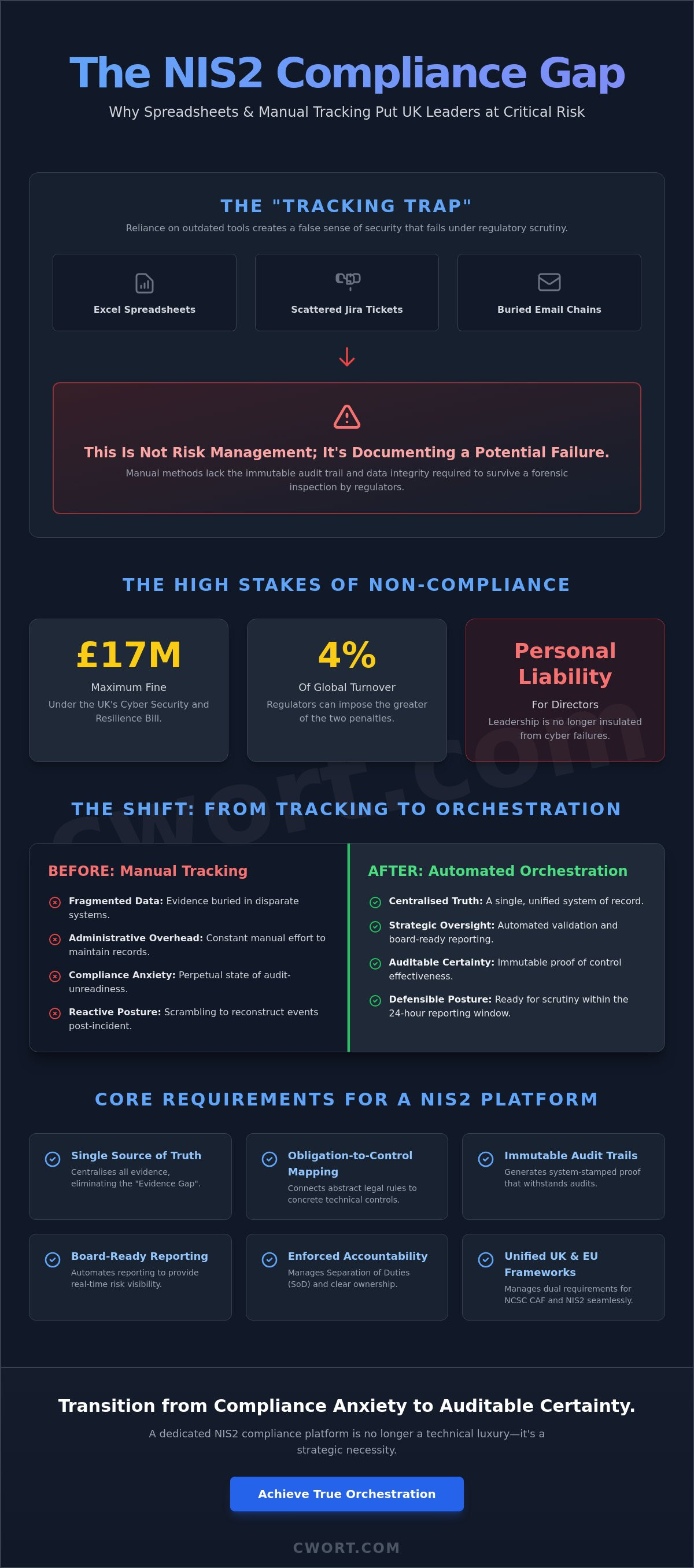
The extraterritorial reach of these rules is particularly sharp. If your firm provides essential services within the EU or sits in a critical supply chain, you're bound by these requirements regardless of your UK headquarters. Failure to comply isn't just a technical oversight. It's a legal liability that carries fines of up to £17 million or 4% of global turnover under the new UK regime. Manual tracking offers a false sense of security; automated orchestration provides a defensible truth.
The UK NIS vs. NIS2 Dilemma
UK organisations often struggle to distinguish between the National Cyber Security Centre (NCSC) CAF-based approach and the prescriptive mandates of NIS2. Both frameworks share a common goal: protecting critical infrastructure. However, the overlap in sectors like energy, transport, and digital providers creates a complex web of obligations. Managing these dual requirements manually is a recipe for disaster. A unified NIS2 compliance platform UK businesses deploy ensures that evidence collected for one regulator satisfies the other, eliminating redundant effort amongst cross-border teams.
Why 2026 is the Year of Regulatory Scrutiny
Regulatory bodies have matured. They've moved from offering guidance to enforcing mandatory validation. In 2026, auditors won't accept a "plan to comply". They demand immutable proof of control execution. This shift is compounded by the personal liability now facing directors and senior management. Leadership isn't insulated from the consequences of cyber failures. This pressure mirrors the DORA Compliance Validation requirements hitting the financial sector. It's creating a universal standard for evidence-based governance. You either have the proof, or you have the liability.
Beyond the Spreadsheet: Why Manual Tracking Fails NIS2 Audits
Stop treating a spreadsheet as a governance tool. Excel is a ledger of intentions, not a record of orchestrated execution. Under the UK's Cyber Security and Resilience Bill, the burden of proof is absolute. Regulators don't want to see a static cell that simply says "Complete". They require system-generated timestamps, the identity of the executor, and the independent validation of the reviewer. Manual trackers are inherently fragile; they're prone to manipulation and lack the immutable audit trail necessary to survive a forensic inspection.
The "Tracking Trap" occurs when organisations mistake administrative activity for regulatory compliance. Jira and Excel weren't designed to handle the complex dependencies of a NIS2 compliance platform UK enterprises now require. When data is scattered, the ability to prove "Separation of Duties" vanishes. This creates a state of perpetual audit-unreadiness. If you can't produce a defensible history of control effectiveness within hours of a request, you're already in breach of the new transparency mandates.
The Risk of Fragmented Compliance Data
Fragmented data creates a dangerous "Evidence Gap" that leaves the board blind to real-time risks. When evidence is buried amongst disparate email threads and siloed project boards, the cost of retrieval is immense. This fragmentation inevitably leads to "Compliance Fire Drills", where teams scramble to reconstruct events post-incident. Regulators are increasingly dismissive of these manual reconstructions. They view a lack of a centralised, chronological system of record as a failure of governance itself. Without an orchestrated system, you aren't managing compliance; you're merely reacting to it.
Enforcing Separation of Duties (SoD)
Separation of Duties is a non-negotiable cornerstone of both NIS2 and the evolving UK NIS framework. Fragmented manual systems frequently fall into the "Self-Certification" trap, where the person implementing a control is also the one marking it as valid. This is a fundamental conflict of interest that auditors will identify as a high-risk failure. A dedicated NIS2 compliance platform UK organisations deploy will enforce this discipline by design. It ensures that the executor and the validator are distinct, authenticated entities. This systemic enforcement replaces policy-based hope with auditable certainty. You can explore how orchestration replaces manual tracking to ensure your duties are correctly segregated.
Core Requirements of a NIS2 Compliance Validation Platform
Selecting an enterprise-grade NIS2 compliance platform UK organisations can trust requires a fundamental shift in perspective. It isn't enough to merely monitor your environment. You must validate your resilience. Many security leaders mistake technical telemetry for regulatory compliance, yet auditors don't care about your raw logs. They care about the specific, evidenced execution of the core compliance requirements. To achieve this, a platform must serve as a rigorous orchestrator that binds evidence to obligations in a way that is both immutable and defensible.
There are five non-negotiable features that define a high-maturity validation system. First, Obligation Mapping translates abstract legal text into structured execution activities. Second, Evidence Binding automatically links outcome data to specific regulatory controls. Third, an Orchestration Engine manages the complex workflow of compliance across disparate departments. Fourth, Audit-Ready Outputs generate board-level reports without manual intervention. Finally, the system must enforce a rigorous audit trail that proves who did what, and when, without the possibility of post-event manipulation.
Validation vs. Telemetry: Knowing the Difference
Security tools like SIEM or XDR provide vast amounts of data, but they don't provide validation. Telemetry tells you that a firewall is active; validation proves that the firewall's configuration meets the specific resilience standards mandated by law. This distinction is critical for incident reporting under NIS2. You need a Governed Investigation Plane that allows you to assess an event's impact against your legal obligations in real time. For a complete view of your posture, your NCSC CAF assessment software must integrate directly with this validation layer. Without this link, your technical data remains isolated from your governance requirements.
Board-Level Reporting and Strategic Visibility
Executive oversight is a core pillar of the new regulatory regime. Directors now face personal liability, making "Real-Time Compliance Dashboards" a strategic necessity. A robust NIS2 compliance platform UK leadership teams utilise must translate granular technical metrics into clear business risk. It's about presenting a defensible truth during high-stakes meetings. Instead of showing a list of patched vulnerabilities, you show a percentage of control effectiveness across the enterprise. This level of transparency replaces the anxiety of potential failure with the calm of auditable certainty. It allows the board to make informed decisions based on evidence rather than optimistic assumptions.
Orchestrating Evidence: The Shift from Tracking to Validation
Compliance isn't a status to be achieved; it's a validated outcome of orchestrated execution. Moving beyond the static tracking traps discussed earlier requires a fundamental shift in how evidence is gathered and maintained. A NIS2 compliance platform UK organisations can rely on must do more than list requirements. It must enforce a rigorous lifecycle that transforms abstract obligations into concrete, defensible proof. This transition is achieved through a disciplined four-stage process.
- Stage 1: Mapping Obligations — You must first identify precisely which NIS2 and UK NIS articles apply to your specific entity. This isn't a generic exercise; it's a granular mapping of legal text to your unique operational footprint.
- Stage 2: Defining Control Outcomes — Shift the focus from "what tool do we have?" to "what does success look like?". Define the specific, measurable outcomes required to satisfy each regulatory mandate.
- Stage 3: Binding Evidence — Establish the "Golden Thread" by linking every activity directly to its corresponding proof. This ensures that every control is backed by an immutable record of execution.
- Stage 4: Continuous Validation — Abandon the concept of "point-in-time" audits. Move toward a state of perpetual readiness where controls are validated in real-time, ensuring you're always audit-ready.
Building a Regulatory Obligation Execution Workflow
Centralised oversight is impossible without distributed accountability. You must assign specific responsibilities across the organisation whilst maintaining a single system of record. High-integrity "Evidence Repositories" are essential here. They ensure data longevity and prevent the loss of critical proof during staff turnover or system migrations. For those in high-stakes environments, refer to NIS2 compliance for critical infrastructure to understand the sector-specific nuances of these workflows. Success depends on a system that enforces discipline by design.
The Role of Internal and External Audits
A validation-centric model fundamentally changes the auditor experience. By providing a clean, logical interface for regulatory inspectors, you reduce friction and accelerate the review process. This level of organisation facilitates faster "Self-Audits", significantly reducing the reliance on expensive external consultancies. Evidence binding is the immutable link between a regulatory requirement and its physical proof. When you can present this link instantly, you move from a position of defense to one of absolute assurance. You can request a platform demonstration to see how orchestration can streamline your next audit.
CWORT: The UK’s Enterprise Platform for NIS2 Orchestration
CWORT is the definitive response to the fragmentation and fragility of manual compliance tracking. It isn't a passive repository for documents; it's a proactive orchestration engine designed to enforce the rigorous standards of the 2026 regulatory landscape. By replacing the "Tracking Trap" of Excel and Jira with a single, immutable system of record, CWORT provides the structural integrity that auditors now demand. It effectively bridges the gap between technical execution and executive oversight, ensuring that every regulatory obligation is met with definitive proof.
The platform’s core strength lies in its ability to automate the complex dependencies of "Evidence Binding" and "Separation of Duties". Whilst manual systems allow for the dangerous self-certification of controls, CWORT enforces discipline by design. It ensures that the executor of a task and its validator are distinct, authenticated entities, creating a transparent trail of accountability. This NIS2 compliance platform UK organisations deploy transforms raw data into a continuous stream of validated evidence, removing the need for the high-stakes "Compliance Fire Drills" that plague fragmented enterprises.
Designed for UK Regulatory Complexity
Managing multiple frameworks simultaneously is a requirement for any modern enterprise. CWORT allows you to orchestrate NIS2, the UK NIS Regulations, and other standards amongst a single interface. This includes seamless integration with our ISO 27001 control mapping tool, which provides a broader governance view for organisations managing international standards. Because the platform is developed and maintained by Lapace Services UK Ltd, organisations benefit from local data residency and a support structure that understands the specific nuances of the UK’s legislative environment.
Transforming Compliance into a Strategic Advantage
Automation does more than just reduce administrative overhead; it shifts the "Cost of Compliance" from a recurring burden to a strategic investment. CWORT generates regulator-ready outputs that eliminate the manual reconstruction of reports, allowing your security teams to focus on resilience rather than paperwork. This level of orchestration provides "Board-Level Certainty" in an era where senior leadership faces direct personal liability for cyber failures. You can move from a posture of hope to a state of auditable truth. It's time to replace the anxiety of potential failure with the calm of a validated NIS2 compliance platform UK leadership can trust. Request a demo of the CWORT NIS2 Compliance Platform to secure your regulatory future.
Achieving Auditable Certainty in a High-Stakes Regulatory Environment
The 2026 regulatory landscape leaves no room for administrative ambiguity. We've established that manual spreadsheets are an inherent risk; they fail to provide the immutable evidence required by auditors and the board alike. Transitioning to a validated, orchestrated posture is the only way to replace compliance anxiety with definitive control. By centralising evidence and enforcing accountability, you ensure that every regulatory obligation is backed by a defensible truth.
Orchestrate your NIS2 compliance with CWORT today and build a resilient future based on evidence rather than optimism. You have the tools to achieve total assurance in an increasingly complex digital world.
Frequently Asked Questions
Does the NIS2 Directive apply to UK companies post-Brexit?
UK organisations must comply with the EU's NIS2 Directive if they provide essential services within the EU or form part of an EU-based supply chain. Domestically, the Cyber Security and Resilience Bill introduced in late 2025 ensures that UK standards mirror these requirements to maintain cross-border operational integrity. Failing to align with both frameworks creates significant legal and operational risk for British firms regardless of their physical headquarters.
What is the difference between a GRC tool and a compliance validation platform?
A traditional GRC tool acts as a passive repository for policies and risk registers, whilst a validation platform provides active proof of control execution. Orchestration ensures that every technical activity is bound to a specific regulatory obligation in real time. This moves your organisation from a simple "status" check to a state of continuous, evidence-backed readiness that survives forensic auditing.
How does NIS2 impact supply chain security for UK enterprises?
Can I use Jira or Excel to manage NIS2 compliance audits?
Excel and Jira are fundamentally insufficient for managing high-stakes audits because they lack immutability and system-enforced accountability. These tools don't prevent the manipulation of data post-event, which is a significant red flag for regulators. A dedicated NIS2 compliance platform UK organisations use provides the tamper-proof audit trails and automated reporting that manual trackers simply cannot replicate.
What are the penalties for NIS2 non-compliance in 2026?
Penalties in 2026 are severe, with the UK’s Cyber Security and Resilience Bill proposing fines of up to £17 million or 4% of global annual turnover for the most serious breaches. For organisations classified as "essential" under EU law, non-compliance can result in fines of up to €10 million or 2% of worldwide revenue. These financial risks are compounded by the potential for personal liability amongst senior leadership.
What is "Evidence Binding" in the context of NIS2?
Evidence binding is the process of creating an unbreakable, timestamped link between a regulatory requirement and the physical proof of its execution. It ensures that when an auditor asks for proof of a specific control, the system provides the exact data, identity, and timestamp associated with that activity. This eliminates the need for manual reconstruction and provides a "Golden Thread" of accountability throughout the audit lifecycle.
How does CWORT handle "Separation of Duties" for regulatory audits?
CWORT enforces Separation of Duties by requiring distinct, authenticated users for the implementation and validation of any security control. This systemic restriction prevents "self-certification" by ensuring that the person marking a task as complete isn't the same individual who validates its effectiveness. This level of rigor is a core requirement for passing modern regulatory inspections and maintaining internal discipline.
Is NIS2 compliance the same as being ISO 27001 certified?
ISO 27001 is a voluntary international standard, whereas NIS2 and the UK’s upcoming bill are mandatory legal mandates with strict enforcement powers. Whilst ISO 27001 provides a strong foundation, it doesn't satisfy the specific incident reporting timelines or the supply chain oversight mandated by the new legislation. You must use a NIS2 compliance platform UK teams can leverage to map existing ISO controls directly to these specific legal obligations.

Article by
Michael Iyiola
Michael Iyiola is a cybersecurity and AI engineering specialist with extensive experience in vulnerability management, detection engineering, and operational resilience. At CWORT, he designs scalable, evidence-driven workflows that help teams meet modern regulatory and security demands.
Disclaimer
The content on this site is provided for general information and educational purposes only. It does not constitute legal, regulatory, financial, or professional advice. CWORT provides AI-assisted insights and workflow automation, but all compliance decisions remain the responsibility of your organisation and its management. Always seek qualified legal or regulatory guidance for decisions relating to DORA, NIS2, ISO 27001, CAF, or other obligations.